
The Silver Deficit Doesn’t Show Up in Price Charts
An Eco-System Approaching its Limit

Intro
What appears to be routine price volatility in silver is masking a deeper structural imbalance. Price action in the $70 to $80 range suggests a market behaving normally; the underlying data suggests the opposite. The signal is not in the chart. It is in the inventory.
In the latest piece from TheStreet, the analysis draws heavily on the 2026 World Silver Survey from the Silver Institute which Goldfix already covered in detail here, outlining a market that has now entered its sixth consecutive year of supply deficit, with the shortfall widening rather than stabilizing.
A Persistent Deficit, Not a Cyclical One
The core claim is straightforward: demand continues to exceed supply, and the gap is growing.
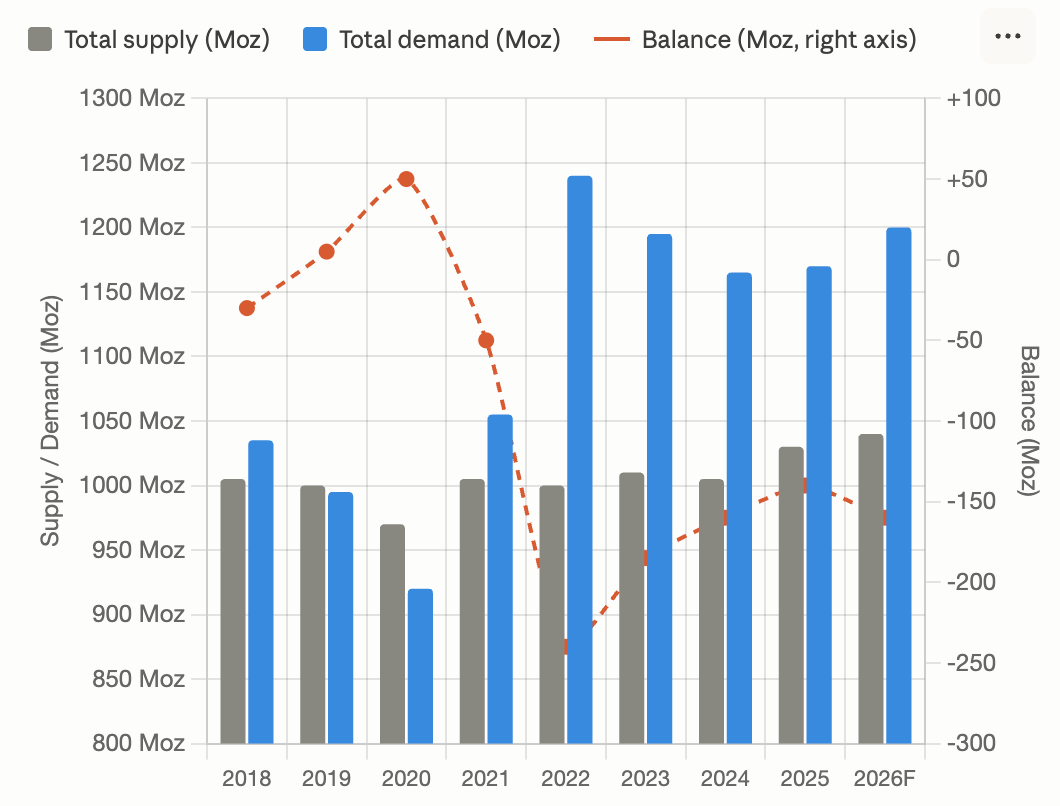
The projected 2026 deficit sits around 46 million ounces, up roughly 15% year over year. This extends a multi-year pattern rather than marking a temporary dislocation.
“Sixth straight year where demand outstrips total supply.”
Mechanically, this matters because commodity deficits are typically self-correcting. Higher prices incentivize production. That feedback loop is not functioning cleanly in silver.
[Graphic Placeholder: Silver Market Balance
Annual supply vs demand (2018–2026), highlighting consecutive deficits and the widening gap]
The Inventory Bridge Is Being Drained
The more important layer sits beneath the annual deficit figures: how the market has been clearing the imbalance.
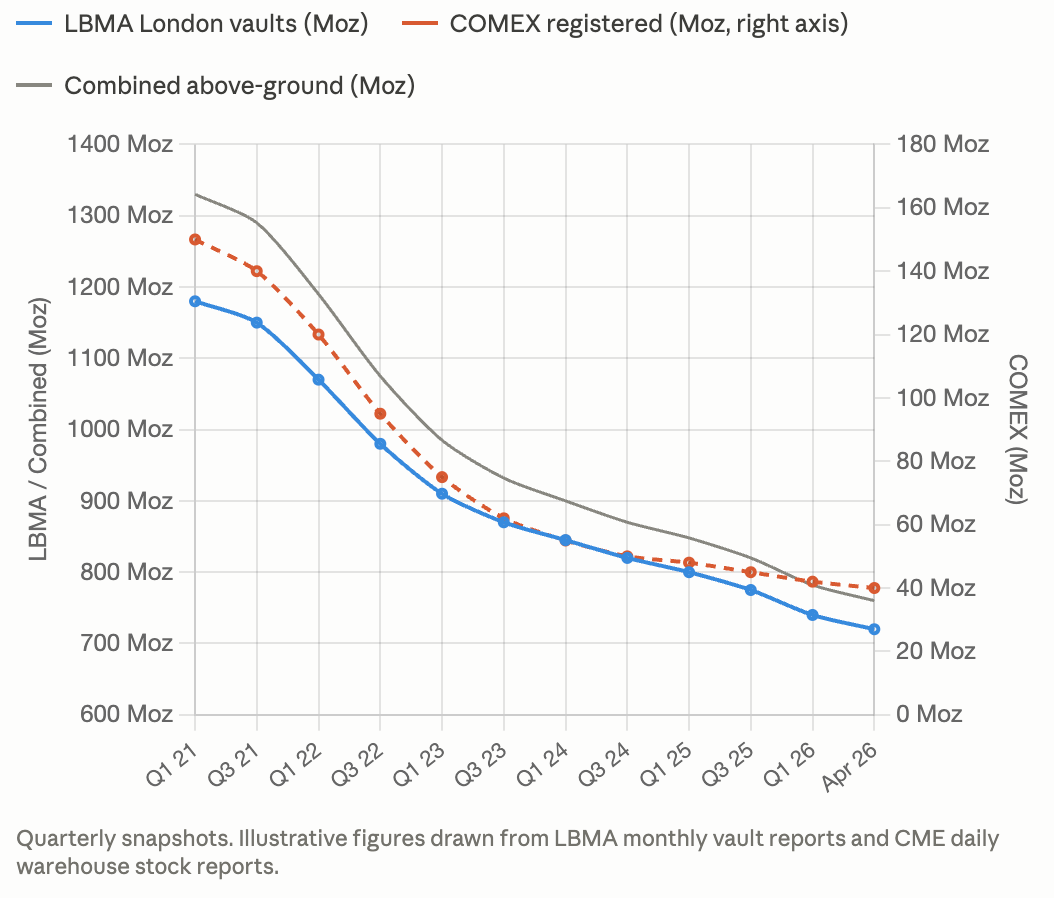
Since 2021, roughly 700 to 760 million ounces have been pulled from above-ground inventories to fill the gap between supply and demand.
“Cumulative drawdowns… have no modern precedent.”
This is not marginal. This is structural depletion.
The mechanism is direct. Mine supply falls short, demand remains steady, and inventories absorb the difference. The implication is equally direct. Inventories are finite, and once drawn down, they cannot be rapidly replenished.
[Graphic Placeholder: Inventory Depletion Curve
Above-ground stock levels since 2021, including COMEX and London vault drawdowns]
A Shrinking Market Despite Flat Demand
The counterintuitive element in the report is that demand is not surging.
Industrial demand is expected to decline modestly, while investment demand offsets the drop, leaving total demand roughly flat.
This reframes the deficit. It is not being driven by excess consumption. It is being driven by constrained supply and insufficient replacement flows. The market is tightening even without demand acceleration.
Supply Inelasticity Is the Core Constraint
The deeper structural issue sits on the supply side.
Silver production cannot quickly respond to price. A significant portion of output is tied to base metal mining, and new supply requires long development timelines. Even in a higher price environment, the response function remains delayed.

This creates a market dynamic where deficits persist longer than traditional commodity cycles would suggest, because the supply side lacks flexibility.
Market Fragility and the Squeeze Dynamic
As inventories decline and supply remains constrained, the system becomes increasingly sensitive to shocks.
The buffer that typically absorbs imbalances is being reduced. Continued reliance on vault drawdowns introduces fragility into the system, particularly if demand stabilizes or turns higher.
The implication is a higher probability of dislocations. These may appear as volatility spikes, short-term squeezes, or divergence between paper pricing and physical availability. Recent price behavior begins to reflect this underlying condition.
Reframing the Signal
The central takeaway is not that silver is volatile. It is that volatility is masking depletion.
Price alone suggests a cyclical asset. Inventory data suggests a system under gradual strain. The market has been transferring metal from stockpiles to meet ongoing deficits, and that process continues until the stock constraint becomes binding.
At that point, price transitions from a reflection of sentiment to a mechanism of rationing.
Closing Observation
The Street piece is not making a directional price call. It is identifying a structural condition as we have been discussing here for months now
A market running persistent deficits, funded by finite inventories, does not behave like a standard commodity cycle. It behaves like a system approaching constraint. That distinction is where the signal sits.
//////////////end://////////
and silver volatility is being whip sawed through the fraud of the ETF x y z
pretending to have the metal i multiple vaults, so no one can audit them all,, at the same time...
Only an idiot would trust 3-4 5th party to have the metal.
They only have price exposure, can not redeem the silver.
The ETF shorts the metal to make a profit...just like Milei did with Argentina´s gold to "earn interest"
sucker....MAduro did the same..14 tons in London....
.Where is that gold now...Trumpy...??
why are we not hearing about INDIA s REPRICING STATEGY ?? THE SILVER INSTITUTE WILL continue lying [ BIX REPORTED THEIR HISTORICAL NUMBER CHANGING FRAUD ] until THE TRUTH SMACKS THEM IN THE FACE