


It is now midway through the 18-month tenure of the 8th Central Pay Commission which was constituted on 3 November 2025, headed by former Supreme Court judge Ranjana Prakash Desai. The commission has to recommend new pay and pensions for 50 lakh central government employees and 69 lakh pensioners1 with its report2 due by May 20273.
While the commission deliberates, pay rises every month. On 28 October, dearness allowance was increased to 63% of basic pay4. State governments typically follow the central pay commission with their own pay commissions. So, the recommendations of this commission will determine the pay of several crore public employees.
It will also determine the value of the prize for which crores of young Indians compete. Between 2014–15 and 2021–22, central government recruitment received 22 crore applications and recommended 7.22 lakh candidates for appointment. That is one candidate for every 300 applications5. Even accounting for the possibility of one applicant applying multiple times, that is an extraordinary amount of competition.
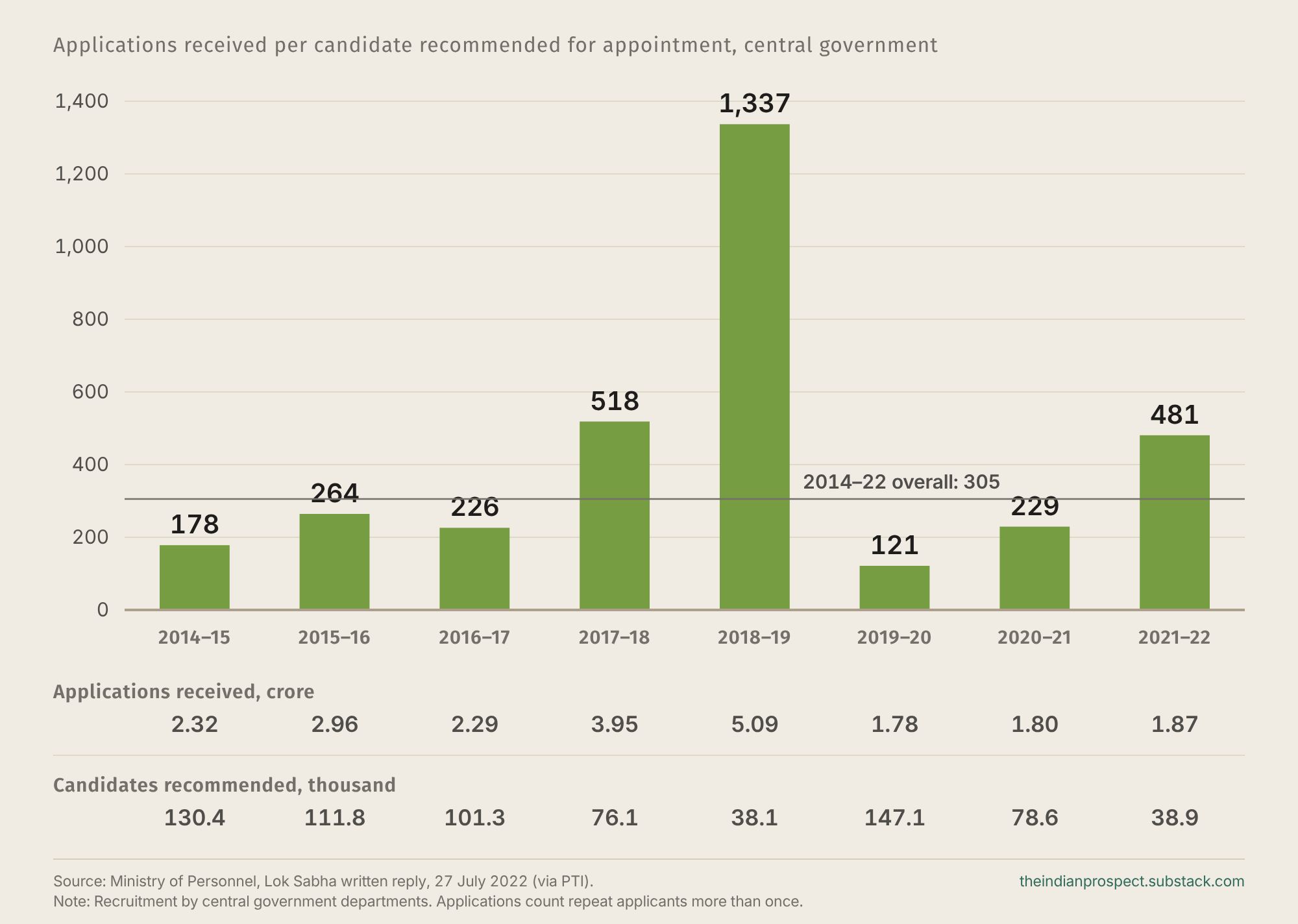
Even as Indians compete intensely for government jobs, governments leave many government jobs unfilled. Police, schools and hospitals and many other administrative departments operate with less than half the staff their own governments have sanctioned. Both of these seemingly contrasting problems in fact have the same explanation. In the lower grades of employment, the government pays much more than the market for similar work. As per the government’s own analysis, it was found that they paid more than double the market rate7.
Why a government job is so valuable
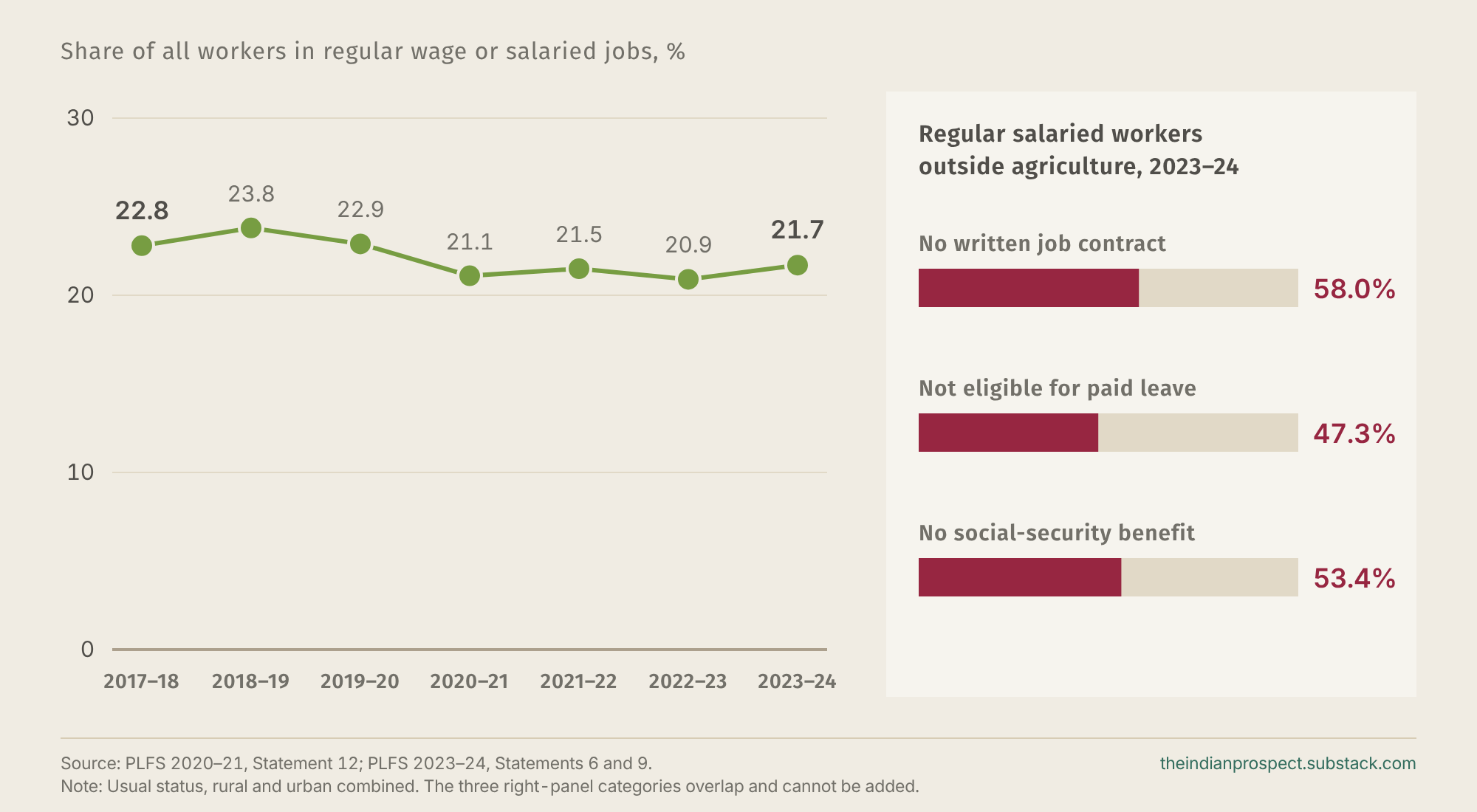
Most Indians do not have secure salaried employment. As of 2023–24, only 21.7% of workers had regular wage or salaried employment8 and this share has not changed significantly since 2017–189. The rest of the workforce were self-employed or worked as casual labourers. Most saliently, even a salaried job does not offer security. Among regular salaried workers outside agriculture, 58% had no written employment contract, 47.3% were not eligible for paid leave and 53.4% did not receive social security benefits8. There is a lot of overlap between these categories, but together they all share the lack of security that is common in most private employment.
A government job removes all these risks at once as it offers protection from sudden dismissal that few private employees have along with a pension to top it off. Private jobs with the same education rarely offer more than one of these and many offer none. Even before counting pay, it is the most secure job most Indians can compete for.
Where the government pays above the market
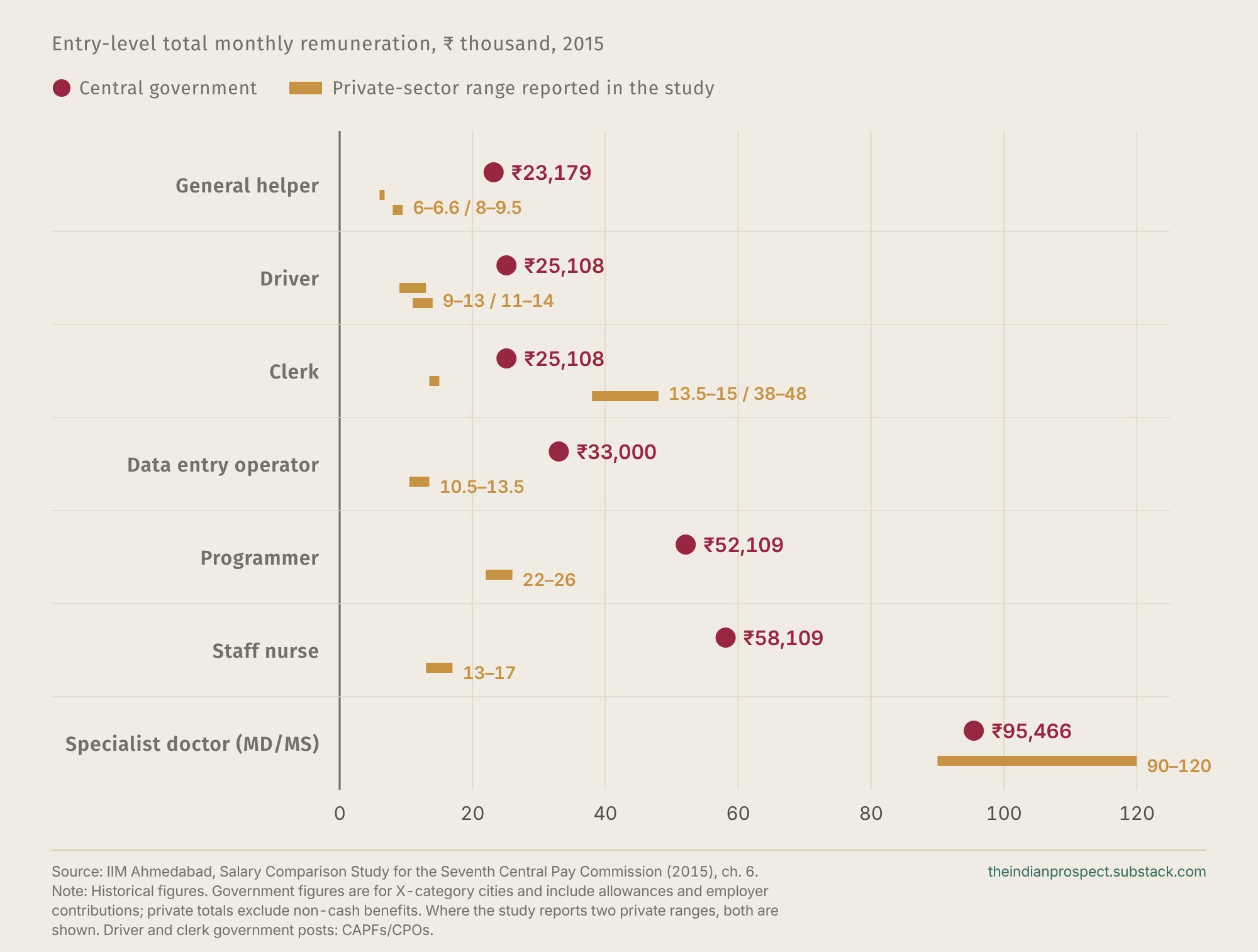
The gap between government and private salaries is the greatest at the lower end of the pay scale as per the government’s own evidence. As per an IIM Ahmedabad comparing government salaries to those paid by the private sector, it was found that the government paid much more at entry level for routine jobs but as careers progressed, private pay rose faster than government pay10. The report noted that the total monthly emoluments of a general helper, the lowest ranked government employee, was ₹22,579 while private companies paid ₹8,000 to ₹9,500 for similar work. The government package was 2.4 to 2.8 times7 as large for the very same work11.
The gap differed based on occupation. While drivers, helpers, and nurses were paid much more in government, specialist doctors were almost at parity and some private clerical jobs paid more. When the market rate for a job is low, the government’s single pay scale sits far above it.
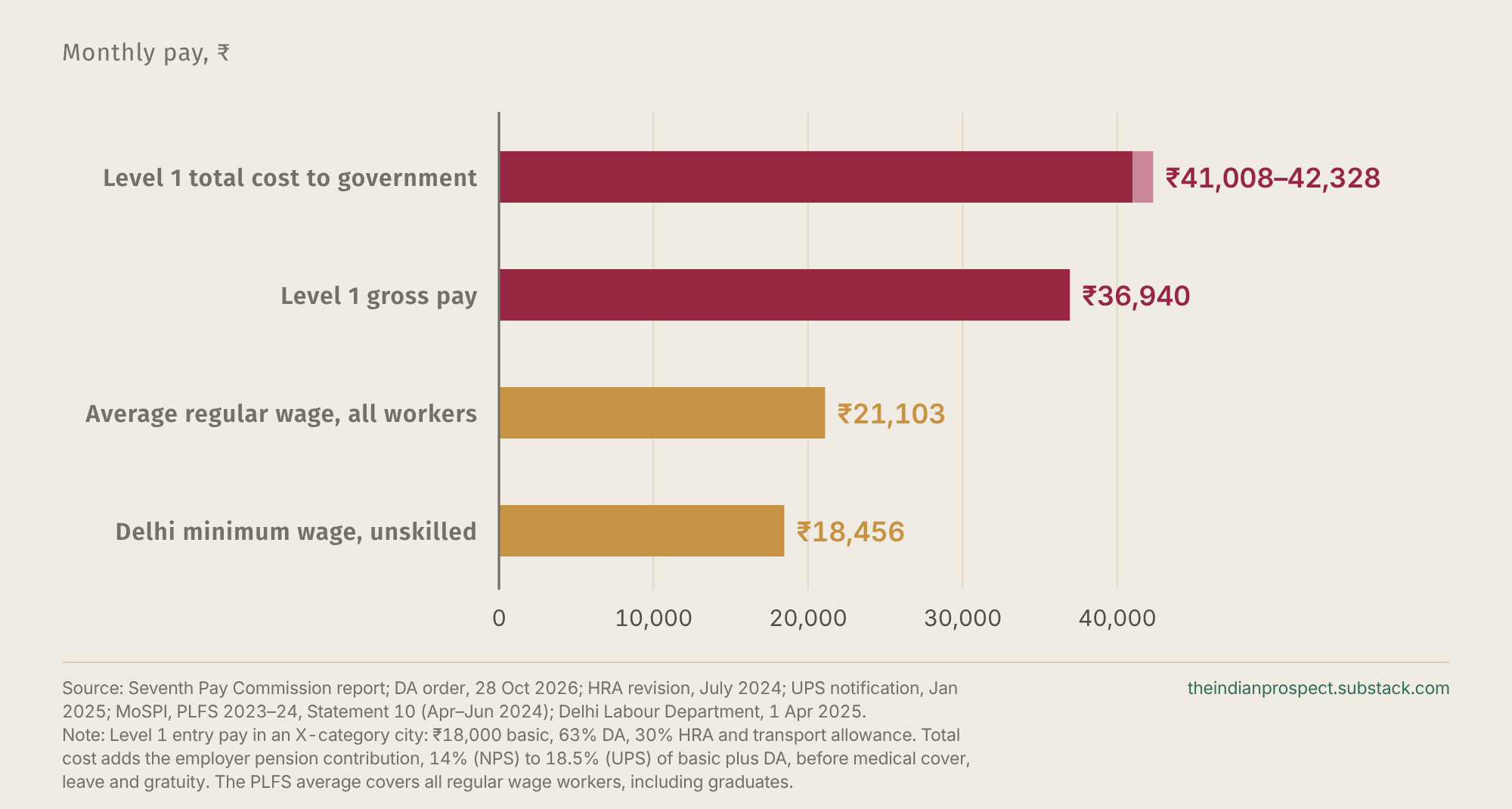
A decade of dearness allowance increases has kept the gap from being closed. An entry level central government employee in Level 1 gets basic pay of ₹18,000 along with dearness allowance of ₹11,3404 , house rent allowance of ₹5,40012 in cities and transport allowance of ₹2,2007. This adds up to ₹36,900 per month. Including the government’s contribution to their pension, each employee costs the government ₹41,000 to ₹42,000 per month, before medical benefits, leave and gratuity13. By comparison, the average regular wage for salaried workers regardless of educational qualification, was ₹21,103 per month in 20248. Delhi’s minimum wage for unskilled work is ₹18,45632.
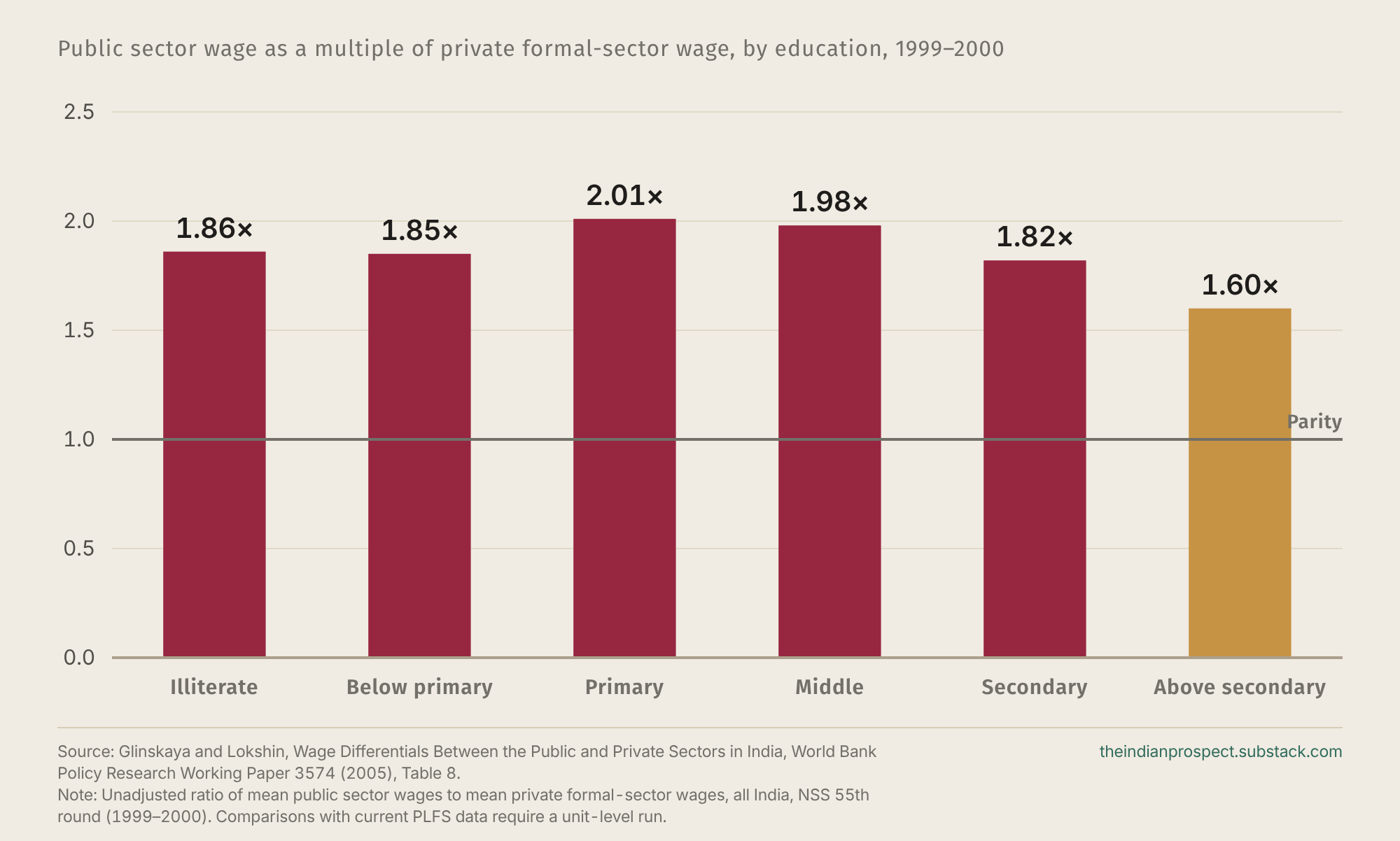
The pattern remains consistent across the economy and over long periods of time. An older comparison using 1999–2000 survey data found that public sector workers with up to secondary schooling earned 1.8 to 2.0 times as much as private formal sector workers with the same schooling. For those with education beyond secondary, the ratio was 1.633.
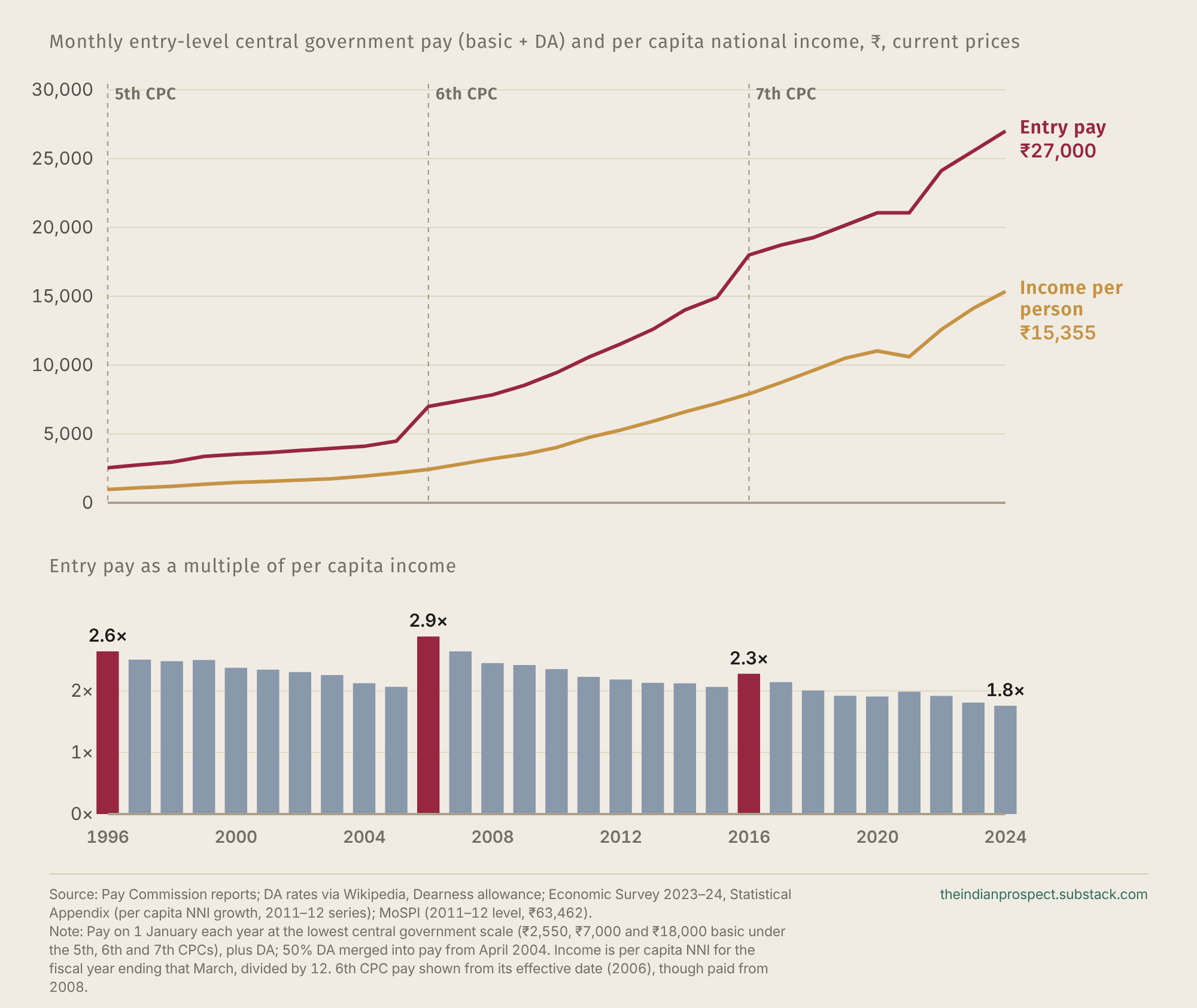
This premium is not something that came about recently either, every pay commission resets the minimum government salary, with dearness allowance increasing it twice a year between commissions. Entry level pay was 2.6 times per capita income when the 5th Pay Commission’s pay scales came into effect in 1996. It was 2.9 times after the 6th Pay Commission reset salaries in 2006. Since dearness allowance only tracks prices34, the ratio falls between pay commissions, to 1.8 times in 2024, until the next commission raises it35.
A prize worth years of waiting
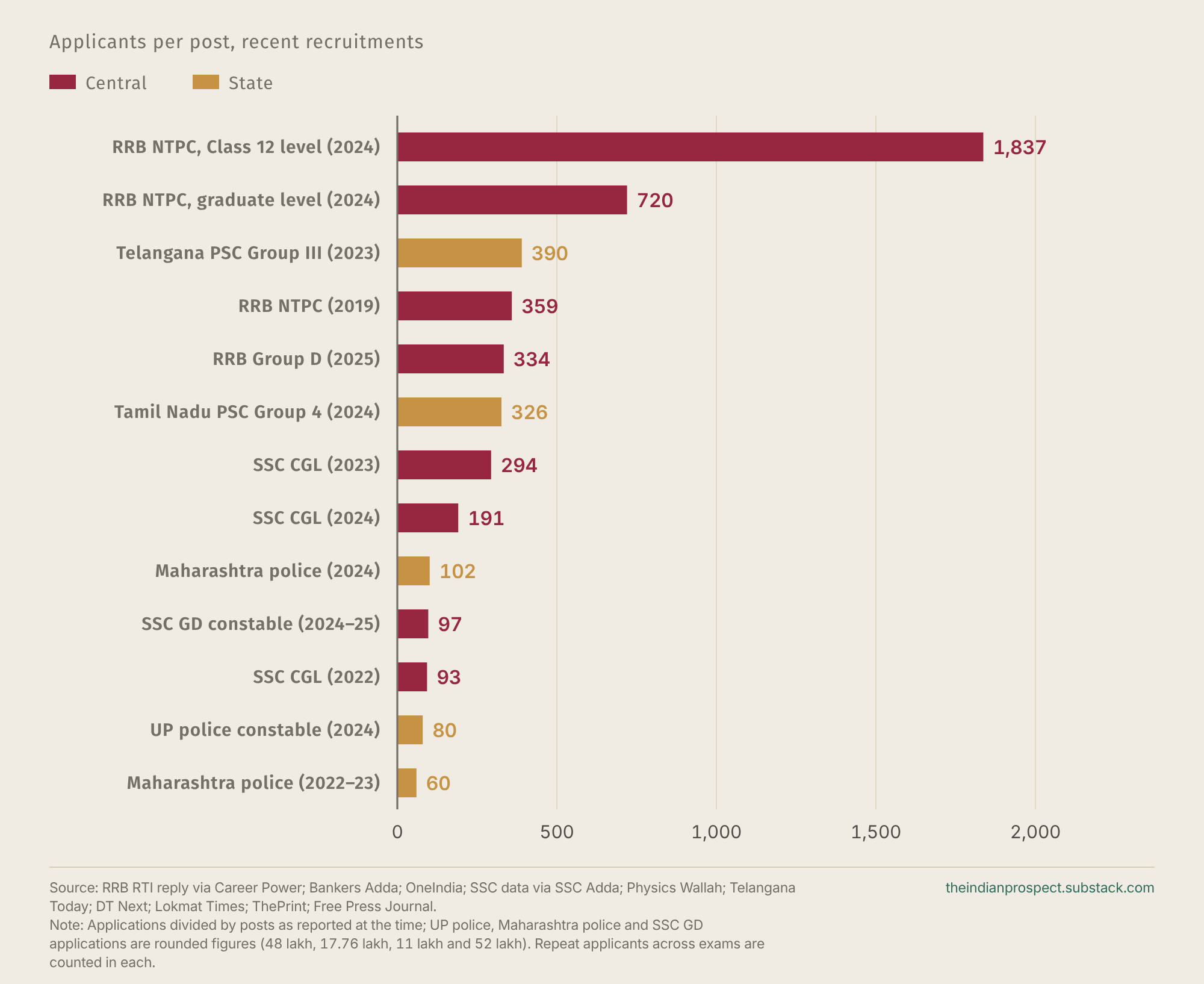
A job that pays much more than the alternative for 30 years, has almost complete job security and ends with a pension is worth waiting for even with long odds. The bigger the premium, the longer the wait worth waiting for. The odds for the most popular entry level posts show how many people are making that bet. For 13 recent recruitments by central and state governments, the median was 294 applicants for one post. For Railway clerical posts open to Class 12 pass outs in 2024, it was over 1,80036.
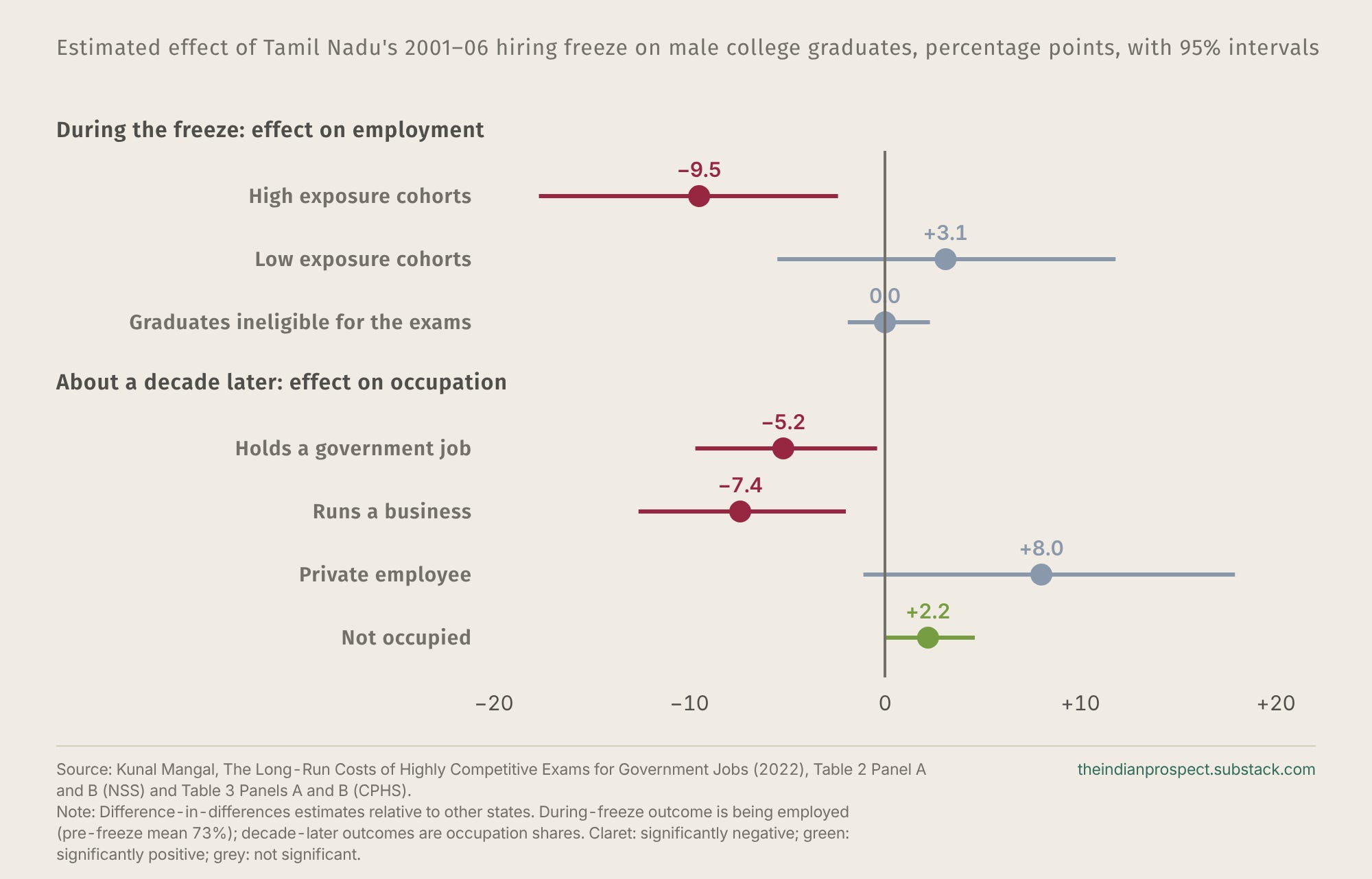
The cost of this queue is paid by the candidates who are not selected. The clearest evidence is from Tamil Nadu. Between 2001 and 2006, it imposed a partial hiring freeze and cut vacancies by 86%. Kunal Mangal of Azim Premji University found that male college graduates most exposed to the freeze were 9 percentage points less likely to be employed during the freeze14. They were not giving up on government jobs, instead they spent longer preparing for the fewer available jobs. The effects lasted for a decade after the freeze ended and the affected cohorts had lower employment, formed their own households later and appeared to earn less than their unaffected counterparts15.
The national data show the same pattern with unemployment among graduates being the highest in the years when most of them prepare for recruitment exams and falling as they approach the upper age limits. In 2021–22, 42.3% of graduates under 25 were unemployed, compared to 22.8% of those aged 25–29 and less than 5% of those 35 and above37.
When the safest job is also the best paid at entry level, the choice to wait feels rational for the individual though the economy loses years of work by some of its best educated young people. Families pay for this bet too, often via years of coaching fees, rent and other costs in coaching hubs like Delhi’s Mukherjee Nagar.
A prize so substantial also ends up being one worth stealing. An Indian Express investigation reported 41 leaks in recruitment exams in 15 states in five years, affecting 1.4 crore applicants competing for just over 1 lakh posts16. Leaks have happened under all sorts of governments and parties and they continue because a post that pays lakhs more than the market rate for decades is worth paying lakhs to steal. The Public Examinations (Prevention of Unfair Means) Act, 2024 increased penalties for such malfeasance and while enforcement can make cheating more costly, the prize continues to be incentive enough.
Why governments hire too few
Considering the attraction of government jobs, one might ask, why the governments don’t hire more people. Is it possibly due to the lack of vacancies ? Well, not really. Instead it comes down to the same premium that lengthens the queue for government jobs that also limits how many people the state can hire.
The number of workers it can employ for a fixed staffing budget is the budget divided by the cost of each worker. So every increase to the cost of a post means fewer possible posts for the same budget.
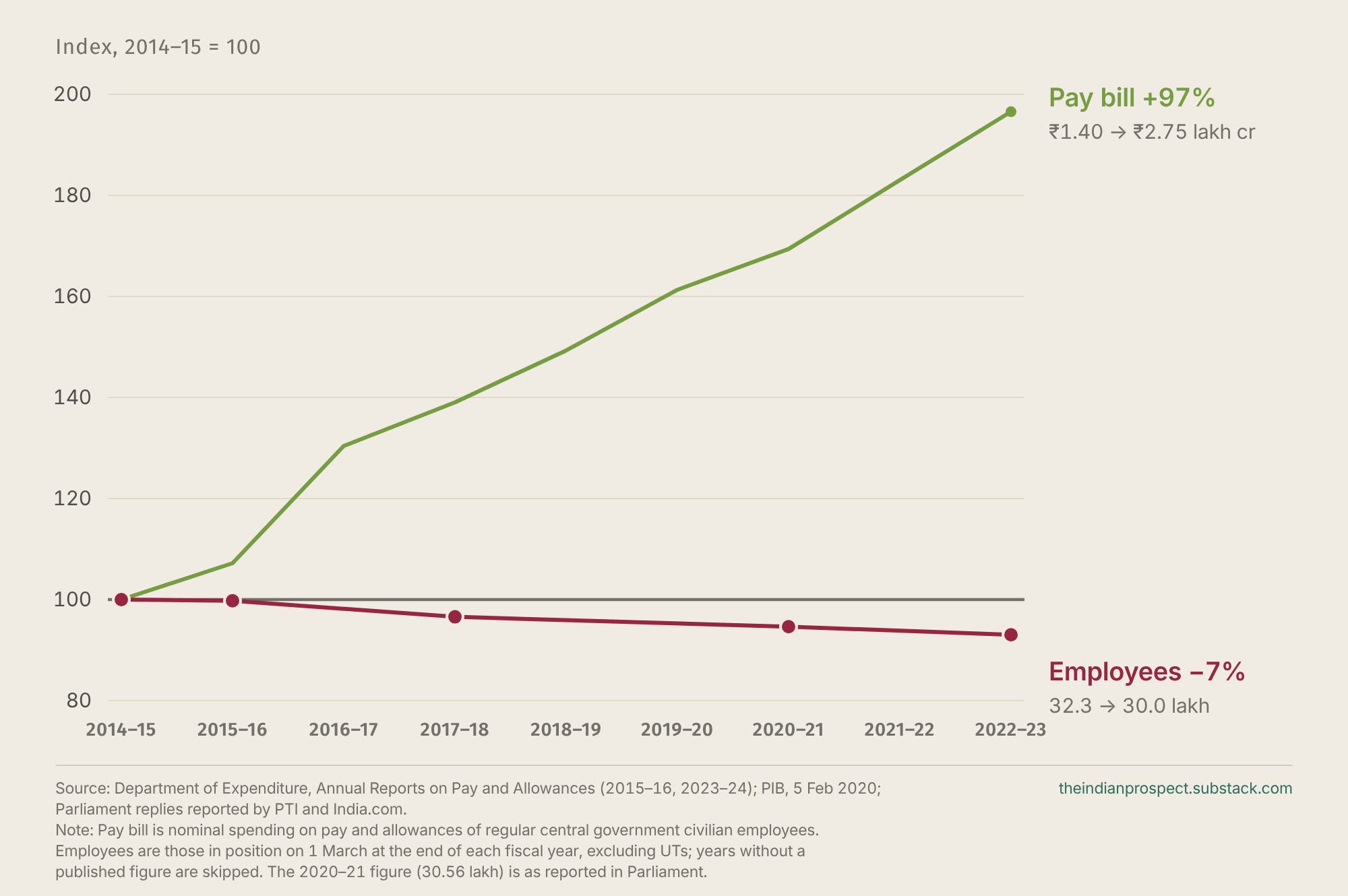
The Government’s own accounts show where its staffing money has gone. From 2014–15 to 2022–23, the expenditure on salaries and allowances of its civilian employees rose 97%, from ₹1.40 lakh crore to ₹2.75 lakh crore18. Over the same period, the number of regular employees in service fell by about 7%, from 32.3 lakh19 to 30.0 lakh18.
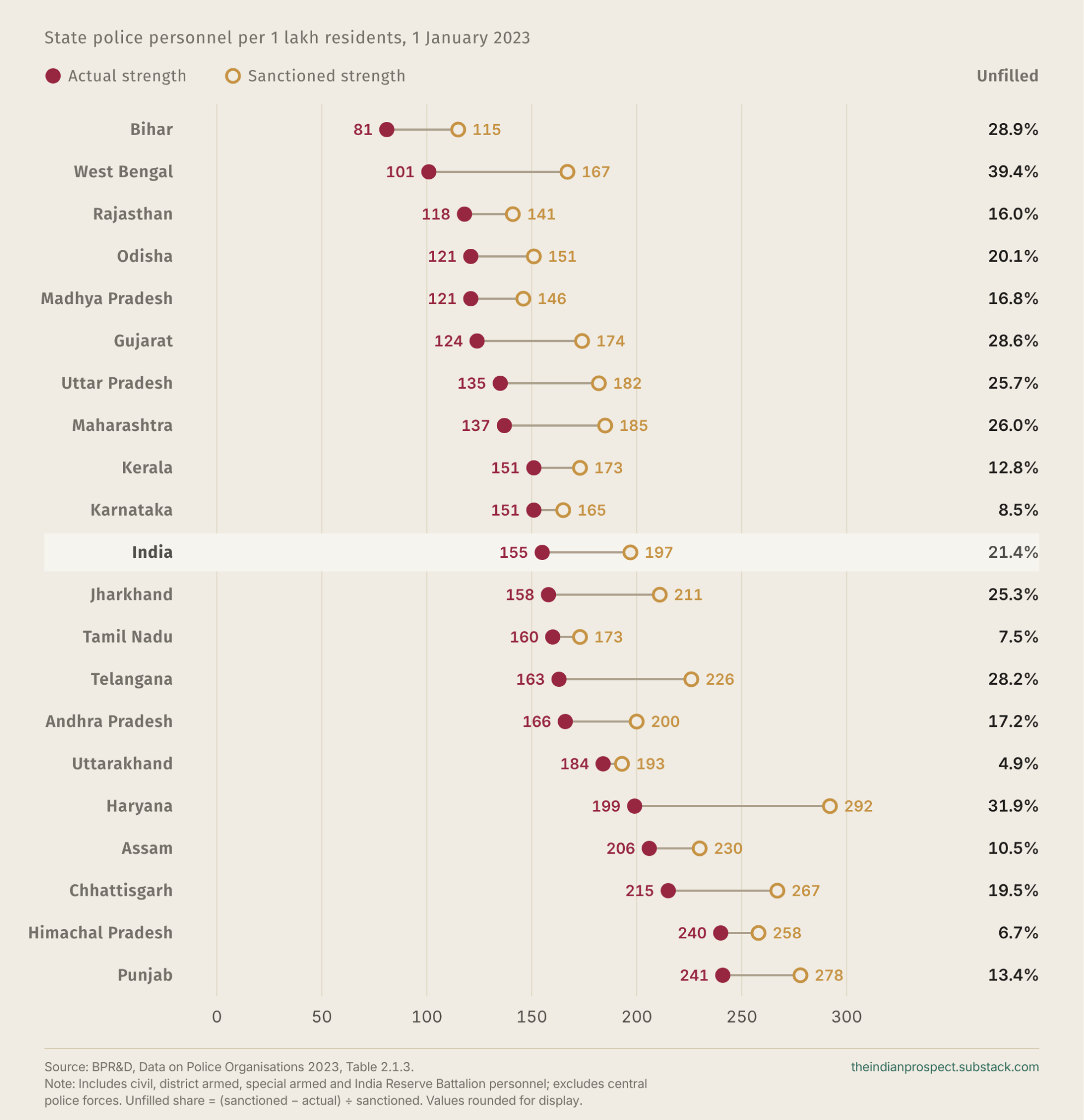
This reduction in workforce has persisted despite the gap between what the amount of workforce that the government says it requires as compared to what it actually employs and the gap is quite stark in case of police officers. As of January 2023, India had about 155 state police personnel for every 1 lakh people, against a sanctioned strength of 197, leaving about a fifth of approved posts empty. Bihar had 81 personnel per 1 lakh people, and Uttar Pradesh 13523. Governments had decided that they needed these police officers, and they hadn’t employed them despite that.
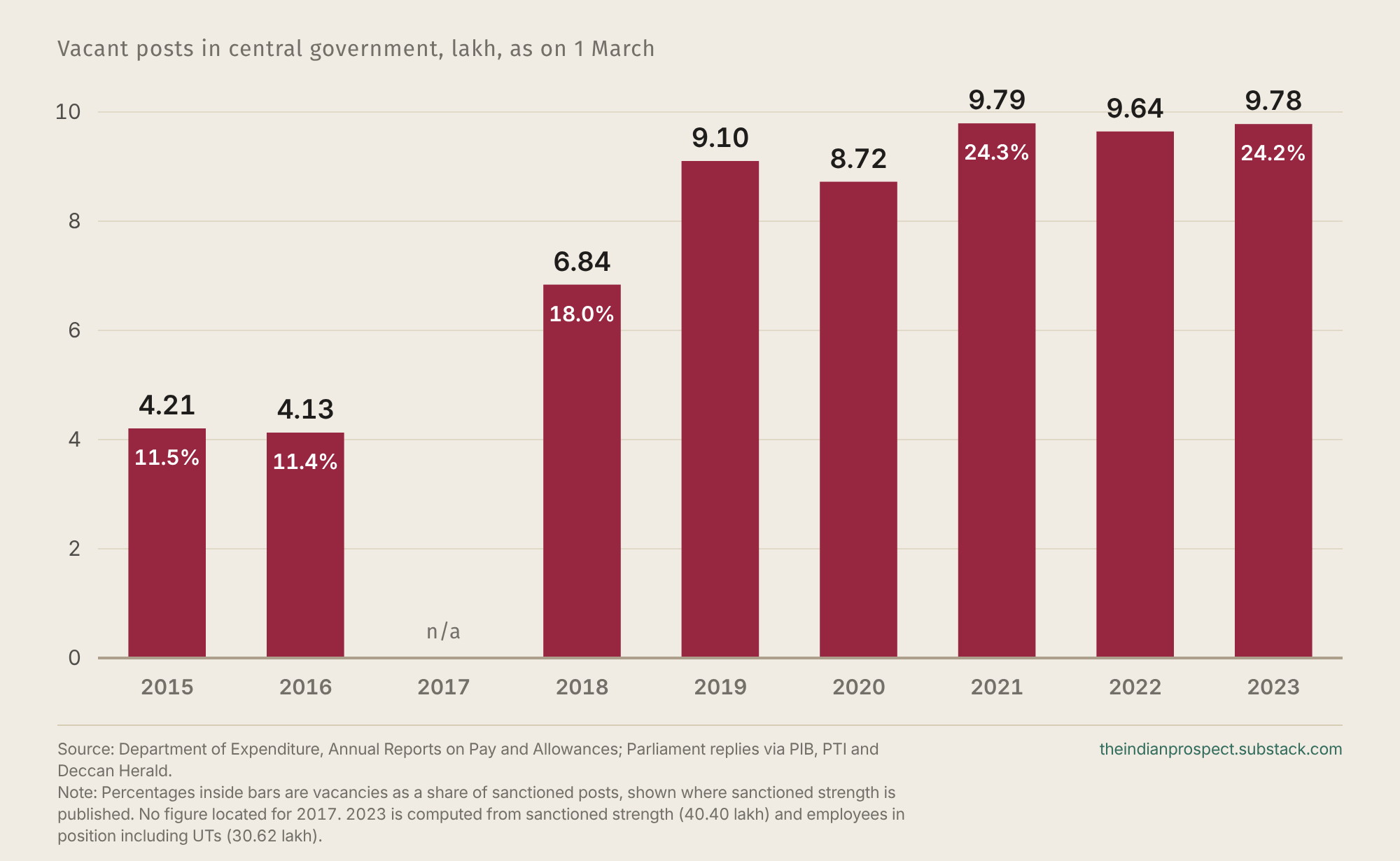
The Centre’s own posts display a similar gap, which has widened. In March 2015, 4.21 lakh central government posts were vacant, 11.5% of the sanctioned strength19 and by March 2021, that had reached 9.79 lakh vacancies, about a quarter of all posts22. The number of vacancies24 has since stayed around that level18.
A major reason behind the avoidance of hiring is the consequence of permanent appointments that commit the government to pay these employees for three decades and more. Salaries rising with increments and dearness allowance along with pension payments after retirement make that an even costlier commitment. Salaries and pensions took up 39% of revenue receipts in 2023–24 across states, adding interest payments and governments are committed to spending 53% of their revenue receipts, leaving little room for more posts26.
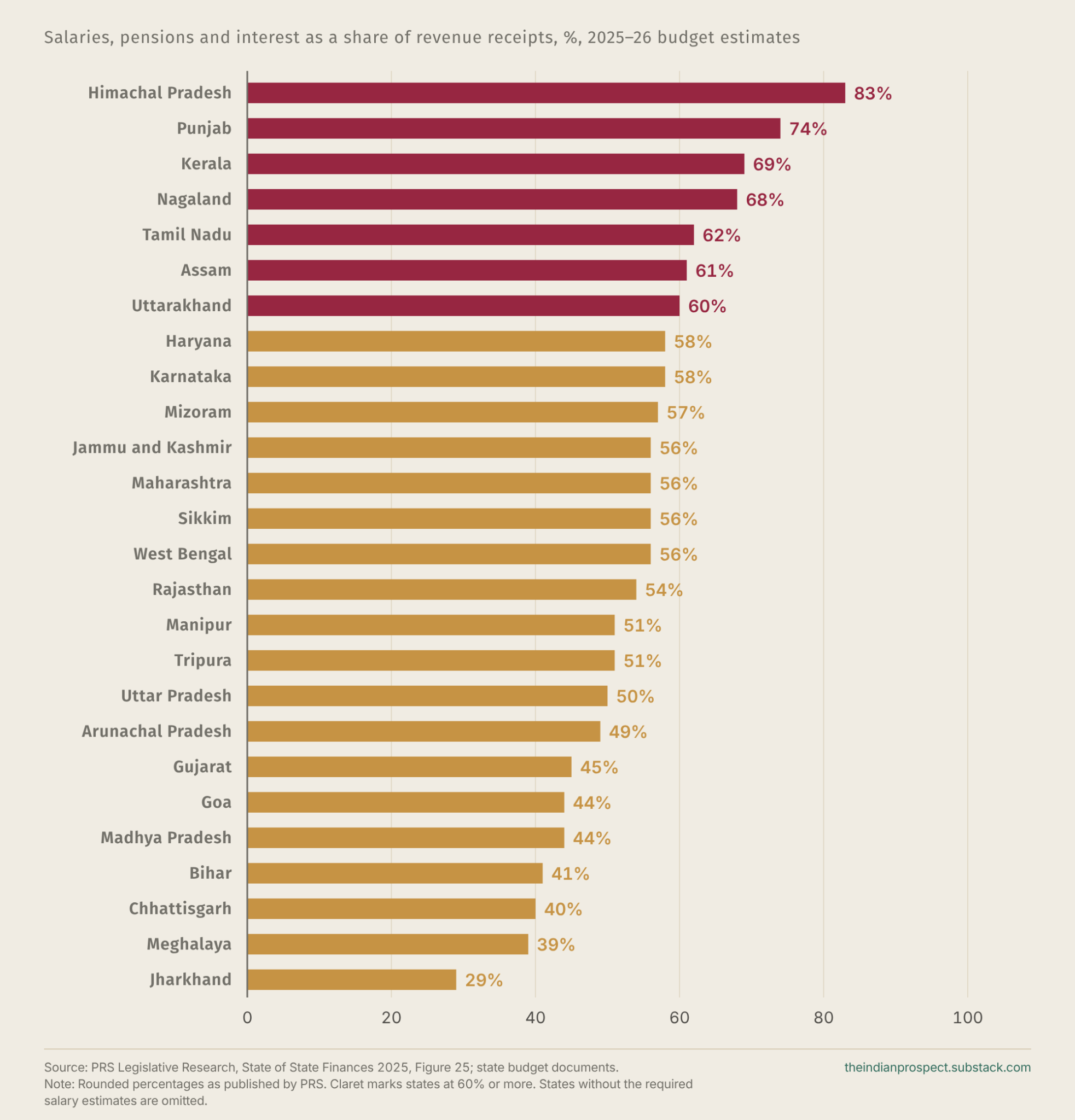
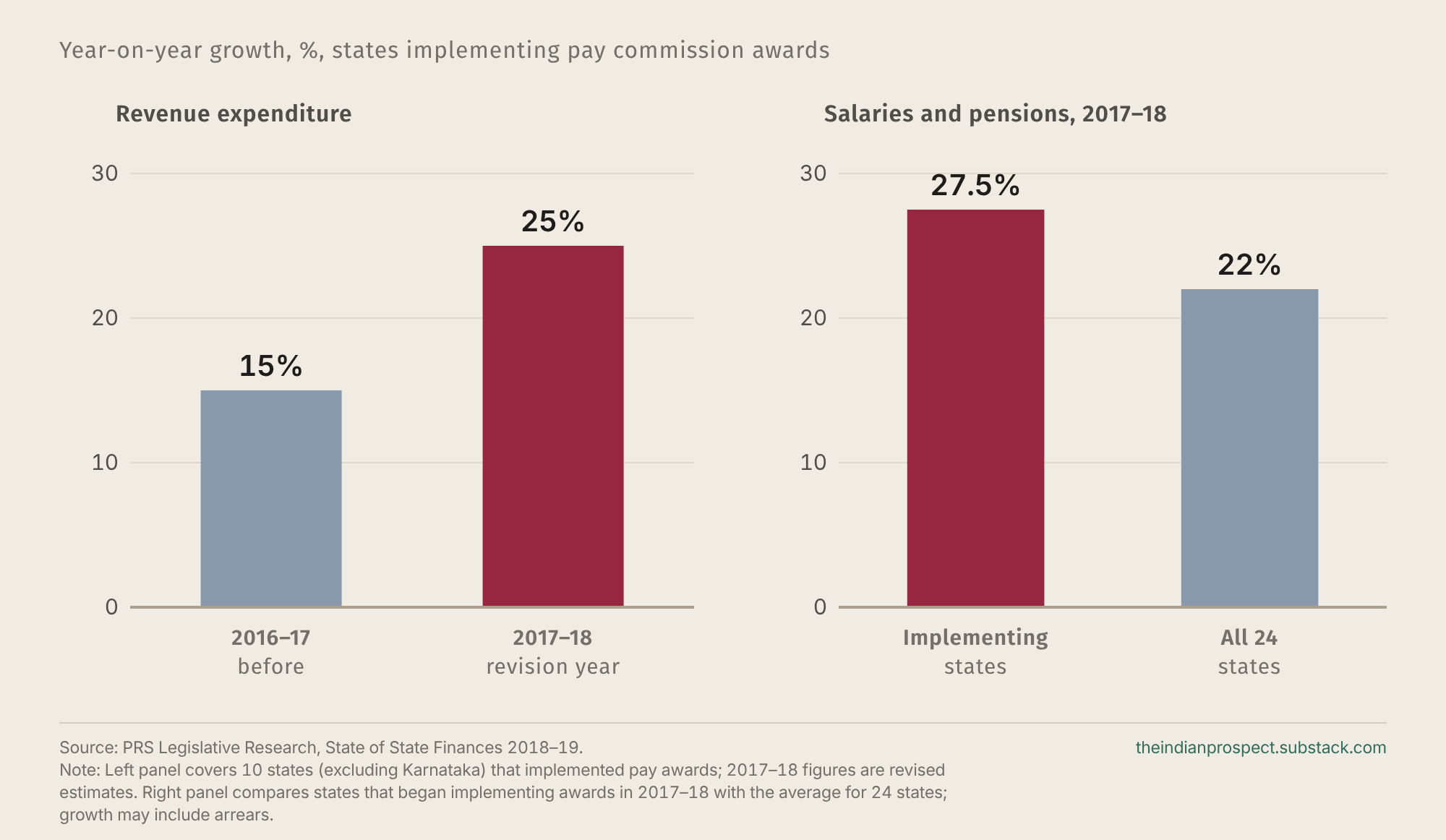
Pay commissions raise these commitments in steps. Karnataka estimated that implementing its Seventh State Pay Commission would cost ₹20,208 crore a year. Most state employees work in the lower grades, where the premium is largest. Each round of pay revision thus raises the cost of every existing appointment and also every future one. In 2017–18, states that started implementing pay awards saw spending on salaries and pensions rise 27.5%, compared to 22% across 24 states38.
The returns to cheaper staffing can be quite substantial as well. In an experiment in rural Andhra Pradesh, Karthik Muralidharan and Venkatesh Sundararaman gave some schools an additional teacher on contract. The contract was paid roughly a fifth of a regular teacher’s salary. Two years later, the schools with contract teachers had better results in mathematics and language, and the contract teachers were no less effective than regular teachers27. The gains came from adding teachers at a lower cost per teacher. Which does bring up the question of the potential gains that are left on the table due to insufficient hiring.
The same scale underpays at the top
The pay structure that overpays routine work also underpays scarce skills. The Seventh Pay Commission fixed the minimum basic pay at ₹18,000 a month and the maximum, for the Cabinet Secretary, at ₹2,50,000, a ratio of about 1 to 147. Private firms on the other hand pay senior specialists and managers many times that. For officer-level and skilled roles, government pay was competitive at entry but then fell behind as private sector salaries rose with experience10.
Because the pay scale ends at the secretary, the secretary’s salary works as a ceiling on what the government will pay anyone. In the early 1990s, when engineers from the collapsing Soviet Union were seeking employment, India considered hiring them for the defense industry. One objection to their hiring was that their salary demands were higher than the pay of a central government secretary28. The same logic applied to the businesses the government controls. In FY25, the chairman of the State Bank of India, the country’s largest lender, was paid ₹63.87 lakh while by comparison, HDFC Bank’s chief executive was paid ₹12.06 crore, about 19 times as much. In 2016, Raghuram Rajan, then RBI governor, joked about feeling underpaid and then stated plainly that as with all public sector entities, you overpay at the bottom and underpay at the top.
The government’s own workarounds from recent times have attempted to address this issue. To hire specialists, ministries bring people in as consultants on contracts outside the pay matrix. In a 2020 advertisement, NITI Aayog offered senior consultants with at least 15 years of experience up to ₹3.30 lakh a month40 while by comparison, an IAS officer7 after about 13 years of service then drew about ₹1.44 lakh34. The top of the consultant band exceeded even the Cabinet Secretary’s compensation of about ₹2.93 lakh. These contracts pay what the market requires because the regular scale can’t.
Both ends of the scale come from the same design. Government pay follows a job’s place in the administrative hierarchy while the market prices each kind of work separately. Where the hierarchy ranks a job above its market rate, applicants queue for it and where it ranks a job below, posts stay empty for want of takers.
The case for the premium, and why that doesn’t stand
The strongest defence of the premium is that the government should be a model employer. When the IIM Ahmedabad study was published, T.T. Ram Mohan of IIM Ahmedabad argued that government salaries counter the inequality created by private firms and may pull private pay upward29. However, that effect is negligible in a labour market where barely a fifth of workers hold regular salaried jobs and the number of government jobs stays restricted. A high wage for a few lakh posts does little for the crores outside them. Not to mention, it is paid for by taxpayers who mostly earn less than the employees they fund.
A second objection holds that a smaller premium would attract weaker candidates and invite corruption. At the lower grades, where hundreds of qualified applicants compete for each post, the pool would remain deep even at lower pay. Neither has the premium succeeded in preventing absence or corruption at this level with absences among staff being endemic in certain functions such as among teachers. While this objection might hold some truth to it at higher levels of government employment, it lacks a case at the lower levels.
A third holds that the premium compensates for transfers, difficult postings and rigid rules. While some posts do carry real hardship, a uniform scale pays the same premium for an office job in Delhi as for a posting in a remote district.
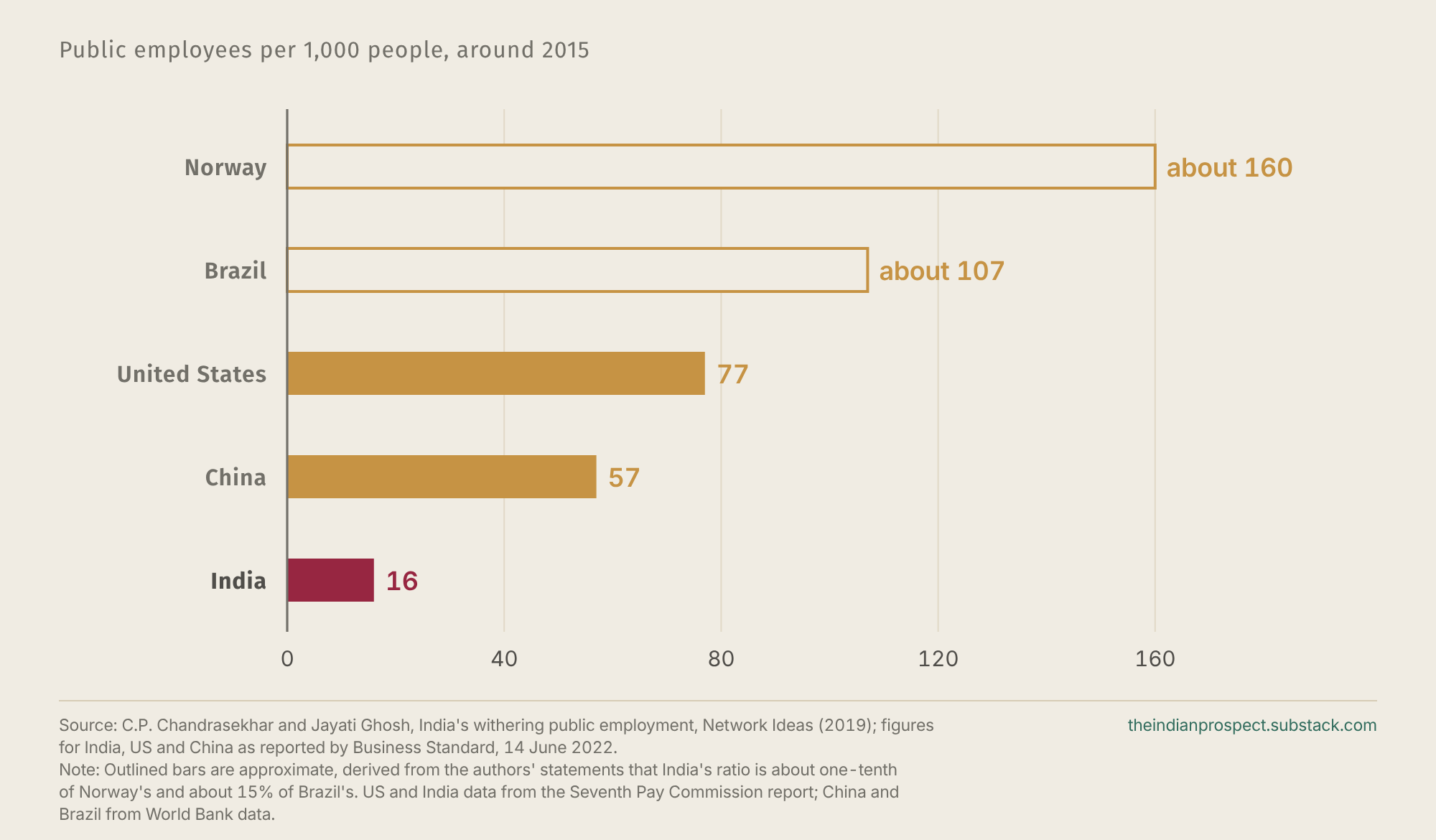
The problem that India faces is instead of too few sanctioned posts, not the pay attached to them. India does have a small public workforce for its population. Devesh Kapur has shown that India employs far fewer public servants per capita than most large economies30. One estimate puts India at 16 public employees per 1,000 people, as compared to 57 in China and 77 in the United States39. The two problems are connected, because the cost of each worker is one reason the state employs so few.
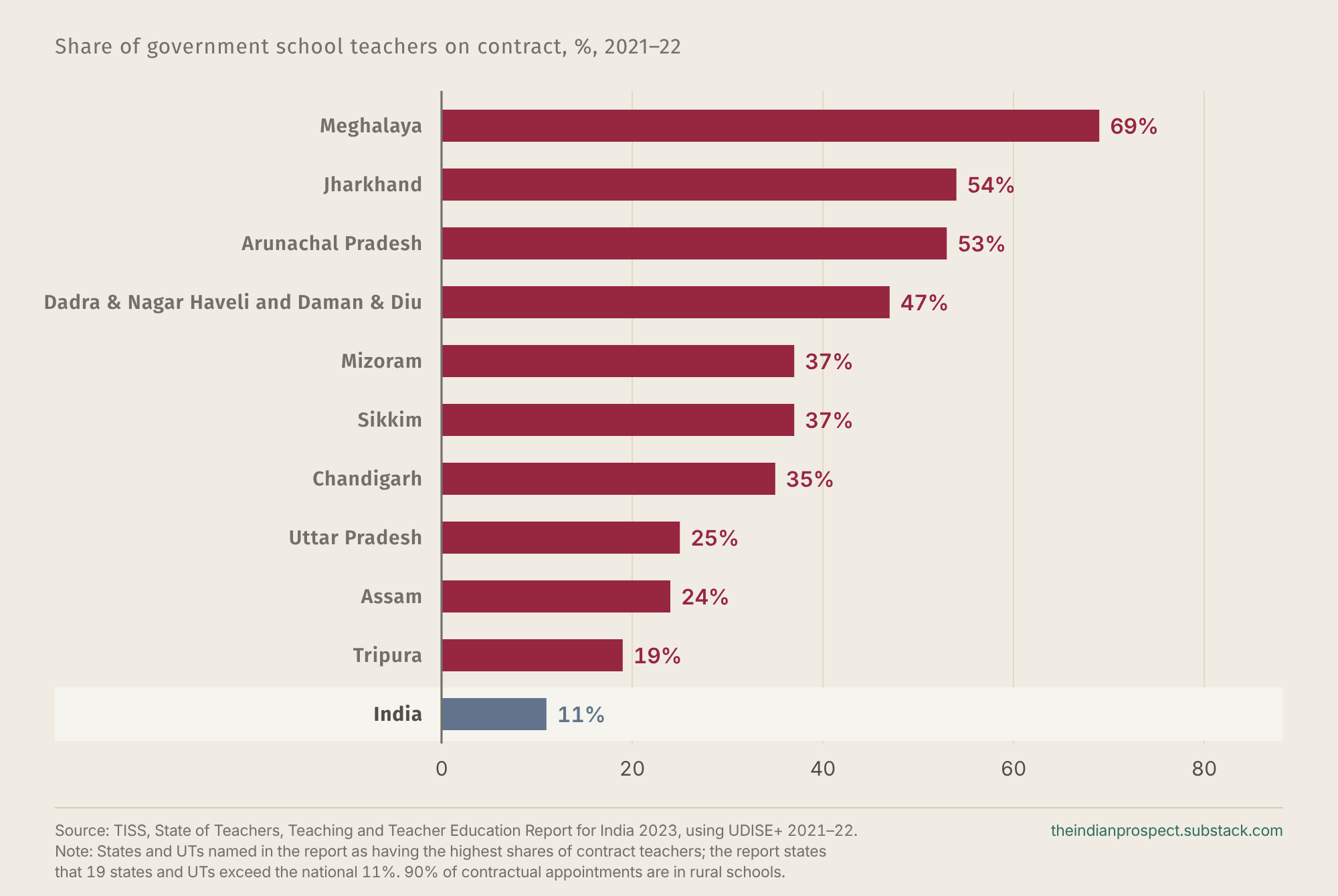
Governments have tried to escape the premium by hiring on contract. In 2021–22, about 11% of government school teachers were employed on contract. 90% of contract appointments were in rural schools31. Similar arrangements have been used for health workers and municipal staff as well
This two-tier arrangement however rarely holds as contract workers do the same work as regular staff but for a fraction of the pay and with little security. Unsurprisingly, they organise and campaign for regularisation leading to governments often conceding. Uttar Pradesh began absorbing its shiksha mitras, first engaged in 1999, as regular assistant teachers in 201241. Similarly, Punjab regularised 12,710 contract teachers in July 202342 and In December 2023, Bihar’s cabinet granted government employee status to about 3.5 lakh contract teachers, subject to a competency test43. Each regularisation turns a low-cost post into a premium post and adds a pension liability and more importantly, it teaches the next cohort that a contract job can become a permanent one with enough pressure. The Andhra Pradesh experiment showed the value of teachers who cost less. That fails when it’s just an insecure second tier working beside a premium one.
One price behind both problems
The candidates who spend their twenties preparing for a job that might not materialise, the coaching hubs that host them and the empty police posts all follow from the decision of how the government prices a job. So does the specialist the government can hire only by going around its own pay scale. Paying far above the market for routine work makes the job the best prize most Indians can compete for and it simultaneously stretches the budget across too few people.
As, the 8th Pay Commission reports its recommendations on pay rises for employees and pensioners. What India gets for the money spent on public servants is equally important. India has one of the lowest public sector workforces in the world and this is not a problem of lack of willing recruits. One fifth of police posts in India and one quarter of central government posts remain unfilled even as India’s outlays on salaries have risen steadily. India’s problem is of the lack of constable on the streets, teacher in the school room or inspector that inspects. Every rupee spent on the rising cost of a routine post is one rupee less to spend on the next post. Even as the commission’s recommendations will be assessed as a deal with the payroll, they should also be assessed also as an estimate of how much India can afford and its missing out on.