


A question with a measurable answer
On 19th November, the annual convention of the Federation of Indian Chambers of Commerce and Industry (FICCI) opened with the Prime Minister, Narendra Modi, providing a checklist of the government’s achievements. Corporate tax rate being cut from 30% to 22% and Income tax getting wiped out on incomes up to Rs 12 lakh a year featured among them1. He observed that the industry always asked for more, but then countered that by asking if they had hired more people or paid them better salaries2?
The Prime Minister then made a further point that in 1930, Mahatma Gandhi came to the FICCI with the message of self-reliance and nearly 100 years later, he observed, the Prime Minister was compelled to do the same. “Is this your success or your failure?” he asked1. This was viewed as a surprisingly direct case of criticism levied at the industry and the economics behind it deserves to be evaluated in seriousness.
The tax cut in 2019 was good policy and it did what a tax cut is meant to do, which is to give firms the means to invest more.
To the government’s credit, it didn’t stop there and instead continued addressing the concerns of the industry regarding cost and demand in the aftermath. Today, India Inc has the means, however it failed to make enough of that and the criticism levied against it has been well earned.
The bargain of 2019
On 20th September 2019, the government cut the base rate of corporate tax for existing domestic firms from 30% to 22%, on the condition that they forgo other exemptions and deductions. Taking into account cess and surcharge, the effective rate fell from 34.94% to 25.17%3. The rate for new manufacturing companies was 15% or 17.16% all-in4.
The rationale was basic economics. Reduce the rate and you increase the after-tax return on every new project. That in turn increases the viability of new projects and increases investment. A single low rate also simplifies a regime of deductions and exemptions that rewards businesses who can afford tax planning and penalizes new movers. Lastly it put India on par with its competitors for manufacturing – China and South Korea5.
The government was transparent about its price. It told parliament the tax cut and related measures would cost it Rs 1.45 lakh crore6. And what it expected in return was a multiplier effect across the economy and new investments7. The bargain is simple enough. The state gave up revenue. In return, the firms were free to expand production, hire workers and compete globally. The test of success is simple too – has each side delivered?
The tax cut worked
The first thing firms did with the windfall was repay debt – and wisely so. India in 2019 was still mired in its twin balance sheet crisis inherited from the profligacy of the UPA government era corporate borrowing and banking lending practices. Companies were over-indebted, banks weighed down with bad loans. Companies used the tax savings to repay banks, build cash buffers8. Six months later, when the pandemic hit, the cushion kept them afloat. It worked; the debt burden of unlisted companies is now at a 35-year low with high interest cover and healthy profits9.
The cut pushed investment in the right direction. A firm-level study of Indian manufacturers by the National Institute of Public Finance and Policy (NIPFP) found that the reduction led to a significant increase in investment by domestic firms, with the effect strongest among larger companies10. At the same time, the fears regarding loss of revenue were overblown. Collections dropped in the year of the cut11 and in the year of the pandemic12, then recovered13 to a new record14.
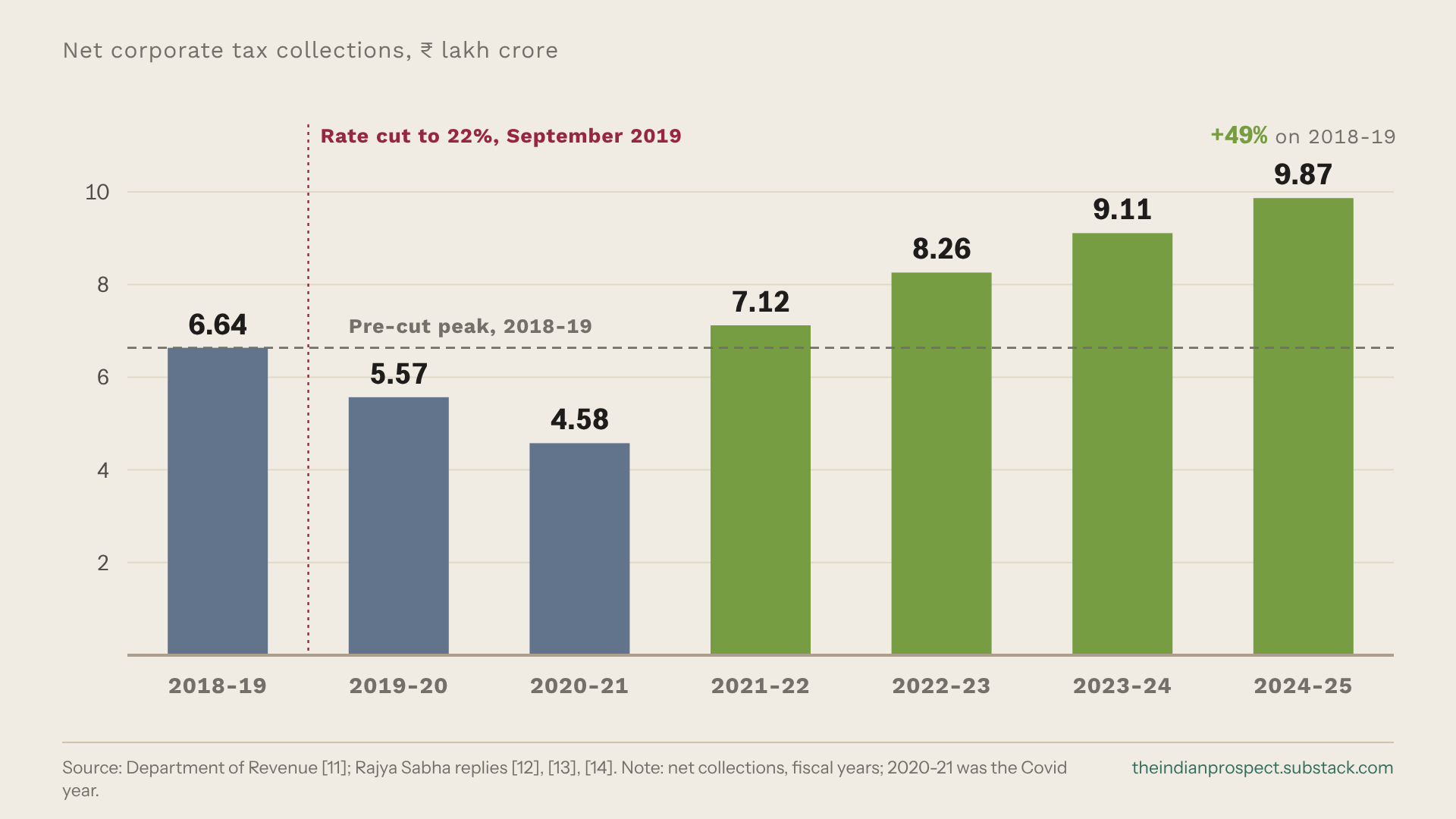
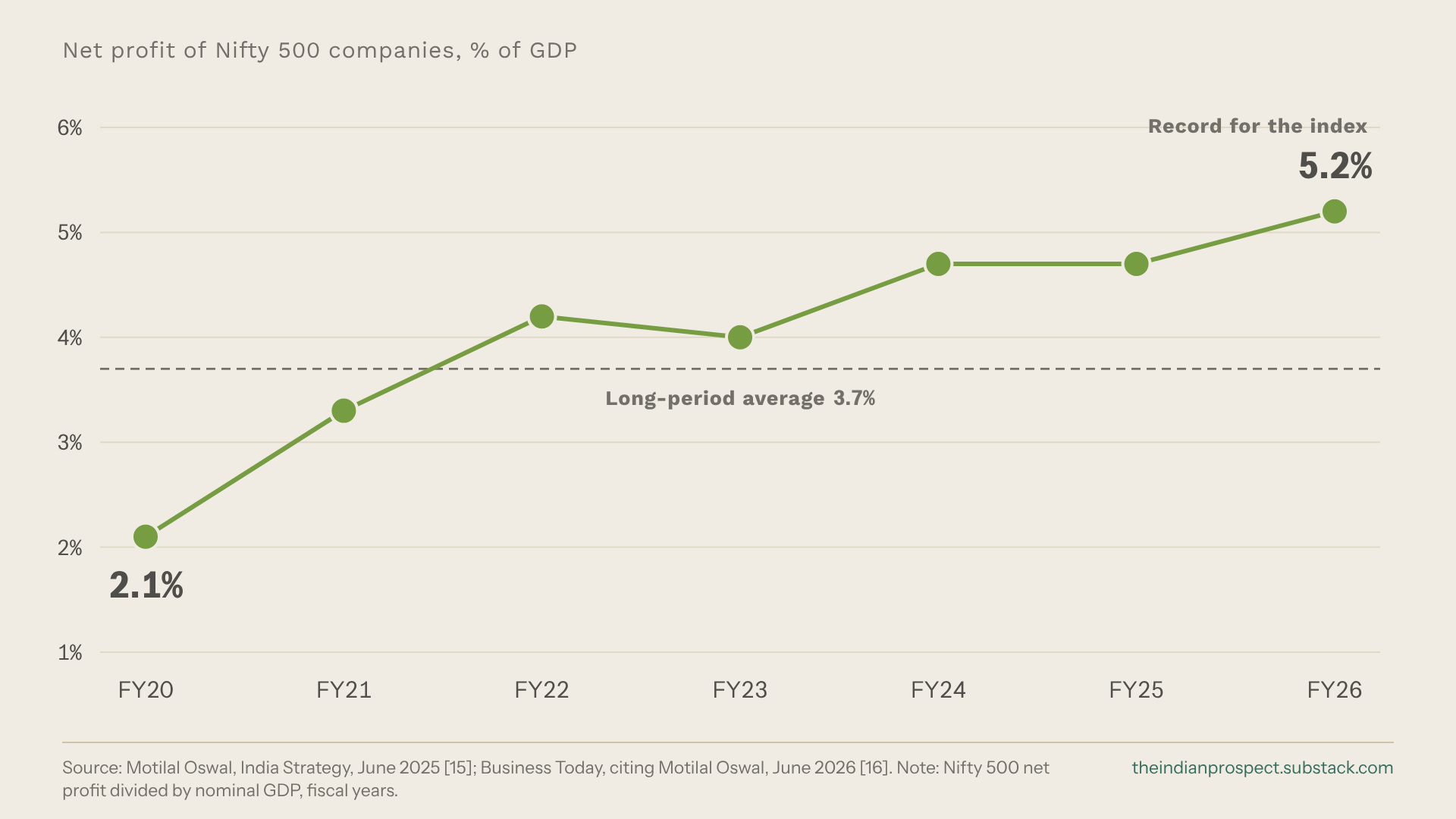
A lower rate on a cleaner base, applied to growing profits, brought in more revenue and profits have risen. Corporate net profits went from Rs 2.5 lakh crore to 7.1 lakh crore between 2020-21 and 2024-2514. Relative to GDP, the profits of Nifty 500 companies went from 2.1% in FY20 to 4.7% in FY2515 and reached 5.2% FY26, the highest ever16.
Capacity addition has continued as well, though often limited to a few sectors. The gross block of more than 5,000 listed companies went from Rs 87 lakh crore in March 2022 to Rs 145 lakh crore in March 202617. Listed companies increased their capital expenditure by 11% in FY2618. And it has been highest where the state has led the way: renewable energy, electronics under the Production Linked Incentive scheme (Tata Electronics is now making Apple phones in India19). Every condition that the tax cut was designed to bring about is in place
The state didn’t stop there
Industry was never short of excuses to hold off on investment. What’s different about the last seven years is that the state addressed every one of them.
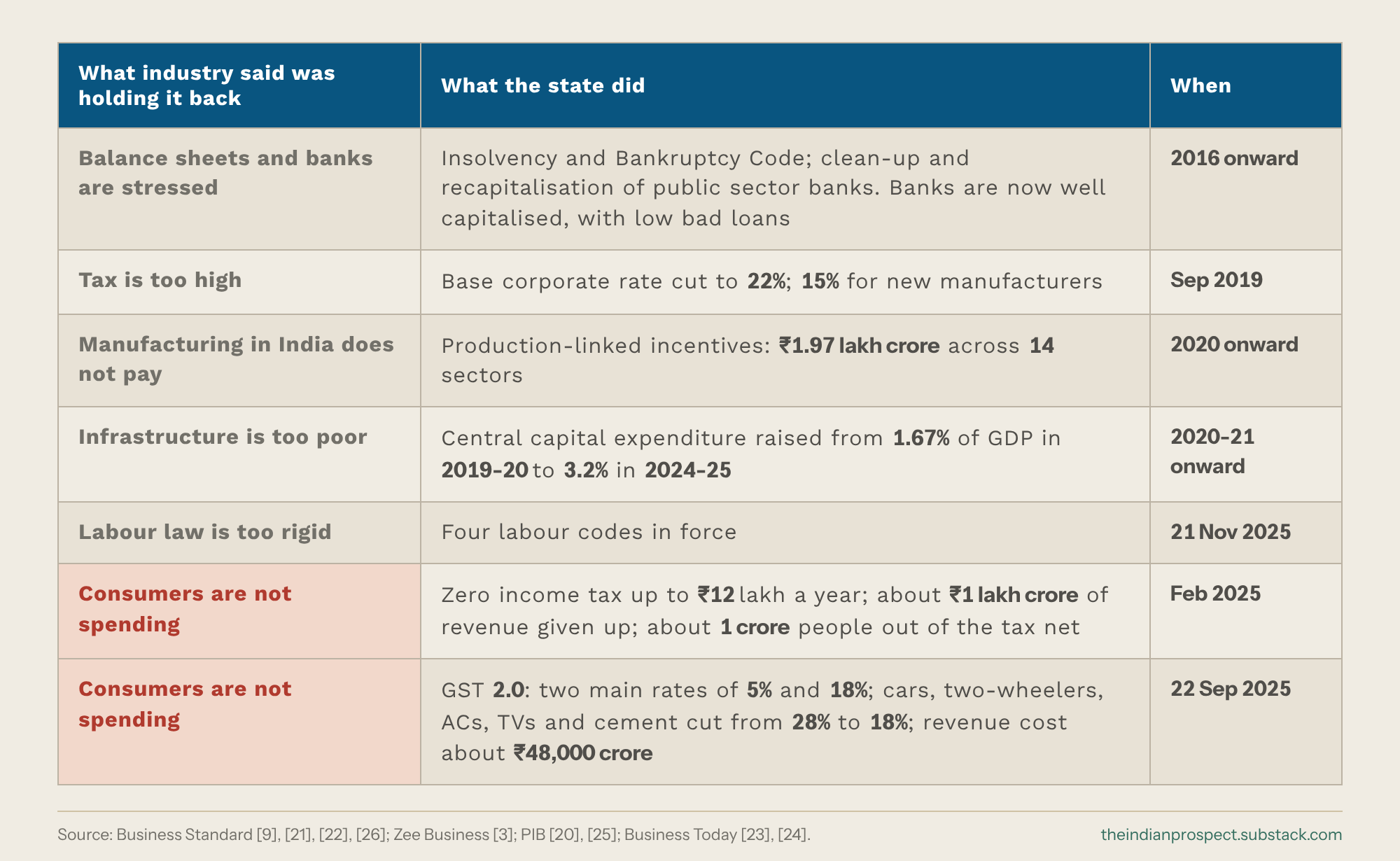
The last two rows are especially important. For ten years, the industry’s standard response to questions on why it wasn’t investing was lack of demand. The government addressed it. It gave up Rs 1 lakh crore in income tax23 and 48,000 crore in GST26 to put money in the hands of consumers. The state’s own capital spending nearly doubled as a share of GDP to 3.2% in 2024-25 as compared to 1.67% in 2019-2021.
This is why PM Modi mentioned the corporate tax rate and the Rs 12 lakh income tax relief in one breath at FICCI1. The state worked on both sides of the ledger. Industry asked for relief on its own costs – they got it. Then complained about lack of demand – they got it.
What India Inc hasn’t done
The cut and the succeeding reforms worked directionally. The Prime Minister’s criticism is on the issue of scale and on that, the record of India Inc has been deficient on several fronts.
Firstly, it has been hoarding cash. Corporate cash holdings hit Rs 10.35 trillion in FY25, more than twice the FY19 amount, while new project announcements fell sharply in FY24 and FY2527. Much of this cash went to paying shareholders. The cut in taxes was followed by a steep rise in payouts. In a sample of listed companies drawn by Business Standard, dividends grew at a rate of only 3% per year between FY17 and FY20. Between FY20 and FY23, they more than doubled from Rs 1.95 trillion to Rs 4.23 trillion, and the profits that were not paid out were not invested either. They piled up as cash.
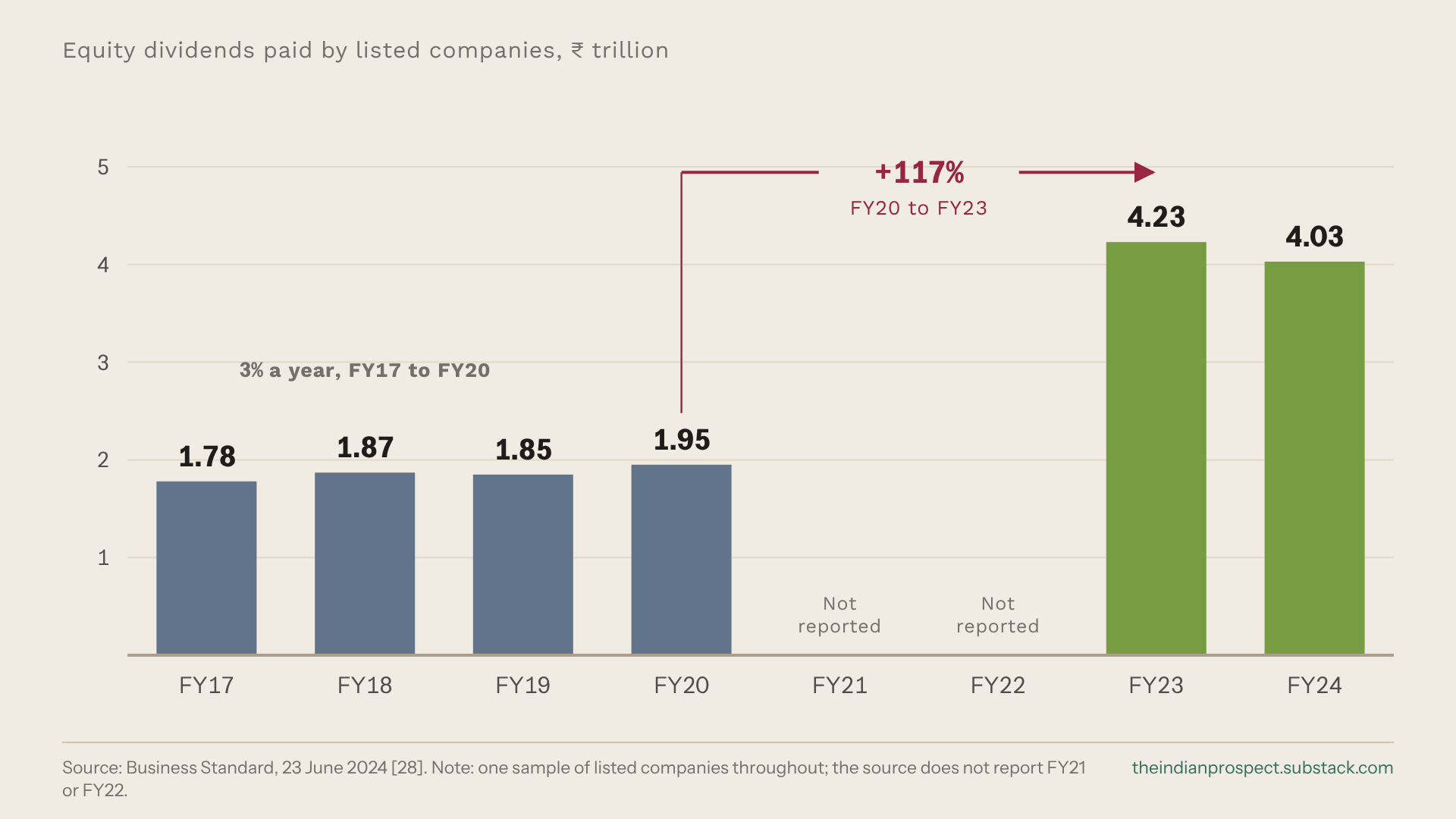
In FY25, payouts grew faster than profits. India’s top listed companies paid a record Rs 5 trillion in dividends, a rise of 10.8%. In the same year, their adjusted profits grew by 5.2%. Nifty 50 companies distributed Rs 2.76 lakh crore of their Rs 6.44 lakh crore profits. In companies controlled by promoters, dividends are largely paid to the controlling family. If companies are paying out more than 40% of their profits in dividends, they have surplus capital and are choosing to hand it back.
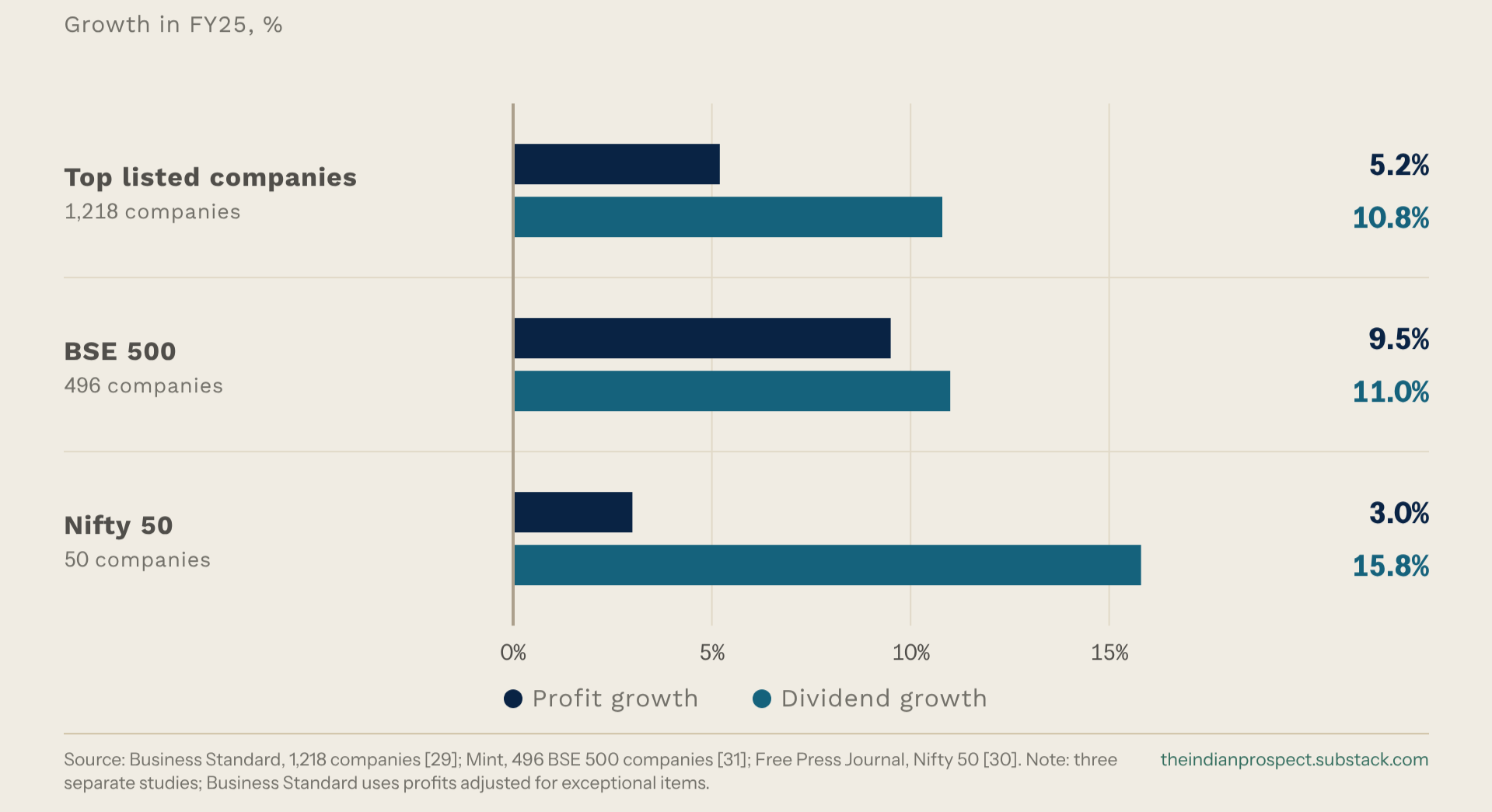
Secondly, large companies are moving away from investing in physical assets to investing in financial assets. Passive income – capital gains and other non-operating income – has nearly doubled as a share of corporate income over the past decade. The share of physical assets on large firms’ balance sheets has shrunk. Where unlisted companies do borrow, they mostly use it to refinance old loans. An ICRA study of 8,000 unlisted and 4,500 listed companies finds that the unlisted ones are mainly responsible for the slowdown in private capex. They include family-owned industrial groups and the Indian subsidiaries of multinationals – companies with the strongest balance sheets in a generation.
Thirdly, hiring and salaries have grown slower than profits. In FY24, corporate profits rose by 22.3%, while employment grew by 1.5%, found the Economic Survey 2024-25. “Increasing income wages is not a moral ask but in the self interest of the private sector, as it has a direct impact on aggregate demand” wrote the Chief Economic Adviser. This is the question that the Prime Minister asked about employees and salaries, translated into numbers.
Fourthly, research spending is still low. India spends 0.6-0.7% of GDP on research and development. Companies fund 36% of this, compared to over 70% in China and the United States. Speaking at FICCI, Modi linked his call for Swadeshi to dependence on imports, including of pharmaceuticals. Self-reliance in medicines, electronics and machinery depends on research that only companies can fund.
Fifthly, the private investment that has come is concentrated in a few sectors and is slowing. Renewables, conventional energy and IT-enabled services took 38% of private investment in FY24 to FY26, up from 25% in FY21 to FY23, according to the National Institute of Public Finance and Policy (NIPFP). These sectors are capital-intensive and employ few. The RBI’s Financial Stability Report shows fixed asset growth at listed manufacturers slowing from 10.3% in the first half of FY26 to 5.2% in the second half. The National Statistical Office’s survey of company investment plans projects private capex to fall by 16.5% to Rs 9.55 lakh crore in 2026-27.
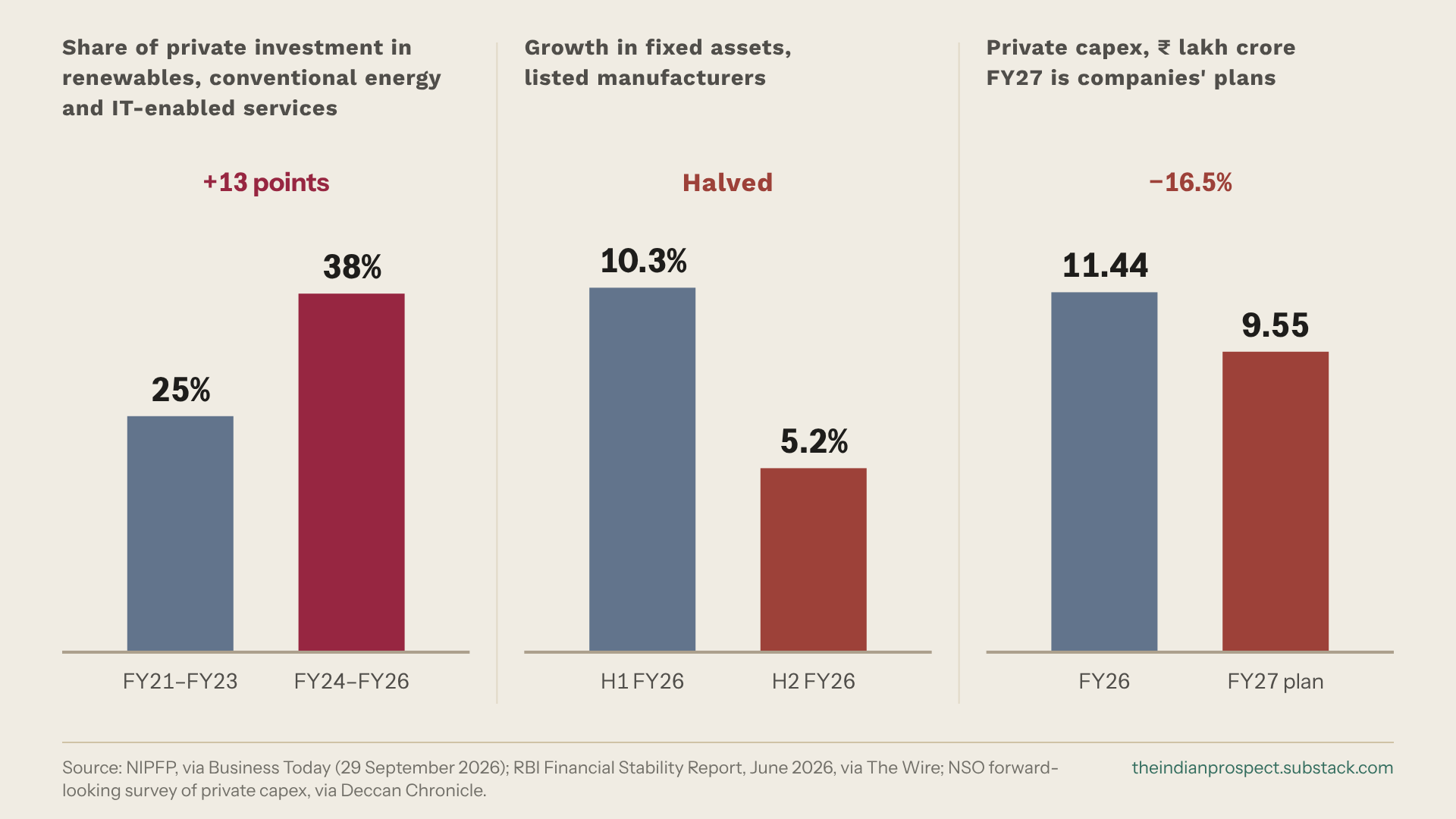
None of the standard explanations for the slowdown hold up. Capacity utilisation is at 75.5%, above its long-term average of 74%, at a level that has historically preceded fresh investment. Simultaneously banks are well-capitalised and corporate debt is at historic lows while demand has received a major boost thanks to two rounds of tax cuts in a single year. Nor does global uncertainty explain it. Investment was weak for years before the latest trade shocks, and trade risk does not explain why companies with record profits are paying out more than 40% of them as dividends.
The cost of the shortfall investment is borne by others: young workers who didn’t get factory jobs, the exchequer that funded the investment cycle with public capex and most importantly the growth trajectory required for India to reach high income status. The World Bank estimates that India needs to invest around 40% of GDP to achieve this and the government cannot achieve this without the participation of industry.
Four years of asking
The Prime Minister’s words at FICCI were the most pointed of a series of appeals that began three years after the tax cut.
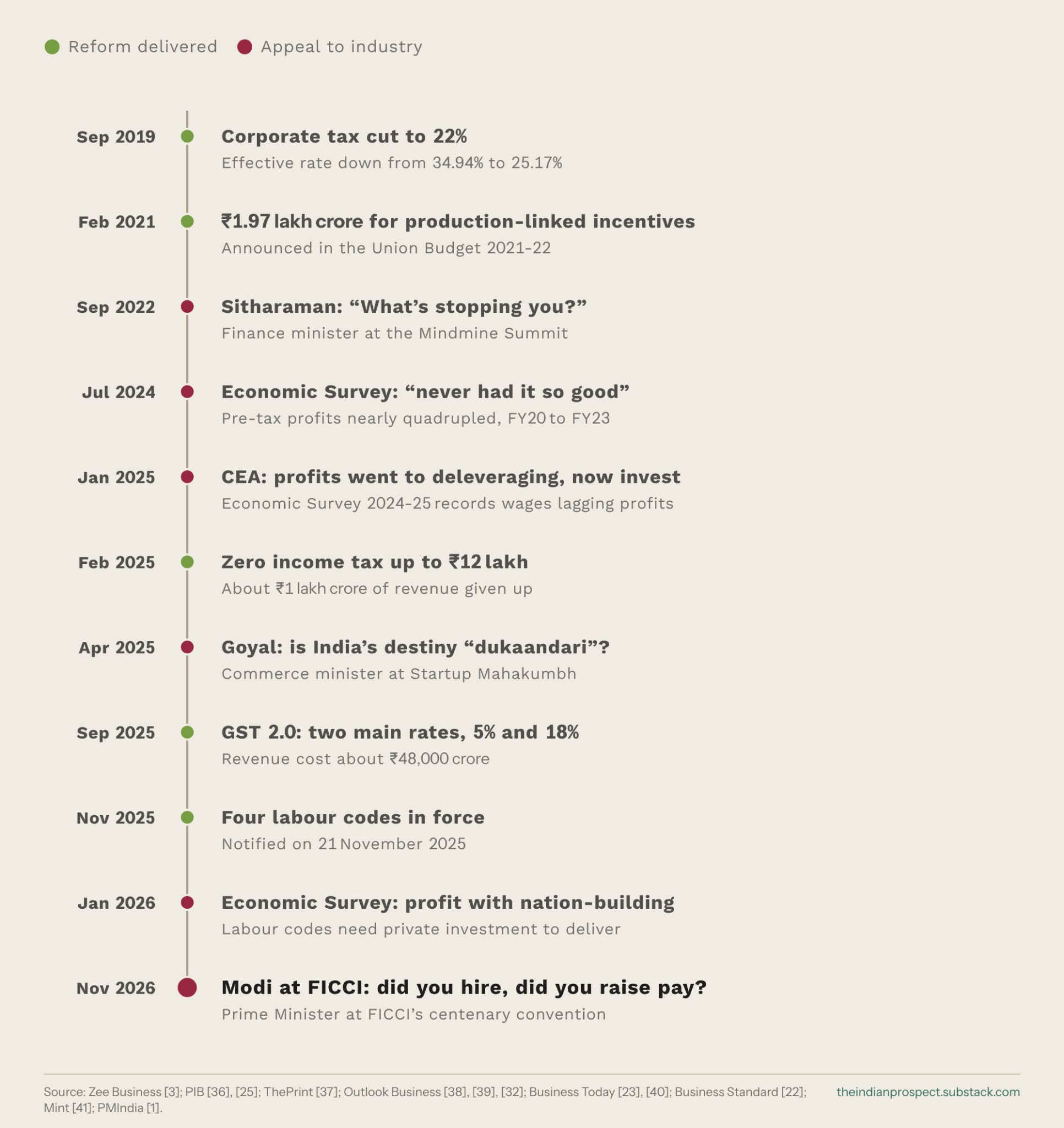
In September 2022, Finance Minister Nirmala Sitharaman told industry that the government had cut the tax rate and given production-linked incentives as demanded. “I want to hear from India Inc, what’s stopping you?” she asked. She compared industry to Hanuman, who didn’t know his own strength.
The Economic Survey for 2023-24 noted that the corporate sector “has never had it so good”. Pre-tax profits of over 33,000 companies nearly quadrupled between FY20 and FY23. It called employment generation the real bottom line for the private sector.
In January 2025, Chief Economic Adviser V Anantha Nageswaran told an Assocham audience that companies had used profits to deleverage and that it was now time to invest. The Economic Survey released weeks later recorded profits at a 15-year high while the wages were lagging.
In April 2025, Commerce Minister Piyush Goyal asked startup founders whether India’s destiny was “dukaandari”, shopkeeping, as Chinese companies built electric vehicles and batteries. The Economic Survey 2025-26 said that the new labour codes would need private investment to deliver results. It asked companies to combine “commercial dynamism” with a “conscious contribution towards nation-building”.
These appeals came alongside a steady stream of reforms, rather than as standalone sermons. The tone has grown more pointed because while the conditions have improved but the response has not kept up. The government has kept the door open: at FICCI, the Prime Minister invited industry leaders to propose further reforms. The position is one of reciprocity, from a government that has delivered its share.
What India Inc owes now
The state’s side of the ledger is full. It cut corporate tax to competitive levels comparable to counterparts, cleaned up the banks, paid companies to start manufacturing, reformed labour laws and put money in consumers’ pockets. It collects more corporate tax today than it did before the cut.
India Inc’s side of the ledger however has several items outstanding. It has to put the cash to work in a new capacity be it personnel or physical goods. It has to share productivity gains with the people who create them, that is the employees. It has to fund research and innovation rather than stick to the safety of import and white labelling. These are the standards by which next year’s FICCI convention should be judged. The government, for its part, has to keep policy stable and predictable so that no company can plead uncertainty as an excuse for waiting.
FICCI will celebrate its centenary next year. In 1930, Mahatma Gandhi asked its members to build India’s capacity to provide for itself and the government has done what it can to make that possible. The next move is up to the people who asked for the tax cut.