

When we talk about AI in India, the conversation usually turns to India’s efforts towards developing indigenous LLMs or alternatively, towards software getting smarter and what all this might mean for our IT services industry. After all, if clients can get more work done with fewer people, what happens to the businesses that have spent decades supplying those people1?
While this remains a serious concern, parts of the manufacturing sector show a different story emerging. Running AI requires buildings full of computers, fibre networks, memory, electricity and cooling equipment. On this front, Indian factories are already finding customers. Thus, while AI might change our services exports, its infrastructure boom is already creating demand for Indian manufacturing.
India’s fibre exports are rising
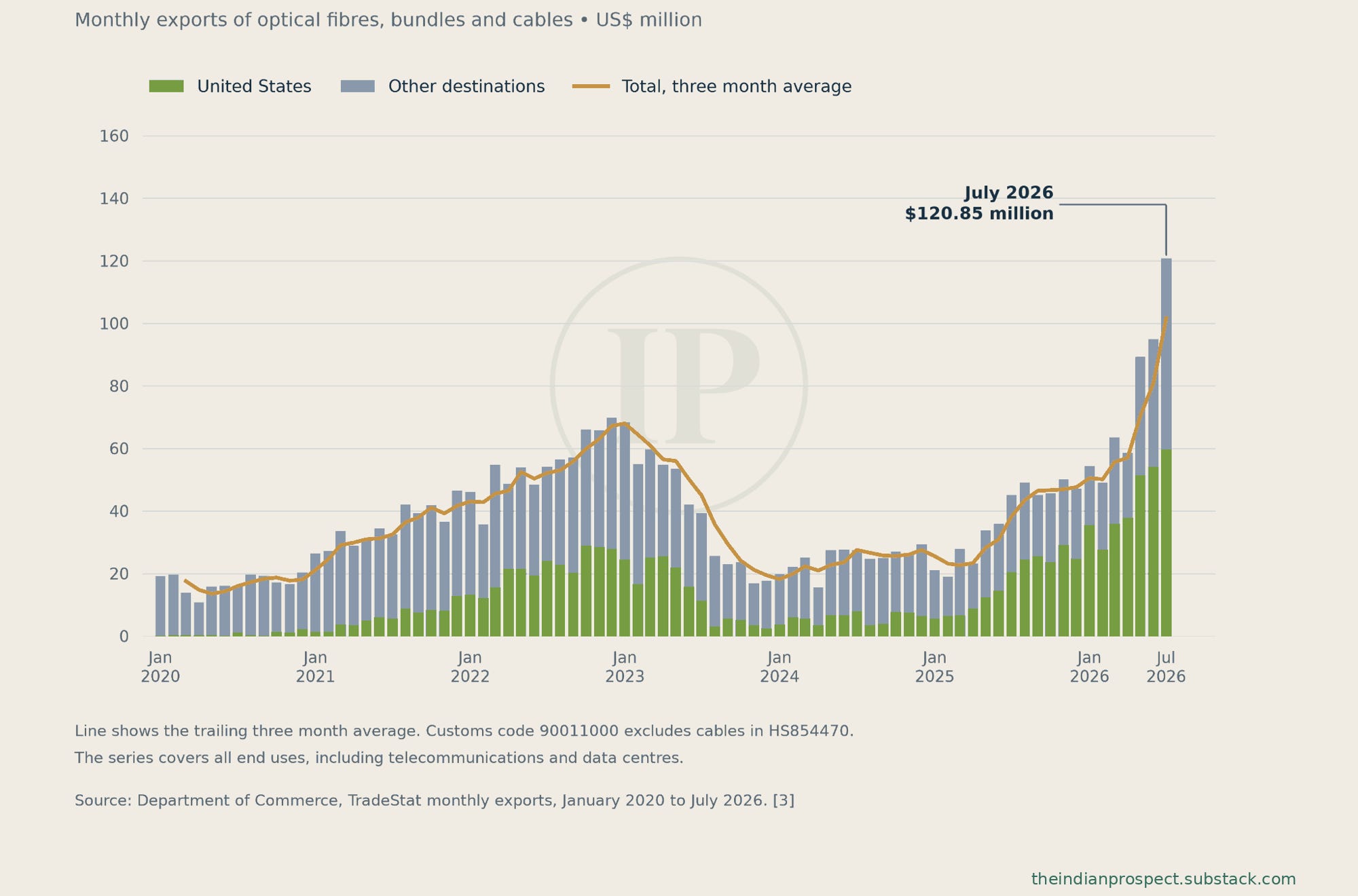
Between April and August 2026, India exported $483 million of optical fibres, bundles and cables, recording an increase of 158%. Here, the United States accounted for approximately $267 million, or about 55% of the total exports and China bought $52.4 million, followed by Poland and Vietnam at roughly $23 million each. According to the Commerce Ministry, this impressive growth is an outcome of sustained investment in AI infrastructure and digital connectivity2.
While it would be misleading to label the entire export figure as “AI sales”, as these products also serve ordinary broadband and telecom networks, they belong to a category of equipment whose market is expanding as the world builds more computing infrastructure.
Why AI needs so much fibre
Training a large AI model involves thousands of processors that continuously exchange data. For such purposes, network bandwidth and delays affect how much useful work computing hardware can actually perform. In this process, optical fibre performs an essential function where it carries data and supports high bandwidth connections within data centres and across long distance communications networks transmitting data. The engineering challenge that remains is to deliver more capacity while limiting signal loss, installation time and the space occupied by cables and connectors.
Corning, a major fibre manufacturer, estimates that AI data centres require more than ten times as much fibre as traditional facilities4. That creates demand, particularly for cables carrying more fibres, compact connectors and systems that can be installed quickly. There is substantial spending behind this demand. The International Energy Agency expects the largest data centre operators to spend more than $700 billion on capital expenditure in 2026, mostly developing new data centres5. Part of that money becomes orders for the equipment going into them.
HFCL, an Indian manufacturer of optical fibre, cables and communications equipment, illustrates the shift. In April 2026, the company said it was exporting more than 70% of its cable production with exports accounting for approximately 41% of total revenue in 2025/26, compared with 12% a year earlier. The manufacturer also secured a 5 year optical fibre cable supply contract worth approximately $1.1 billion with a ‘global hyperscaler’. Its engineers had also developed cables containing up to 6,912 fibres, alongside requisite connector systems. These new products have helped in addressing the practical problems of fitting more connections into limited space and reducing installation work6.
Cisco, an American multinational conglomerate, opened a factory with PLI beneficiary Flex near Chennai in 2024, where it manufactures routers designed for uses including mobile networks. Dixon Technologies, with its joint venture with Taiwan’s Gemtek, also plans to make optical transceivers in India, starting with telecom products and later moving into higher-speed modules for data centres.
Furthermore, India already has a growing export base in networking equipment. The government told Parliament that exports under the telecom and networking Production Linked Incentive scheme reached ₹19,240 crore in 2024–25, three times their 2021–22 level.
From cables to AI servers
At its Faridabad plant7, Netweb Technologies designs and assembles circuit boards and integrates processors, memory, storage and software into AI systems. It uses processors from Nvidia and AMD. In September 2025, Netweb announced a ₹1,734 crore order to supply systems built on Nvidia’s Blackwell platform for the IndiaAI Mission.
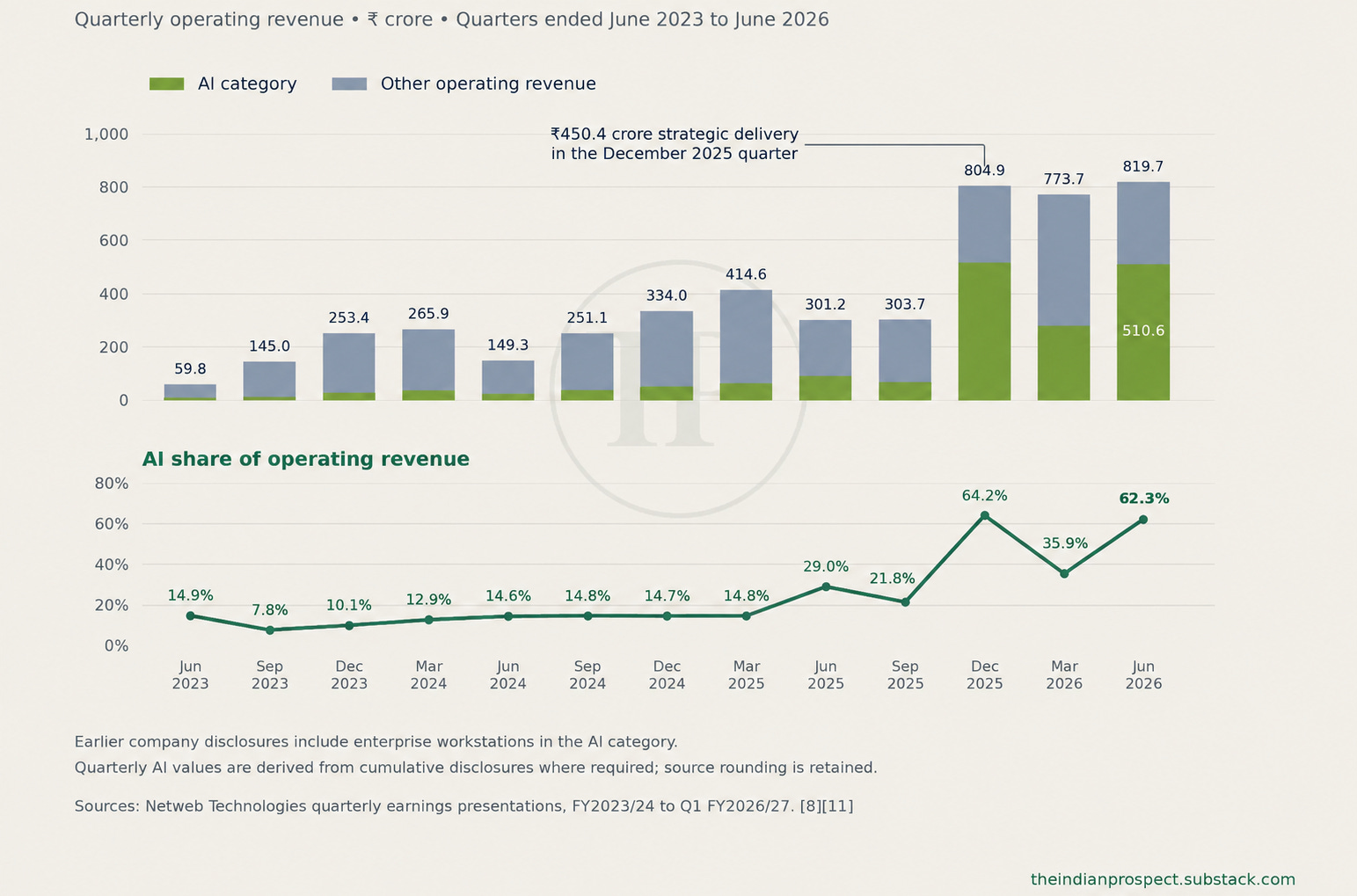
In the 2nd quarter of calendar year 2026, Netweb’s AI systems generated ₹511 crore, nearly six times the figure a year earlier and 62% of the company’s operating revenue8. A large order helped drive the jump. Netweb said it fulfilled about ₹430 crore of that order during the quarter. In the September 2026 quarter, Netweb’s AI-system revenue rose to ₹773 crore, even as its share of operating revenue fell to 58.4%. The company had also received ₹5.94 crore in April 202510 under the government’s production-linked incentive scheme for IT hardware, which covers servers9.
Memory and cooling expand the manufacturing base
Growing demand for computing capacity also creates opportunities in memory and storage. Micron’s Sanand facility assembles and tests DRAM and NAND products, adding a further manufacturing stage to India’s semiconductor industry. The facility began commercial production in February 2026 and represents approximately $2.75 billion of combined investment by Micron and its central and state government partners, with Micron expecting to assemble and test tens of millions of chips at Sanand in the first year. The facility converts wafers from the company’s overseas factories into finished memory and storage products and supplied its first Indian made memory module to Dell for laptops manufactured in India12. The project was backed by commitments covering 50% of its cost from the Centre under the Modified Assembly, Testing, Marking and Packaging scheme and 20% from the Gujarat government13.
Further, Cooling is another increasingly specialised manufacturing opportunity. As computing power grows, equipment that can remove heat efficiently without compromising reliability becomes an essential component of the systems. Schneider Electric’s Bengaluru factory manufactures coolant distribution units and equipment that carries heat away directly from chips. It is the company’s third liquid cooling manufacturing facility globally, alongside ones in the United States and Italy, putting Indian production into another specialised part of the AI infrastructure market14.
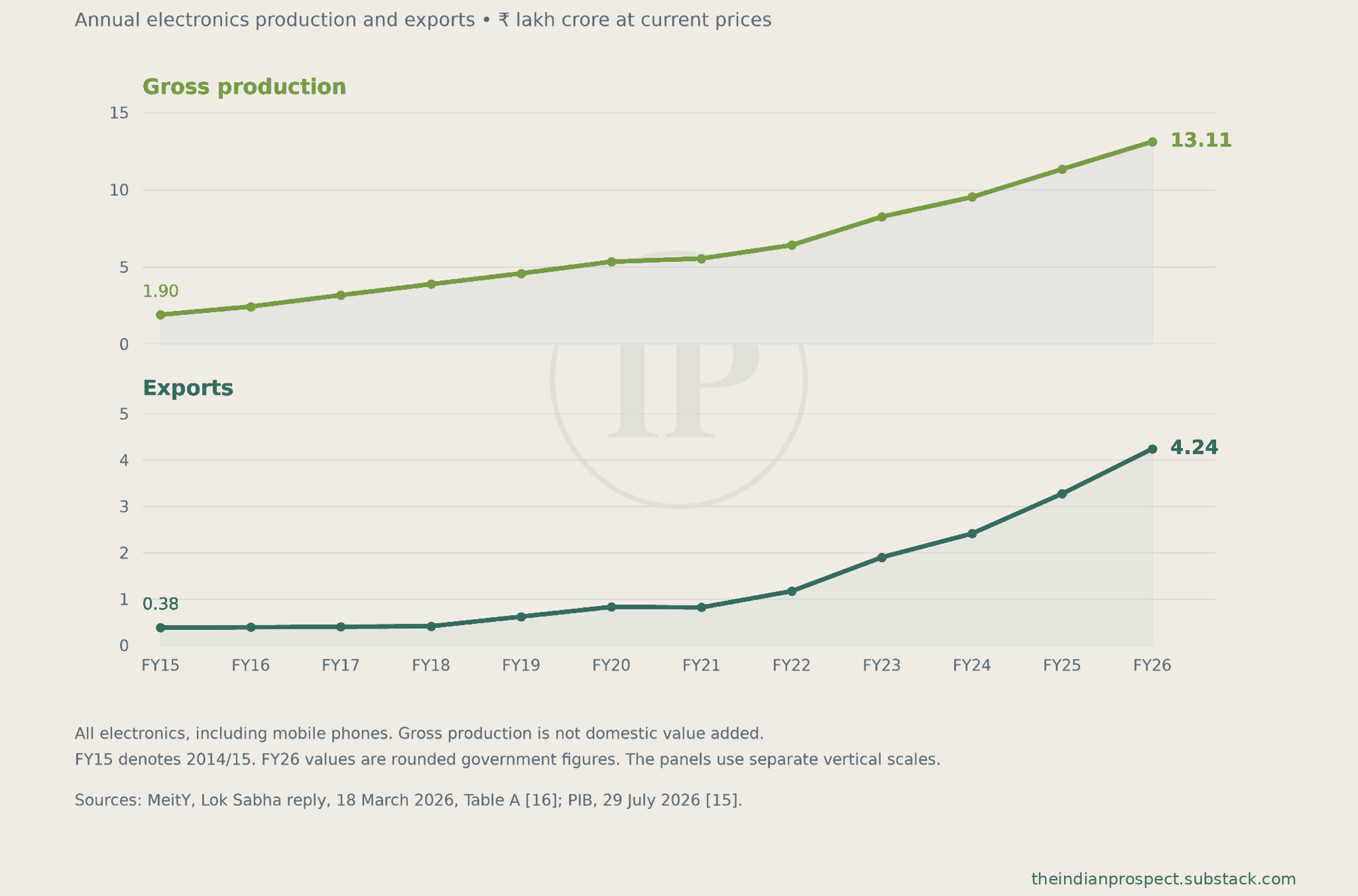
Zooming out, these developments show the recent expansion of electronics manufacturing. In 2025-26, Indian electronics production stands at ₹13.11 lakh crore, up from approximately ₹1.9 lakh crore in 2014/15. Within a decade, electronics exports rose from around ₹38,000 crore to ₹4.24 lakh crore. By July 2026, the government reported 12 approved semiconductor projects, involving committed investment of approximately ₹1.64 lakh crore, with three already in commercial production15.
What this means for India
While much of the broader electronics growth comes from mobile phones and other products. Its relevance to AI is the expanding base of factories, suppliers, trained workers and production experience on which more specialised manufacturing can develop.
The economic gains can extend beyond the final exporter. Larger orders support demand for materials, components, testing, logistics and engineering services. Supplying overseas customers also gives manufacturers a market larger than domestic demand alone. PLI incentives9 and semiconductor support13 are helping build that capacity10 as global AI investment expands the market for it.
There is still considerable ground to cover. Netweb’s systems depend on foreign processor technology; Micron’s wafers arrive from abroad. Gross sales therefore exceed the value created within India. Developing more local components and intellectual property will determine how much of each sale stays in the country.
What they establish is that India has several ways to participate in the AI economy. Alongside the difficult questions facing services, there is a growing industrial opportunity, already visible in export receipts, working factories and equipment being shipped to customers.