On 25 November 2026, the government approved a ₹11000 crore ($1.2 billion) incentive programme in an effort to encourage the domestic manufacturing of advanced construction and infrastructure equipment. The eight year programme will cover seven categories of machinery that India currently imports or has substantial dependence on imported components3.
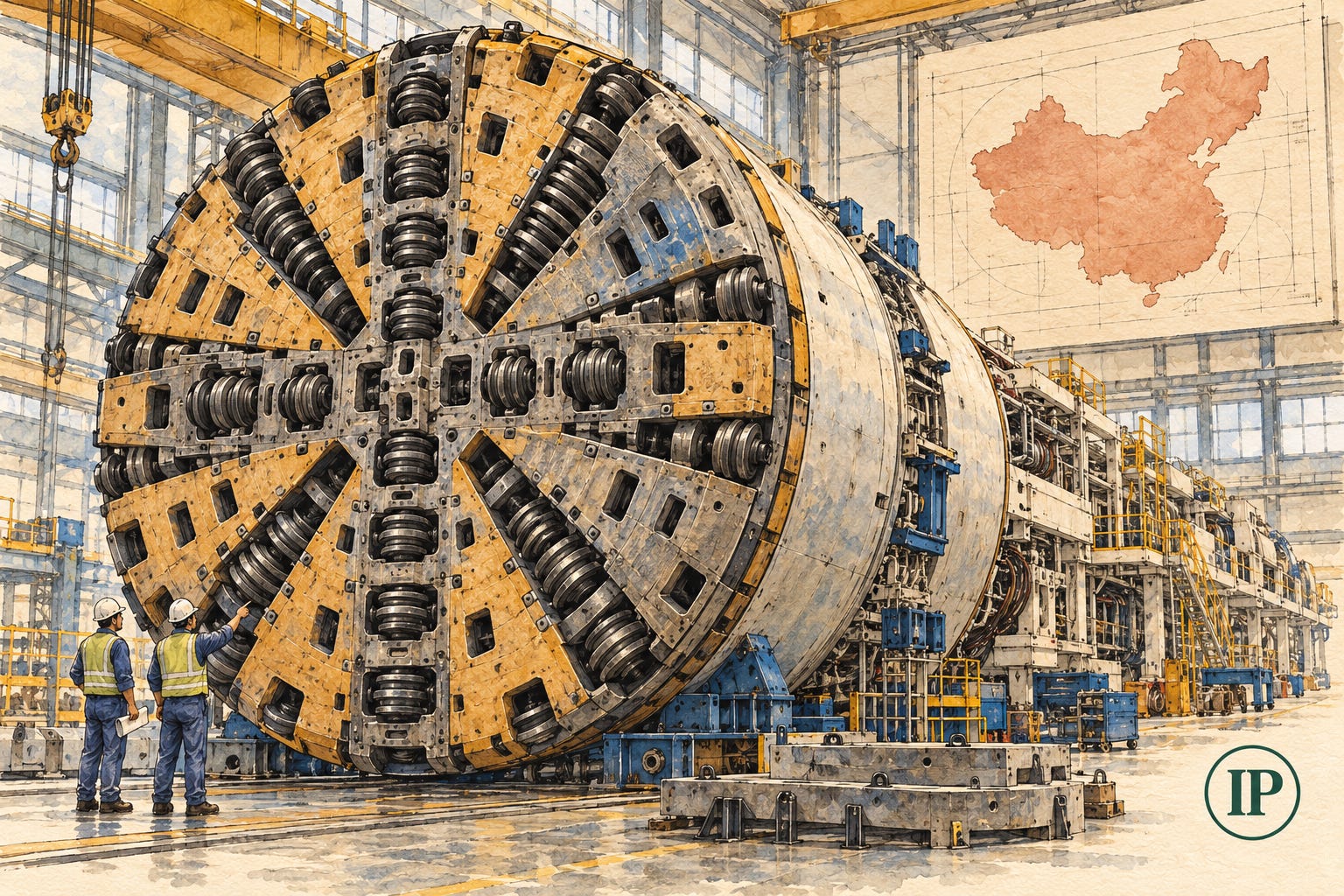
This announcement comes a month after China announced new controls on exports of tunnel-boring machinery and related equipment which raised concerns about building infrastructure when access to specialised machinery and critical components depends on overseas suppliers.
China’s export controls
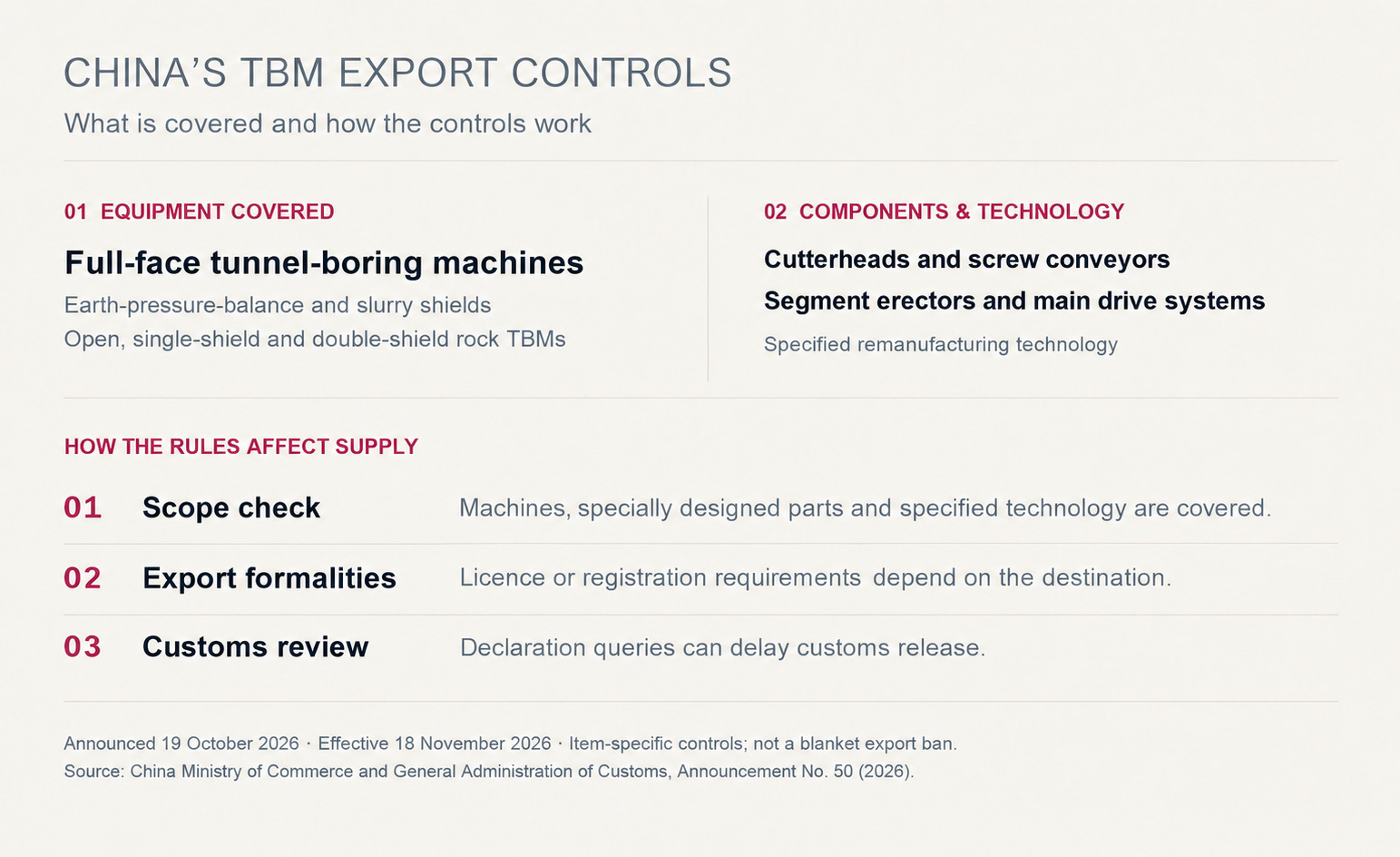
In October 2026, China announced export controls on specialised tunnelling machinery, components and related technology. They became effective from 18 November and require Chinese exporters to obtain a licence for covered items. This adds a regulatory step to the procurement process for overseas customers, including those in India.
The controls cover full-face tunnel-boring machines and specially designed components such as cutterheads, screw conveyors, segment erectors and main drive systems1. Specified remanufacturing technology is also covered. These controls are meant to give Beijing greater authority over the movement of critical tunnelling technologies, creating uncertainty for projects that depend on access to these machines and parts2.
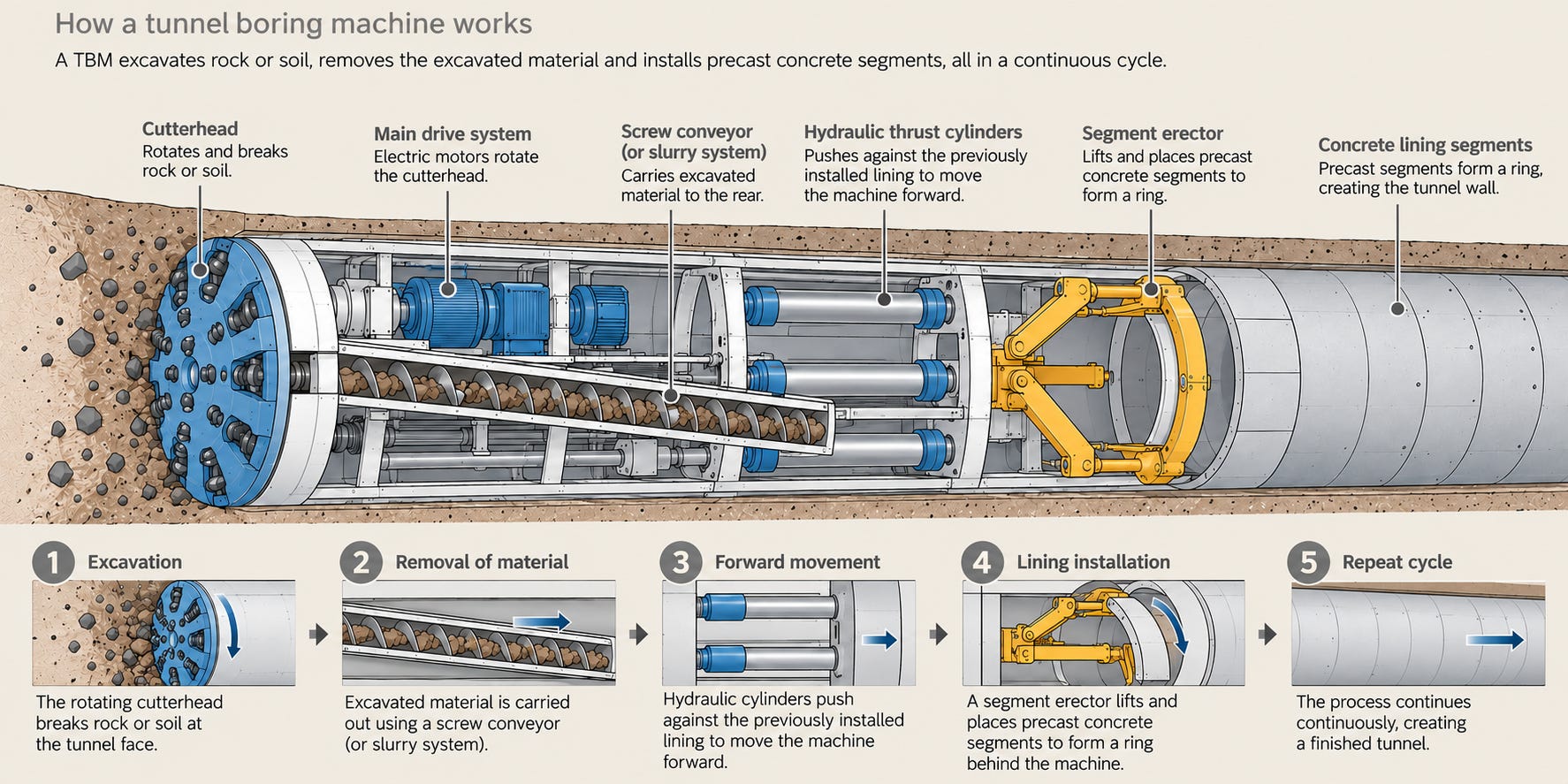
A tunnel-boring machine (TBM) uses a rotating cutterhead to excavate underground tunnels that helps in reducing surface disruption. In India, TBMs are used for metro projects, excavating railway tunnels and major transport corridors where different ground conditions require different machines. For example, earth-pressure-balance TBMs are used in soft ground, slurry systems in water-bearing areas whereas hard-rock machines are used in tougher formations. The Mumbai–Ahmedabad high-speed rail project, for instance, has used a 13.6-metre-diameter Mixshield TBM7.
Problems with TBM supplies from China have been a contentious issue for a while. In October 2024, during a Delhi Metro journey with German Vice Chancellor Robert Habeck, Commerce Minister Piyush Goyal raised concerns over delayed deliveries of German machinery. Goyal mentioned China’s repeated blocking of TBM shipments manufactured by German firm Herrenknecht and questioned future purchases if deliveries remained uncertain20. Herrenknecht later acknowledged that Chinese customs delays had disrupted or prevented shipments to Indian customers19.
India’s industrial dependence on China
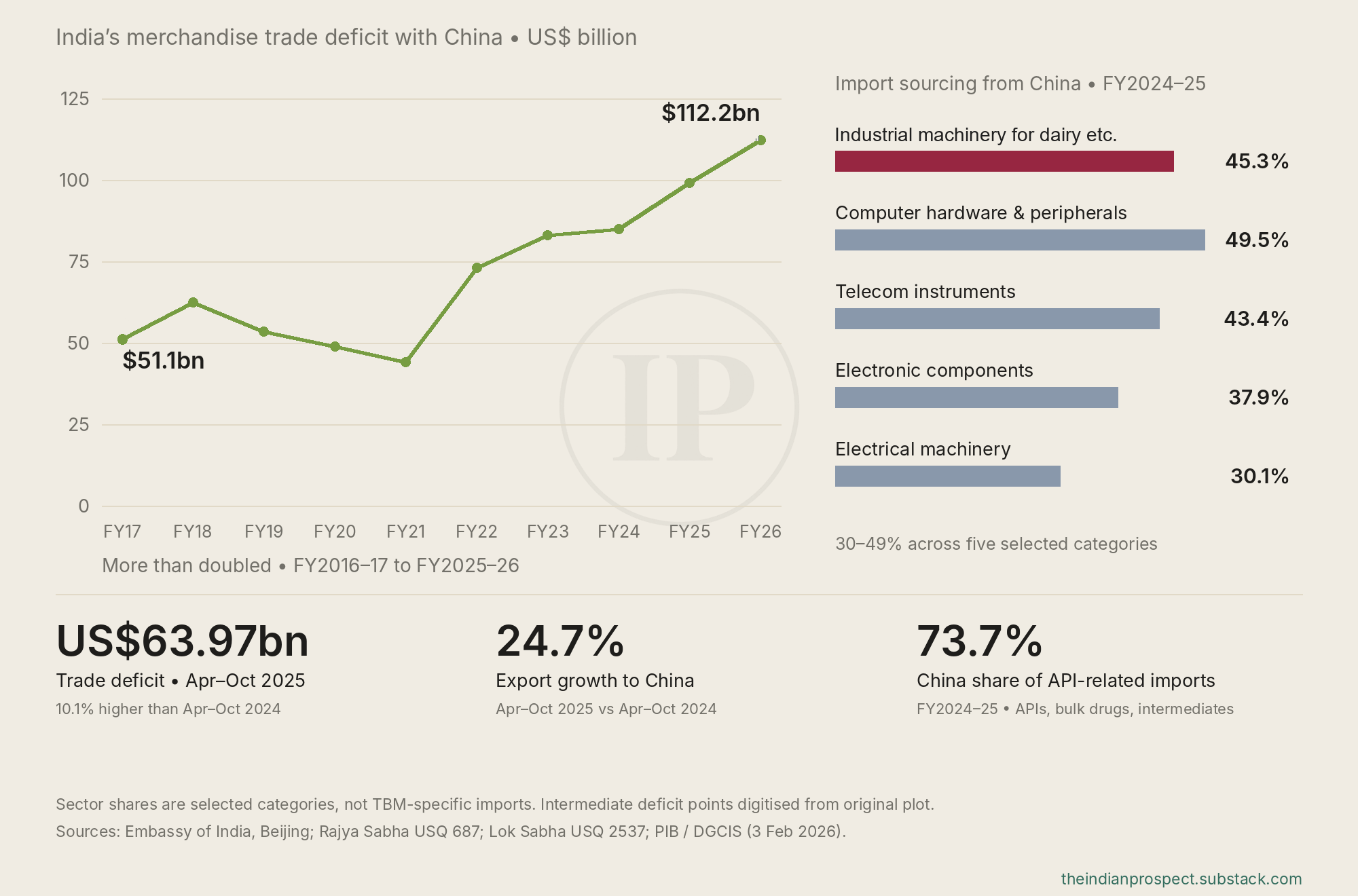
The issues from exposure often emerge after a TBM has entered service, where equipment is configured for particular geology and project specifications. Usually, its specialised spares and technical support are not always interchangeable across manufacturers. India’s vulnerability is more than an isolated tunnelling issue, rather, it is a highlight of a broader industrial relationship. A high concentration of imports in particular equipment and electronics makes substitution expensive and slow, especially when projects depend on established technical standards and supplier relationships. Further, the scale of dependence is evident in industrial equipment where supplies from China accounted for 49.5% of India’s “computer hardware and peripherals” imports21 and 30.1% in electrical machinery in FY2024–2522. The broader trade imbalance also widened with India’s deficit more than doubling from $51.1 billion in FY2016–17 to $112.2 billion in FY2025–2625.
India’s manufacturing opportunity
According to Reuters, the incentive programme will run for eight years and is expected to attract investments of ₹21000 crore ($2.27 billion) and aims to substitute imports of ₹22,500 Crore. It covers not only tunnel-boring machines but also hydraulic excavators and cranes alongside five categories of components. The programme includes incentives for engines and transmission systems. Eligible manufacturers will receive incentives ranging from 8% to 13% of incremental sales over five years. Further, a grant of ₹375 Crore will be provided to establish a dedicated testing facility for construction and infrastructure equipment3.
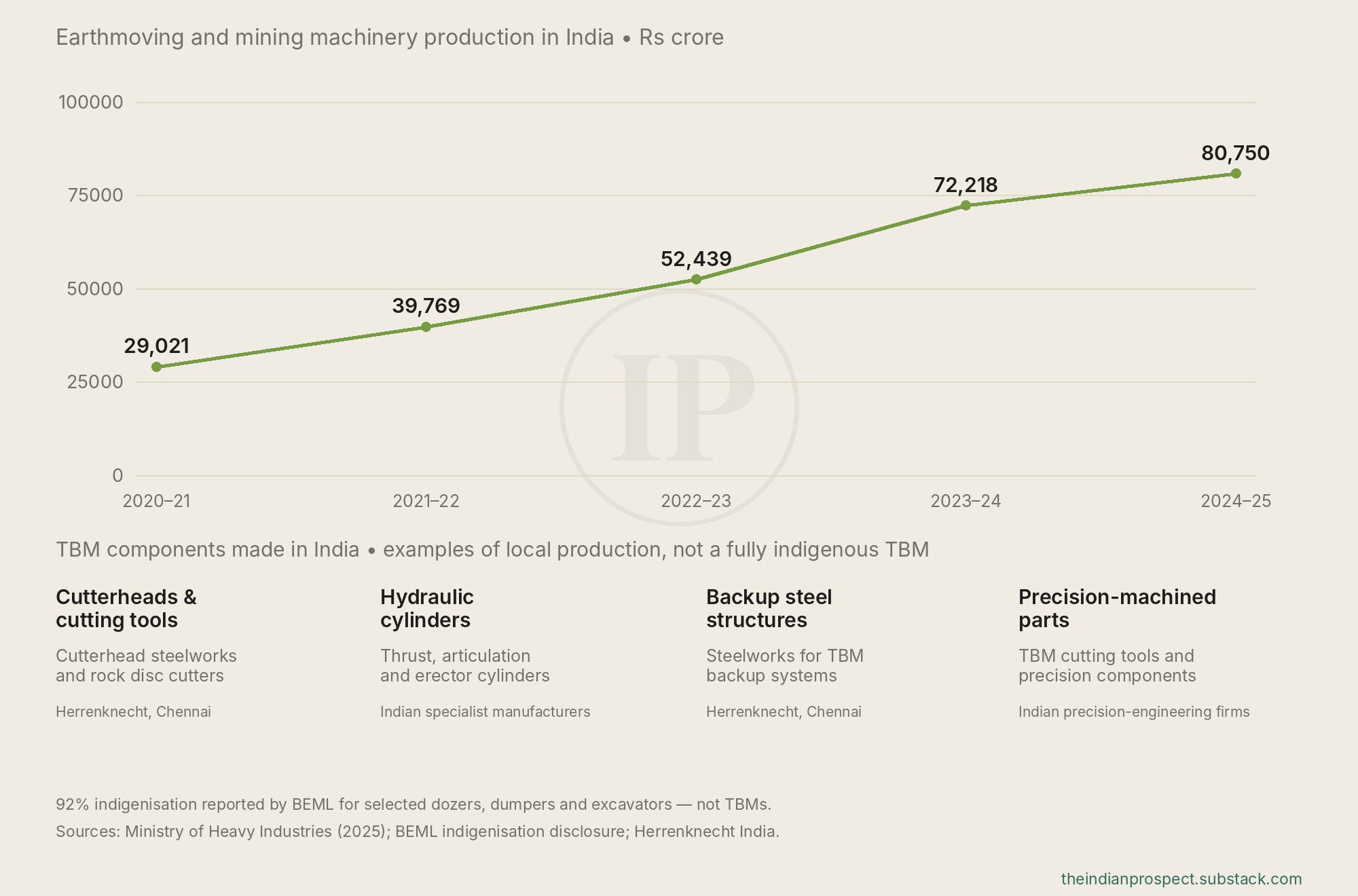
In August 2026, Reuters valued India’s construction and infrastructure equipment market at $ 10.5 billion (Rs 1 Lakh Crore) and ICEMA recorded domestic sales of 1,26,961 construction machines in FY2024–25, with 98% of equipment sold domestically produced in India23. Yet according to the government reply in the Parliament, ₹34,500 Crore worth of equipment are import dependent where ₹30,250 Crore accounts for components and aggregates26. The approved incentives are meant to target these gaps.
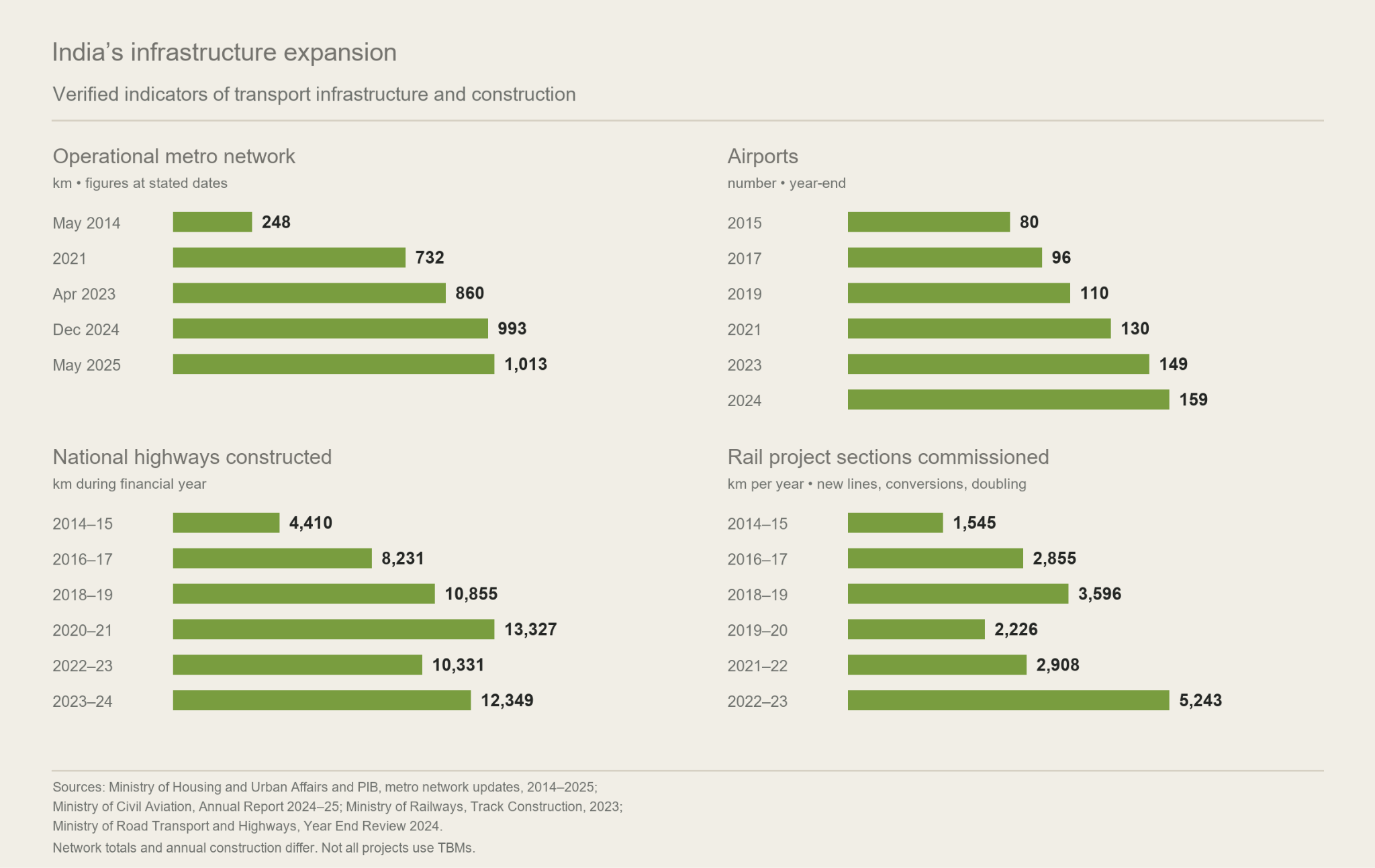
India’s extensive investment in metro systems, railways, roads etc offers a sustained market for advanced construction equipment. Turning that demand into actual manufacturing capability would lead to substantial improvement in the quality of precision engineer and specialist machinery production in India.
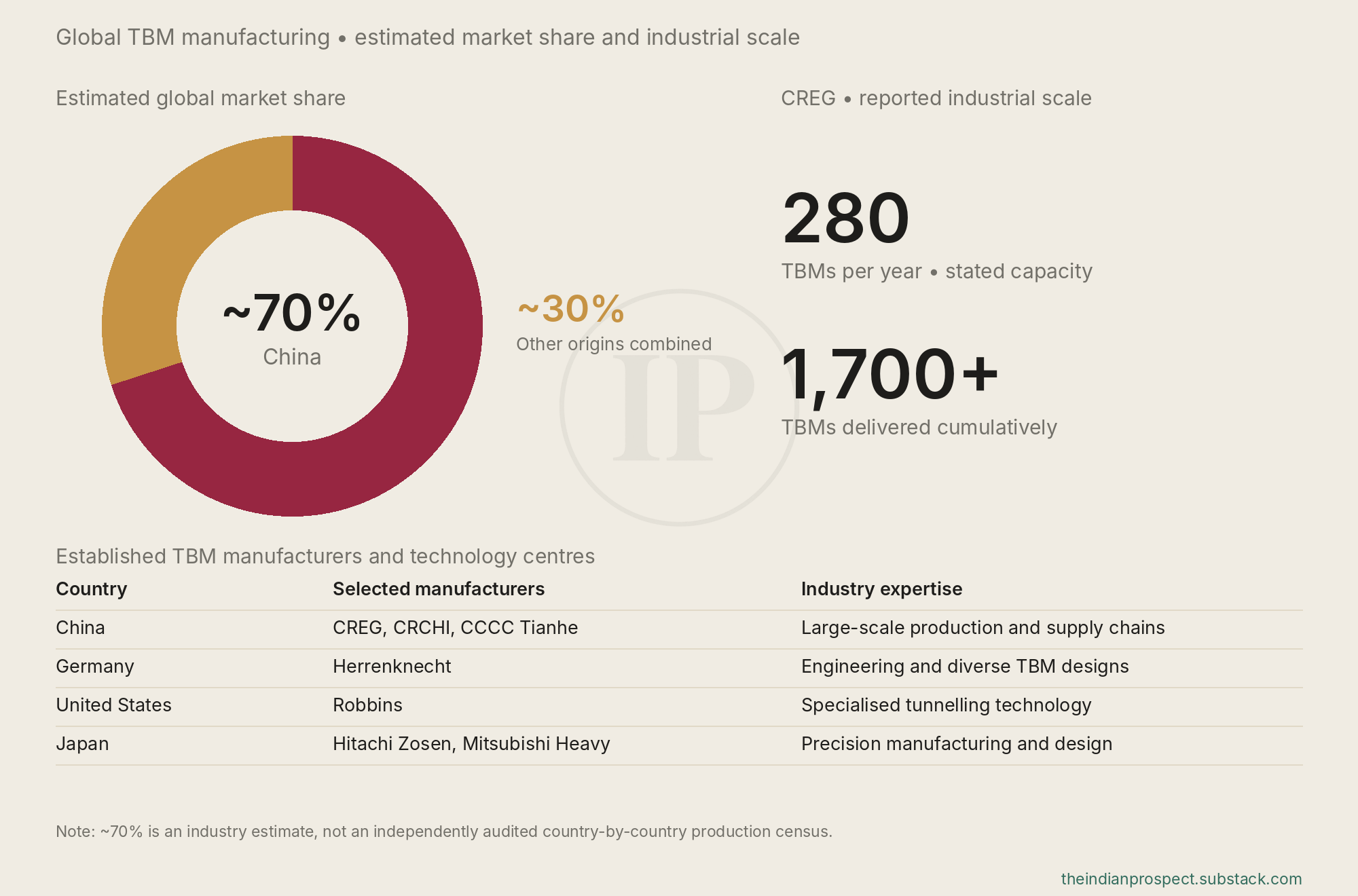
China itself serves as a good example of such infrastructure led demand creation. Decades of investment in metro networks, railway tunnels and other underground projects have allowed Chinese manufacturers to expand production, strengthen domestic supply chains and develop technological expertise. A 2024 peer-reviewed study found that Chinese-made machines were used in 19 of the 24 large-diameter shield-tunnelling projects initiated in China during 2021–22. China’s importance in the global TBM industry15 extends beyond its domestic manufacturers as international firms17 have also established operations16 and partnerships there18, drawn by the scale of the country’s market.
Building India’s TBM Industry
India already has capabilities in key areas such as heavy engineering, fabrication, machining and hydraulics. Herrenknecht has reported manufacturing ten TBMs at its Chennai facility for Chennai Metro8. While, in October 2026, Robbins reported achieving 80–85% localisation in machines manufactured for the Bhopal and Patna metros9. The company is now working with suppliers to manufacture bearings, gearboxes and variable-frequency drives in India, which form critical parts of a TBM’s drive and control systems.
Developing indigenous design capabilities is another area of opportunity. State-owned BEML is working towards developing TBMs based on its own technology and intellectual property13, initially focusing on machines between 3.5 and 6.5 metres in diameter10. Developing larger and more specialised machines, such as the 13.6-metre TBM used for the Mumbai–Ahmedabad high-speed rail project, would represent a further advance in India’s heavy engineering capabilities.
The sales-linked incentives under the newly approved scheme improve the commercial viability of investing in domestic equipment and component manufacturing. The proposed testing facility would also provide manufacturers with infrastructure to test and certify specialised machinery within India.
Joint ventures, technology transfers and foreign investment can bring advanced engineering expertise to Indian firms while supporting local production of components, providing a foundation for developing a competitive TBM industry12.
Given the long history between the two countries, relying on Beijing for critical equipment carries risks that go beyond trade. India’s push for domestic manufacturing to produce advanced machinery at home would reduce dependence on Chinese suppliers and give India greater control over the pace of its infrastructure development.