

Guénon in the Konservative Revolution
Around Leopold Ziegler, with a bit on Edgar J. Jung and Evola.

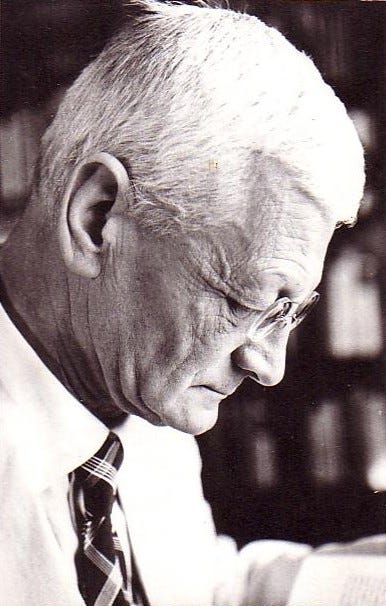
[It is almost impossible to find anything in English1 on Leopold Ziegler (1881-1958), although he was, in his times, considered a conservative figure on par with Oswald Spengler — and as of today, influences the German AFD’s philosopher, Marc Jongen2. A presentation of his Metaphysics of Tragedy, with many translations, is however available at Greg Johnson’s Counter-Currents thanks to the work of Alexander Jacob. Coming back to Ziegler, not to mention his influential works on Buddhism3, the profound mark he left on his friend Edgar Julius Jung, the conservative revolutionary éminence grise of Franz von Papen who fell victim to the Night of the Long Knives due to his plan to kill Hitler4, one can note that he was read and frequented by well-known, important figures: quoted by Walter Benjamin in his Origin of German Tragic Drama (1925), by Ernst Jünger5, by architect Mies van der Rohe in lectures; corresponding with the young Georg Lukacs, presented in a short essays by Hermann Hesse as by Max Horkheimer, participating in great European magazines alongside with prestigious names6, this independant scholar also introduced René Guénon to German audiences, whom he interestingly presents as the potential head of a secret France, akin to the secret Germany of Stefan George and his disciples7. The article in which he did will be preceded by the first pages from Ernest Seillière’s substantial presentation of Ziegler, taken from his work on German Neoromanticism (1927, dating from before Ziegler’s encounter with Guénon’s work) and by quotations translated in a translation of Mies van der Roes Notebooks. It will be followed by Hermann Hesse’s review of Ziegler’s Tradition (1936), by Robert Steucker’s short presentation of his, by an excerpt of H. T. Hansen’s Julius Evola and the German “Conservative Revolution” (2002) in which his links with E. J. Jung are addressed, and by references to the very few other texts of his and about him (mostly reviews) available online in French.]
“In the time between the two world wars, no other German philosopher of history and religion — besides Oswald Spengler and Graf Hermann Keyserling — attained such impact and acceptance as Leopold Ziegler. The more regrettable is the neglect into which Ziegler and his work have fallen in more recent times. And it is with hope for new recognition and evaluation of Ziegler that one opens and reads his latest and perhaps his most important book.”
(review of Das Lehrgespräch vom allgemeinen Menschen, 1956,
in Books Abroad, 1957: Vol 31, Issue 3, p. 291.)

Mysticism and Romanticism: Leopold Ziegler (Ernest Seillière, 1927).
In the last few years, Leopold Ziegler published two major works: Gestaltwandel der Goetter that we can more or less translate as The Evolution of the gods, and Das heilige Reich der Deutschen, the Holy Empire of the Germans. After the apparition of the first of these books, the Frankfurter Zeitung compared the author with Oswald Spengler, whose Twilight [sic] of the West had such an astonishing success around the same time:
“These are two works of the same rank, wrote the critic of the great Rhenish paper, for they spring from philosophers-poets or poet-philosophers who strive not towards abstraction or towards classification only, but towards wisdom, enlightening the moral signification of the world, who do not treat history as minute erudites but tend, through her, to the education of the religious sentiment of the audience, according to their personal views. Ziegler is the prophet of a movement enclosing itself into the catacombs, the bringer of a Germany, of a Europe unforeseen, of a new mankind. Both take place among the greatest writers of their generation. The language of Ziegler in particular is admirable: he struggles, in a faustian effort, to render a soul to present times, to found the religion that will support the man of tomorrow in the fight, etc…”
This parallel with Spengler — which could be completed with a comparison with the Count [Hermann Karl] von Keyserling, whom so many of his fellow countrymen listen to since the war —, imposes itself in a way to the reader of Mr Ziegler, who in fact invites us to. He in fact complains, in his Autobiography, about the bad luck attached to each of his books, who were almost all published, coincidentally, at the same time as other works in the same vein, but of an easier reading, or more proper to flatter the tastes of the public. And the names of Keyserling and Spengler, precisely, come under his pen due to the concurrence made by their two main works to his Evolution of the gods. — In my opinion, the Count von Keyserling, who is very close to him, — having his sources in the same “classical-romantic” German metaphysic — made himself more accessible to the mediocre spirits, due to having recently put his theoretical suggestions in the frame of a remore and picturesque voyage. As for Spengler, his work, more paradoxical, stays very clearly and purebredly imperialistic, prussophile, under a title seemingly disheartened; yet this work is only disheartening for the other Western peoples, for all concurrents of Germany in the world! A considerable element for success, as we can guess! Mr Ziegler, who is of Swabian ascent and does not keep Prussia close to his heart, seems to be more representative of his race than his two imitators. Indeed, all of presend-day Germany doesn’t think like him, far from that. But when it comes to one question he touched or to another, she can always end up sharing the views that I will expose, due to her romantic heredity. I would say that he in fact brought more than one suggestion of 1800s German romanticism to the level of the current scientific progress, in order to make it be adopted by his contemporary and fellow countrymen of 1920.
His most direct and constant inspiration is Friedrich Nietzsche, whom he equals to and sometimes prefers to Buddha. It is not a triviality considering the real cult he devotes to the Indian ascetic, to whom he dedicated a specific work: The Eternal Buddha, Der ewige Buddho. (This o, in German, indeed matches better the Far-Eastern pronunciation). In one of my first writings, almost immediately translated into German, I had already stressed the two alternative inspirations of Nietzsche, the one rational and historicist, the other romantic-aesthetic. The German critique presented me more than once as the continuator of the nietzschean apollinianism and Mr Ziegler presents himself openly as an adept of his dionysiac thought, as expressed especially in his most famous book, Thus spoke Zarathustra, which has the advantage on his other works of not being fragmentary, and to frankly adopt a lyrical tone. Here is a link between us that made the study of his thought, so personal despite the initial influence that I just underlined, much more interesting and attaching to me.
In his Evolution of the gods, he presents the Zarathustra Chapter called The Convalescent (Der Genesende) as the draft for a third Testament, after the Old and New of the Scriptures, as the promise of a third Covenant with some undefined metaphysical Power; a covenant by the grace of which a new era, specifically European (but deep down, Germanic) would come, religiously speaking. His religion is by the way quite particular, as he openly professes a staunch atheism: a superficial one rather than deep, to say the truth, his god being the World (another name for the Nature deified by modern romanticism); which makes his a romantic from the start, if, as I rend to think, romanticism is the present form of naturistic mysticism. Despite the fact that in Germany, the word romanticism has a different meaning than in France, — having been applied to the Right-winged naturists who locate their Eden in the Middle Ages, rather than to the Leftist ones, who locate it among the savages, and far later, in a largely Roman and romanticized Pagan Antiquity, — despite Mr Ziegler not accepting this designation, rather reactionary beyond the Rhine, he constantly gives in to adhere to romanticism, attributing to this word a meaning often more similar to ours (and of mine in particular) than to the one currently in fashion beyond the Rhine. These pages have the main goal of putting these nuances in light, and to show the contacts and persisting differences between the French and German kinds of romanticism.
I mentioned above the autobiography written by Mr Ziegler for the Felix Meiner publishing house of Leipzig, which has been asking distinguished philosophers, for a couple of years already, about the story of their vocation, of their mental evolution and of their personal ideas. Born in Carlsruhe around 1880 (he does not give a precise date), he studied in his home town and, when teenage years came, he felt very strong artistic tastes arising. First and foremost it was music that conquered him: classical in the concert, wagnerian in the theater:
“Here finally could the joyful extatism of my ardent youth be content, he writes, this extatism which, since my prime youth was not nurtured anymore, not even borne by my educational surroundings, and so vigorously repressed by the exigences of common life in modern society. Luckier eras, luckier races knew how to give it full satisfaction with their religious festivities. The theater of my hometown became a substitute for an initiation that used to be given in the holy Eleusis, to the adepts of its profound mysteries. In my better days, it was even superior than the one Bayreuth would have gave me, already spoilt by cosmopolitanianism and cabotinage as it was. Indeed, this Eleusis of Baden, far away from Hellas, lamentably lacked the divine and limitless background, which opened in front of the devotees of Demeter Dionysios and gave them a vital metaphysical support. The musical tragedy of Wagner is able to provide one with a hygiene, but never to become either sacrament or religion.”
His initiation to painting was no less enthusiastic. He had a taste of the seekers of new ways, Klinger and Stueck, Hans von Marées and Thoma, Boecklin and the French impressionists (undoubtedly Manet, Renoir, Degas, Pissaro). In philosophy, Schopenhauer, Hartmann, Langbehn, Houston Stewart Chamberlain were his first masters. The German romantics, Novalis, Jean Paul Richter, Hoelderlin, Kleist made a strong impression on him. — His health went through grave crises several times. He nevertheless became a doctor in philosophy with a thesis on: Western Rationalism and the platonician Eros. At the same time, he was drafting a Metaphysics of the tragic and an Essence of culture, and felt each day more and more in opposition with the German academic philosophy, which he treats in his works with no complacency. He went on to grow through the study of exotic religions, that of China and India especially, through that of the philosophies of Life, James, Bergson, Simmel, and imposed upon himself some in-depth scientific studies in the field of theoretical mechanics. His first writings published before the war are called On the Relations of plastic arts with nature8, the Tyranny of the synthetic work of art9, the Worldview of Hartmann10, and People, State and Personality11. — His more recent works, manifesting the growing maturity of his thought are the ones I mentioned in the first lines of this essay.12
“The symbolistic character of architecture is most definitely emphasized by Leopold Ziegler [in Florentinische Introduktion…, 1912]. For him, the accent in architecture shifts from the emphasis on construction to the development of those parts which are per se structurally undefined, such as facades, ceilings, etc. The lawfulness of matter becomes evident to him in man-made structures rather than in nature. Nature has form, architecture (and sculpture) is form. Since for Ziegler’s metaphysical concept essentially the work of art represents a value, architecture should show only a “necessary minimum of structural elements,” a most outspoken anti-functionalistic attitude.”
(Zucker, The Paradox of Architectural Theories at the Beginning of the “Modern Movement”.)
Ziegler in Mies van der Rohe’s Notebooks (1926).
[Footnotes related to Mies quotes and mentions are put into brackets.]
Nature proceeds from relatively unorganized unity to highly organized unity, goes therefore In all ways from whole to whole and differentiates only to reorganize on a higher level. [Ziegler, Zwischen Mensch und Wirtschaft, pp. 52-53.]
All capitalistic economy is organized economy, that is, a type of production that, by planned dismembering and assembling, dividing and putting together of the work process, alms for greater effectiveness than would be possible without such ordering. 45 and 46 important Ziegler.
Rathenau: The creation of an organic economy is what we need. Ziegler 51
53 on top
53 on bottom
To take and give in one breath.
To differentiate and to Integrate, dissociate without associating
Ziegler 64 on top
[Mies refers here to a paragraph in which Ziegler, in his search for an “organic economic form,” discusses Marxist economics. The passage of which Mies writes “saying of Marx, very good,” indicated as “64 on top,” reads:
“Just as the savage must wrestle with nature to satisfy his needs, to maintain his life and to reproduce, so must the civilized man, and he must do that under all forms of social organization and under all possible modes of production.... Freedom in this area can only exist so far as societal man, the associated producers, regulate their material exchange with nature rationally, bring it under their societal control, in order not to be ruled by its blind power.... But there always remains a realm of necessity. Only beyond that begins... the true realm of freedom, which, however, only blooms forth if it is erected with the realm of necessity as its basis.”
Mies shows a comparable idea of freedom as an understanding of necessity in his concept of the building art, the technical necessities of which must be mastered so that “the world of our creations will blossom from within. We want no more; we can do no more.”]
Saying of Marx, very good, 67 very good, 81, 112-115.
[Ziegler, Zwischen Menschen und Wirtschaft, p. 81:
“The initiated emancipation of the fourth estate, the event of the age and not preventable by any power on earth, leads either to the absorption of the proletariat into the organic economy, or it leads to the chaos of social revolution. There is no third possibility. Either Abbe and his ideological relatives Rathenau and Ford — Or Marx and Lenin !”
Pages 112-115 express themselves in flowery terms as to the phenomenon of this stage,
“where the citizen transforms himself to mousy bourgeois, or where, in the language of Marx, he becomes exploiter of society’s work force and turns profit thief” p. 113.]
Ziegler 233 Impractical work is unsocial
Mensch und Wirtschaft. 23
It has again come to pass that a historical impulse must by necessity activate its counter-impulse, if it does not want to wear itself out.
[Ibid., p. 23:
“...the deliberate rebellion against an economy that claims to be causa sui and thereby wants to make one forget the circumstance that the earth has been entrusted to the human species as domicile and workplace rather than as an object of commercial speculation. And just as the land reform of George, Damaschke, and Oppenheimer places the inalienable world beyond the laws of merchandise, so socialism in the historically valid stance of Marx fights against the abusive habits of delivering human labor to the same laws of merchandise.”]
29. on bottom Death.
[Ibid., p. 29:
“Such a realization of socialism is implied when Henry Ford expressly announced in The Great Today, the Greater Tomorrow: ‘Labor is no merchandise’”
(a reference to Henry Ford, Today and Tomorrow [Garden City, 1926]).]
Ziegler 149
Against use-objects
150 very [Important-crossed out] right, optimal products.
However the functionalists may rationalize their work, it is all the same to us provided we can say yes to their achievements.
[Ibid., pp. 149f.:
“What motivates the imagination and stimulates desire are mainly goods that differentiate themselves from others by the claim that each in its own way is the best of its kind. It is not the most necessary nor the most functional or most comfortable that is viewed as the best and most excellent. In short, we encounter here a mythologically styled instinct that functions like a powerful human sacral system oriented toward desirable goods of optimal rank, optimal value. I need not emphasize here the role played by optimal products in mythological tradition. We all remember the winged sandals, the seven-mile boots, the magic hood, the bag of fortune ... all of which embody the optima of their type and heighten the human capabilities of their happy owners beyond all natural measure.”
[Taken from Neumeyer, The Artless Word: Mies Van Der Rohe on the Building Art, 1991 [1986], pp. 294-296]
René Guénon (Leopold Ziegler, 1934)
[Editor’s introduction] We are publishing hereafter a study of German philosopher Leopold Ziegler on René Guénon, whom we presented to our readers in 1926, when the question of Orient and the West, which has interested the elites for a long time, was posed with special passion in the intellectual world.
René Guénon pursued since then, with the greatest spiritual rigor, the cycle of his metaphysical inquiries, and withdrew in one of his intellectual motherlands. In Egypt, his esoteric thought can go further away from the curiosity of the profane critique. Hence why we find relevant to put before the eyes of our readers the following lines, where one of the main aspect of this thought is presented, under a light that Guénon, most strict in this field, would recognize to be conform to his own views.
We must however stress that, if we are glad to be able to publish this article (whose German version has appeared in the September 1934 issue of the Deutsche Rundschau), naturally we do not allow ourselves to approve the consequences that could be taken from Guénon’s ideas in favor of the current movement of the spirits in Germany. If such is the thought of Ziegler, we will not follow him in this path.
J. B.
An error, still widely common in Germany, consists in believing that the spiritual France of to-day mainly lives off what we call “the ideas of 1789”. Whoever looks at it a bit closer will find many a correction to bring to such a belief; and, in order to uproot its very foundation, one only needs to make René Guénon known to the German reader, as the author in which a France still way too unknown of us found the sharpest confirmation of its doubts, and the clearest expression of things it suspected, more or less obscurely. The work of René Guénon, now equally important in terms of volume as it is in that of the proper value of its content, is turned towards a future that broke ties by principle with the tendencies that have predominated in the West for the last six or seven centuries. Guénon wants to see the time of revolutions, of social emancipation come to a definitive end, and wants to see the opposite process come after, which would be that of general reintegration and “reordering” [une remise en ordre générale]: these ideas remarkably meet with the ones I developed in my article on the German State, published this March in the Deutsche Rundschau. We must finally come back to the eternal order of things, to the universal order ruling both the macrocosm and the microcosm, the only order that ever was and that will ever be. At the base of such a program, our thinker places an idea that we can never take seriously enough: that of an “integral tradition”, the central idea of his entire work.
What shall we understand by that? Mainly a “pure doctrine” — metaphysical, or pure intellectuality [in French in the original: métaphysique ou intellectualité pure] — about the world, God and man, a doctrine that we see being outlined more and more clearly one day after the other, and which has been the common, prehistorical good of mankind, and, anyways, the common good of the highest spiritual expressions of the historical era. Probably of “hyperborean” origins, and transmitted, in prehistorical times, by men of the North to the then inhabited areas, this pure doctrine, among us in the West, has fallen into oblivion more and more since the end of the middle age; it has been rejected over and over by the Renaissance and the Reformation, by science, by the “enlightenment” and by “culture”, and only in very recent times have we “remembered” of it, from all across the spectrum. Very well, will people say at home, in Germany; but all this is not entirely new as long as we can find back in this one of the conceptions of our romanticism which, from Herder and Hamann, keeps trying to penetrate, and this not always unsucceedingly, into the buried strata of our soul and spirit, which are those of the “integral tradition”. But in truth, it is precisely where Guénon seems to come closer to the fundamental thought of the German romanticism that he goes away from it in the most notable way: namely by his very particular method of looking for the traces of the aforementioned tradition. To him, it is an unshakable fact that the integral tradition will never be grasped through the habitual methods and tools of science: that there is thus no decisive result to expect from either the shovel of the archaeologist, or from the documents of the historian, or from the symbols of the mythographer, or from the manuscripts of the philologists, or from the study voyages of the ethnologist, or from the “ancestral remembrance” (Erberinnern) [note of the translator: allusion to certain contemporary racist theories] of the philosopher. One cannot do, of course, without a scientific device of this kind, or of a similar one. But, whatever we do, only the one having a direct tie to the integral tradition, wherever it subsists, living, will be able to go further with safeguards. This case is only present nowadays in the Orient, in the regions where the “pure doctrine”, received of old from the North, maybe in the most distant past, passes from mouth to mouth in the secret orders of brotherhoods and where the rites of initiation or of “spiritual reattachment”, as old as mankind is, are still performed.
Applying such conceptions, Guénon has lived for several years in Northern Egypt, where he continues to draw from sources familiar to him for long, that are for now either dried out for the West, or not flowing again yet. Thus this surprising paradox came to realization, that Guénon could expose on the Cross teachings known by esoteric Islam, which are yet unsuspected among the Christians. Or that he possessed informations of the highest importance on the doctrine of cosmic cycles, of “spheres” and “aeons”, of the platonician “great year”, of the ages of the world and of the “degrees of universal Existence”: a doctrine that was widespread in the Classical Antiquity of Mediterranean peoples, without which one cannot understand in its true meaning any word from the Gospel. Or finally that, in a general view embracing, with an almost unequaled science, the sacred books of China and of India, of Israel and of Egypt, of Arabia and of Persia, Guénon can interpret, with this same primordial doctrine of the cycles, the apocalyptic looking events of our present, without yet getting lost in prophetic or mystagogic pretentions. Hence why, and only thus, that Guénon could publish, under the titles The Crisis of the Modern World and Spiritual Power and Temporal Power, two writings that I could characterize as the most profound and the finest of those treating of man in “crisis”. The most profound and the finest, as I say, because there, it is not an individual talking to us, it is no longer — as a matter of principle — an “individuality” or a “personality”, of whatever level it is, but it is mankind itself that teaches us, about facts and events appearing to be unimaginably more ancient that the little history we possess, as soon as we envision them not in their simple historical reality, but in their deeper meaning. Here the temporal is finally measured with eternal measures; measured, counted and weighted, and considered to be too light. But, under the aspect of the “great year”, it is also reintegrated in the movement and the aeonic cycle of rebirths, outside of which the West tried to escape, as a horse gets carried away, stampeding, going out of his way.
One can yet not sum up the content of Guénon’s works, both very varied and developed; it must be assimilated at the cost of an effort not always negligible. To my knowledge, Guénon is yet only, and this, even in France, but the center of a relatively restricted circle: one of the most important of all centers of cristallization of a regenerated esotericism, just like many are born as if by themselves, all over Europe, however. To us Germans, the notion of a “secret Germany” has always been familiar: these words do not only designated the microscopic but thoroughly chosen elite of those who, silent and unknown, save the heritage of Germandom through the storms of history, but also, undoubtedly, those who feel responsible for the conservation, in Germany, of the entirety of the “primordial knowledge” (Urwissen) of our species, that is to say, of the “integral tradition”. It is possible that a “secret France” will be born under the inspiration of Guénon, and it would not be pure chance that a tie would unite him with the country of the pyramids and of hermetic mysteries. Thus we can only hope that the isolated individuals who, at the present hour, are taken aback by the vision “of a new heaven and of a new earth”, would reach out to one another: for the common good of two peoples who make up the shattered heart of our continent and who, precisely due to the “ideas of 1789”, have been upset with one another for so long, and in an almost irremediable way.
Leopold Ziegler - Tradition (Hermann Hesse, 1936)
LEOPOLD ZIEGLER is an eminent cultural critic and philosopher as well as a vivacious writer; a new work by him may be considered an intellectual event. His latest book, Tradition, is a far-reaching attempt at a complete survey of the spiritual and psychic tradition of mankind for the purpose of unifying this vast mass of tradition from an Occidental and Christian point of view. Ziegler postulates a unity in the human spiritual experience of all times, a new conquest and activation of abandoned and neglected powers of the soul, and also postulates a “catholic,” that is, a worldwide, universally valid Christianity, not a Christianity that drives out and makes war on “heathen” traditions but one that assimilates them within itself. With great understanding and suggestive powers of empathy he explains in the first section the rite, that is, the great system of customs, cultures, magic, and ritual of the primitive stage of mankind—the world of magic. The second section is called Book of the Mythos and the third Book of the Doxa. He champions the claim of the spirit to appropriate the experiences, exercises, and methods of inspired ways of life from all times, all nations and cultures, and out of them to make a new universal wisdom of life for today and tomorrow. Whether this is possible or practical to attain remains a question. In his drive toward universality, in his assumption that there is a supratemporal and supranational common denominator of all human spiritual experience and art of living, he has had many noble predecessors; his wonderful and truly creative Utopia of a universal gnosis has exercised long before his time a magic attraction on lofty spirits in many centuries, and even if his conclusion were “only” a fiction, it would be a noble conclusion worthy of our sincerest attention. But it is more. It is not only a collection of information about magic, about yoga, about cult, myth, and customs of all times, it is a true conjuring up, a true summoning forth and making visible of the hidden, always present world that has never completely faded from human consciousness. Therein lies the living worth and great attractiveness of his book; it is a true seer who wrote it, not simply a scholar and collector. His familiarity with the wisdom of the Orient (some twelve years ago he wrote a widely praised book on Buddha) gives him the ability to see separate things as one, everywhere to concentrate upon the living basic source, not on transitory manifestations. He will be attacked and rejected by the dogmatically entrenched Christians; his universalism breaks through barriers that have always been held sacred by the churches and religious communities of Europe. And in the end it remains more than questionable whether what he understands by Christianity can be combined with the “real” historical Christianity.
But Utopias are not dreams that are to be slavishly turned into reality; they emerge in order to prompt discussion of possibilities that are as difficult as they are desirable, and to strengthen faith in those possibilities. A distinguished and vigorous mind here conjures up within the picture of what is past the spirit of what is to come. There will be no lack of criticism from many sides, for a book of this sort must encounter opposition. But there will be no lack of readers on whom it will continuously exercise an influence—and in a thousand invisible ways it will help to build the future. A short time ago the Italian Giulio Evola published his work Revolt Against the Modern World, which treats almost exactly the same complex of questions but with less freedom and freshness, more pomposity, and is not without occult eccentricities. We consider Ziegler more reliable.13
On Leopold Ziegler (Robert Steuckers, 2015)
November 25, 1958: death in Überlingen, on the shores of the Lake Constance, of German traditionalist philosopher Leopold Ziegler. Born in Karlsruhe in 1881, he would become, in Germany, the proponent of the “primordial Tradition”, but with a lesser success than Guénon in France or Evola in Italy.
To Ziegler, religious, metaphysical and cultural traditions all find their origins in a “primordial revelation” of the divine (eine Ur-Offenbarung des Göttlichen). As soon as he finished his secondary and scholarly studies, Ziegler would become faithful to this vision, and would never cease to deepen it. The initiates know that such a Tradition exists, he wrote, that behind the apparent prolixity of phenomenons, it forms a unity. In 1951, he receives the title of doctor honoris causa of the Faculty of theology in the University of Marburg. In the 1950s, with Walter Heinrich, he attempts to generalize the “traditional method” and to defend the “integral Tradition”.
Lesser known is his role in the 1930s, at the time of the ascent of the National Socialist movement. Friend and éminence grise of Edgar Julius Jung, he wrote a capital work in two volumes, Das heilige Reich der Deutschen (The Holy Empire of the Germans) which sparked his fame in the conservative milieux. Jung took inspiration from it for his work on the domination of lesser-men (Herrschaft der Minderwertigen). In May 1934, an overexcited Jung announces him his project of assassinating Hitler to take his place, in order to save Germany from disaster. Ziegler attempts to dissuade him, giving him the following argument: “The union, in a single person, of the political murderer and of the supreme Guide can only lead the people and the Empire to the ruin.” Jung is killed during the Night of the Long Knives at the end of June 1934. Ziegler escapes to a similar fate thanks to the action of a couple of good Swiss friends who shelter him from the vengeful squads sent after his opponents by Hitler.
Let us note that at the end of the 1950s, shortly before his death, Ziegler takes part in the launch of the magazine Antaios, created by Ernst Jünger, Julius Evola, Mircea Eliade and Ziegler himself.
[…]
Ziegler thought both on the notions of Empire and Tradition, mixing in a sublime synthesis an approach of Buddhism, a reflexion on the Imperium Europaeum, on the European spirit, on the apollinianism of our continent and on the motherly divinities of European mythologies. Imperial and non neo-nationalistic, Ziegler can be compared to Evola, from whom he can be distinguished due to his “feminist” cult of the Muttergottheit. The Holy Empire of the German nation is, to Ziegler, anchored in the history of its migrations, themselves presided over by the restless, ever-wandering or ever-on-a-quest divinity Wodan. But after having arrived to Rome, the Germans inherited the heavy task of reinstoring the pax romana. To Ziegler, this can only be achieved through an intense collaboration between all peoples of the continent:
“On a continent with a historical structure such as ours, never will a nation alone be able to pretend to the exercise of a political supremacy over all the others. Here is an axiom for present times just as for the future.”
Ziegler and Edgar J. Jung (T. H. Hansen, 2002)
[Excerpt from Philippe Baillet’s preface]
At the same time as [his contacts with the völkisch milieux] (see the articles he published between 1932 and 1934 in the magazine of the Herrenklub), Evola furthered his contacts in the German and Austrian nobility, as with the “Young-Conservatives”. In conformity with his innermost temper, entirely foreign to the logic of apparatuses and to rigid structures of belonging, he constitutes himself a network of relationships, favoring direct ties and personal contact. When it comes to his many relations within the Germanic conservative groups, the most astonishing and puzzling point in T. H. Hansen’s work is the demonstration of the close ties between Evola and Edgar Julius Jung, ghostwriter of Franz von Papen and inspirer of the famous Marburg Speech (17 June 1934), final “proclamation of faith” in a “ghibeline” and conservative Germany that underestimated the National Socialists for too long. Also important is the information given by the author about the friendship between Jung and Leopold Ziegler, the man who tried to make the work of René Guénon known in Germany.
[…] But the member of the Herrenklub to whom Evola was the most deeply tied was undoubtedly Edgar Julius Jung (1894-1934), author of the then classic work Die Herrschaft der Minderwertigen (The rule of the inferiors, 1927), of Sinndeutung der Deutschen Revolution (Meaning of the German Revolution, 1933) and of a whole series of articles published in journals and magazines. E. J. Jung was then the herald of the “Young-Conservatives” (Jungkonservativen), as defined by Armin Mohler. Mauersberger defines him as a political “gambler”, which might be a bit extreme. The philosopher Leopold Ziegler (1881-1958), on his side, said once that it was the “most resolute, the most coherent, the most courageous and the most intelligent opponent to Hitler”.
In 1924, Jung founded a small secret troop that shot to death Heinz Orbis, head of the Palatinate separatists. He took upon himself the entire responsibility of this action, despite the fact that he was not its executor. Let us recall that at the time, the Palatinate was under French occupation. Convinced that he was to be able to count on the considerable financial means of the great industry (among which I. G. Farben), Jung founded his own movement called Neue Front in 1927, supposed to federate a whole series of then scattered groups.
He also conceived a sort of Order that would take the lead of the State, both spiritually and administratively. In this he took inspiration from the Ordenstaatsgedanken [conception of the State as Order], just like Evola, Ernst Jünger, Alfred Rosenberg and Carl Schmitt. In the thesis he devoted to him [E. J. Jung, Papenkreise und Römkrise 1933-1934, Heidelberg, 1966], Karl Martin Grass considers that Jung, despite his pragmatism, placed the origin of his political action in the “metaphysical domain, imagined in a transcendental way” and that, according to him, the mobiles of political action took root in “a domain located beyond reason”.
One can see here an obvious affinity with the thought of Evola, both of them being influenced by Plato. Typical of Jung was his interest for Othmar Spann’s (1878-1950) ideas and his aspiration to unite the “totality” (Ganzheit) of intellectual and social forces. Bernhard Jenschke agrees with this judgment and talks about “Jung’s profound conviction” according to which “a real change of the communitarian life is only possible if based upon a religious foundation” (Zur Kritik der konservativ-revolutionären Ideologie in der Weimarer Republik : Weltanschauung und Politik bei E. J. Jung, 1971, p. 74). This author also insists upon the “universalist conception of the community in Jung” (pp. 86 sqq.).
In the correspondence between Jung and Pechel, published by Mauerberger, Jung stresses the fact that he was helped by the Krupp firm, but that he also, probably, counted on the support from Bosch. More than with a party, Jung believed he had to act with the help of his “Order”, but in the backstage. Great industry, on its part, counted upon him to constitute a powerful movement against Hitler. In a letter from December 23, 1930 to Pechel, Jung writes:
“Naturally in the West, a National Socialist psychosis reigns, and Adolf Hitler again benefited from his habitual waves of enthusiasm. But aside from that, there is the simple reality of my influence, stronger than ever. […] It is a fact that I represent, as of today, one of the rare oppositions to National Socialism. But only at the condition that I do not get carried away into a ridiculous fight against Hitler. My task is precisely the contrary.”
In a letter from September 5, 1929 to the head of the Rheinisch-Westfäilische Zeitung, Jung already affirmed:
“As for my position about fascism, I have to say confidentially that the whole goal of my political life goes to the creation of a dictatorship. I only warn against a dictatorship devoid of meaning, which would be unbearable to the German people. Such is the motive of my desperate efforts to underline the meaning of the organic State, through a spiritual deepening.” (quoted by G. Merlio, ‘E. J. Jung et l’illusion de la “Révolution conservatrice”,’ in : Revue d’Allemagne n°3/XVI, 1984, p. 395, note 1).
In 1932, a member of the Herrenklub, Franz von Papen, is named Reich chancellor. Von Papen naturally has the support of the old Prussian ruling class and of great industry. Upon Pechel’s advice, he takes E. J. Jung as a private secretary [see Yuji Ishida, Jungkonservative in der Weimarer Republik : Der Ring-Kreis 1928-1933, 1988, p. 218]. Jung finds himself in an extremely influent position, especially since one of his tasks is the redaction of the chancellor’s speeches. One must specify that von Papen went as far as to publicly adhere to the political ideas of Moeller van den Bruck, of Leopold Ziegler and of Edgar Julius Jung [in his Appel an das deutsche Gewissen, Oldenburg, 1933]. He also knew very well Othmar Spann’s conceptions.
There is no doubt that Jung was in very close and friendly contact with Evola. That is confirmed by Jung’s childhood friend Edmund Forschbach, who writes in his Edgar J. Jung : Ein konservativer Revolutionär (Pfullingen, 1984, p. 85) that Evola was, among all the people from abroad that Jung knew, the only one with whom he maintained regular correspondance. Leopold Ziegler too, who promoted the ideas of René Guénon in Germany, and the author of his 2-volumes-long Das Heilige Reich der Deutschen (Darmstadt, 1925), wrote in a letter from June 9, 1951 to Walter Heinrich (1902-1984), then a professor in Vienna:
“Evola! Until then I only knew him by name. But he had found a way to reach my assassinated friend Edgar Jung; he wanted to create a Ghibelline party with him. Jung had the very serious intention to present him to me.” (Briefe 1901-1958, 1963, p. 208).
Considerations on the holy Grail follow.
In his book, Forschbach puts an important aspect under light, which confirms the close relations existing between Evola and Jung: when he quotes (p. 118) some parts from the famous Marburg Speech, pronounced by von Papen, then vice-chancellor, but mostly written by Jung, in which the totalitarian aspirations of the National Socialists are vigorously and very clearly denounced. This speech was pronounced on June 17, 1934, when Hitler was already head of State since January 30, 1933. The consequences didn’t take long to come, and were ruthless. Von Papen was forced to resign and Jung was assassinated by a group of National Socialists during the “Night of the Long Knives” (June 30, 1934), despite the fact that there was no link between him and Ernst Röhm. In this context, it is not uninteresting to learn that later, on the nazi side, it was stressed that Jung was executed due to his contacts abroad. In the Marurg speech, ultimate and too late attempt of the conservative opposition to resist the absolute grasp of Hitler upon the power, von Papen declared:
“What needs to be kept in mind about what is flourishing today in Europe in the best and noblest minds, is some sort of gestation of a new Ghibelline party” [translated from the somehow inaccurate French translation; see note 13] (Wer darüber unterrichtet ist, was sich in Europa heute in den besten Köpfen und den edelsten Seelen vollzieht, der fühlt förmlich, wie eine neue Ghibellinen-Partei in Europa zu keimen beginnt).14
Any reader of Evola will recognize here some of his ideas; to Forschbach too, there is a clear reference to the evolian reasonings here. Moreover, this sentence perfectly matches the previous excerpt taken from Leopold Ziegler’s letter to prof. Heinrich. In his speech, von Papen in fact talked about the “Third Reich” too, about the “Reich of the Holy Spirit”, precisely like the medieval monk Joachim of Flora who, in his visions, saw it be born after the “Reign of the Father” and the “Reign of the Son”. [fleur’s note: a quick search into the original text shows no sign of either expression in the Marburg Speech.]
It is in this context that we must take into consideration an excerpt from the letter sent by Leopold Ziegler on April 10, 1951 to his friend, psychiatrist Ludwig Binswanger, which brings further light, assuredly unsuspected:
“Again fear of the death known in this night, which preceded my flight to Kreuzlingen, assails me. Around the evening, my wife managed to have confirmation of the uncontrolled rumors on the capital execution of Edgar Julius Jung in the night of the June 30 purge. Among all German political figures, he was the one I had been the closest to; we pursued, for our people and its State, goals similar to the point of identity. On the Pentecost, we evoked again, with inconsiderate clarity, Jung’s project to kill Hitler. Some of my letters, even if written in a prudent manner, must have been found among Jung’s correspondence. In short, there was good reason to feat that I would have shared Jung’s fate — and all the more since in Spring, I went again to Sorrente at Jung’s demand, in order to meet with vice-chancellor von Papen with the intention of ‘opening his eyes on Hitler’”. (op. cit., p. 209).
The friendship between Jung and Ziegler went back to the end of the 1920s. But they did not personally meet until 1931, in Jung’s flat in Munich. In order to support Jung’s efforts, Ziegler even declared himself ready to present his own thought in a summarized way. This gave birth to the leaflet Fünfundzwanzig Sätze vom deutschen Staat (Twenty-five theses on the German State, Darmstadt, 1931). The only disagreement between the two men fell upon knowing whether Jung, after Hitler’s assassination, would be able to take the lead of the country. Ziegler did not think so, but questioned his choice later, asking if, with such a sharp judgment, he had not intervened negatively upon the course of history (cf. Martina Schneider-Fassbaender’s biography, Leopold Ziegler : Leben und Werk, 1978, pp. 150-159, and Thomas Seng’s Weltanschauung als verlegerische Aufgabe : Der Otto Reichl Verlag, 1909-1954, 1954, pp. 250 sqq. and 509). […]15
Articles by Leopold Ziegler, translated into French
‘René Guénon,’ in Cahiers du Sud, July 1935, pp. 584-588.
‘La crucifixion cosmique,’ in Hermès, 3, 1937, pp. 54-58.
‘René Guénon et le dépassement du monde moderne,’ in Études Traditionnelles, Nos 291-292-293, 1951, pp. 209-212.
[part of an article on ‘The influence of Guénon in German-speaking countries’ is a critical account of this article, also presenting the figure of Ziegler; see Vers La Tradition, N° 122, 2010-2011, pp. 20-30.]
On Ziegler (in French)
Review of his article on Avenarius in Logos, t. 2, 1911-1912,16 in Revue de métaphysique et de morale, January 1914, p. 26.
On his article ‘The metaphysical war’ from the Frankfurter Zeitung, in Journal des débats politiques et littéraires, 19 November 1914.
Ernest Seillière, New morals and religions in Germany: Neoromantism beyond the Rhine river, 1927, ‘Mysticism and Romanticism: Leopold Ziegler,’ pp. 197-274 [sub-chapters: Essential definitions; Ancient German mysticism; Modern German mysticism: Romanticism; The future German mysticism].
Review of Gestaltwandel der Götter (Metamorphosis of the gods) and Das heilige Reich der Deutschen (The Holy Empire of the Germans), in Mercure de France, October 1927, pp. 485-488.
Review of Magna Charter einer Schule (The Great Chart of a New School), in Mercure de France, January 1929, pp. 474-475.
Review of Der europäische Geist (The European soul), in Revue d’Allemagne, January 1929, pp. 658-659.
On Ziegler receiving the Goethe prize, in Mercure de France, October 1929, pp. 230-232.
On Ziegler’s pagano-christian syncretism in Das heilige Reich der Deutschen, in La Vie intellectuelle, 10 July 1934, p. 188.
Review of Überlieferung (Tradition, 1936), in Comœdia, 22 November 1941.
André Préau, ‘The technical age according to Martin Heidegger [Holzwege, 1950] and Leopold Ziegler [Die neue Wissenschaft, 1951],’ in Cahiers du Sud, January 1953, pp. 93-102 [99-102 for Ziegler].
Sophie Latour, ‘The archetype of the Androgynous in Leopold Ziegler,’ in L’Androgyne, Cahiers de l'hermétisme, 1986 [reed. 2003].
Marc Sagnol, ‘Tragic and sadness in Walter Benjamin, in XVIIe siècle : bulletin de la Société d’étude du XVIIe siècle, 1 October 1995, pp. 727-744 [contains a short description of Ziegler’s Zur Metaphysik des Tragischen pp. 732-734].
H. T. Hansen (Hans Thomas Hakl), Julius Evola and the German ‘Conservative Revolution,’ 2002 [see supra].
Thouard, ‘Ecrire l’histoire intellectuelle hors des cadres : les Enfants de Georg Simmel,’ pp. 133-134.
With the exception of a couple articles on Traditionalists, A Blog for the study of Traditionalism and the Traditionalists moderated by Mark Sedgwick.
Who wrote the foreword to the second volume of Ziegler’s Complete Works, containing the Gestaltwandel der Götter, 2002, the entries dedicated to Leopold Ziegler and Ziegler’s Überlieferung [Tradition, 1936] in the Kindlers Literatur Lexikon, but also dedicated a thesis to “Non-forgetfulness of tradition and truth in the transhistorical eon; Outlines of a hermetic interpretation of the present following central motifs in Leopold Ziegler and Peter Sloterdijk” (Nichtvergessenheit Tradition und Wahrheit im transhistorischen Äon ; Umrisse einer hermetischen Gegenwartsdeutung im Anschluss an zentrale Motive bei Leopold Ziegler und Peter Sloterdijk) in 2009.
See Magub, Edgar Julius Jung, right-wing enemy of the Nazis : a political biography, 2017. Two of his works have been translated into English: The Significance of the German Revolution (1933), Arktos, 2022, and On the Threshold of a New Era (1930), Imperium Press, 2023.
“I owe the word ‘Gestaltwandel’ to Leopold Ziegler – as well as a conversation about The Worker, shortly after it was published. We were near the refuge above the Goldbach Chapel, where I now turn to these notes with a good view of the lake.” (1993, translated by the Jünger Translation Project.)
Such as in Richard Kroner’s Logos, in Karl Anton Rohan’s Europäische Revue alongside with Schmitt, Evola, Thomas Mann, Hemingway, C. J. Jung, Montherlant, Hofmannsthal and many more, and after WW2, in Antaios with Jünger, Eliade, etc.
See Norton, Secret Germany: Stefan George and His Circle, 2002, Jesi, Secret Germany, Myth in Twentieth-Century German Culture, 2023 [2021], and Baigent, Secret Germany: Claus Von Stauffenberg and the Mystical Crusade Against Hitler, 2008 [1994].
[‘Über das Verhältnis der bildenden Künste zur Natur,’ in Logos. Internationale Zeitschrift für Philosophie der Kultur 1 (1910/11), pp. 95–124.]
[‘Wagner. Die Tyrannis des Gesamtkunstwerks,’ in Logos. Internationale Zeitschrift für Philosophie der Kultur 1 (1910/11), pp. 371–404.]
[Das Weltbild Hartmanns. Eine Beurteilung, 1910]
[Volk, Staat und Persönlichkeit, 1917]
Seillière, Morales et religions nouvelles en Allemagne : le néoromantisme au delà du Rhin, 1927, pp. 198-201.
My belief : essays on life and art, 1974. Also see Arthur Liebert’s short review in The Philosophical Review, 47(1), 1938, p. 56:
“A metaphysics of history in a universal sense is likewise offered us by Leopold Ziegler in his comprehensive and thoughtful work, Ueberlieferung (1936). The basic idea of this book is that historical development represents the self-development of man. But the concept of man must not be taken in an empirical or sociological sense. The ‘eternal man’ is involved. This eternal man has the roots of his being in God. If we reflect on the famous Platonic doctrine of Reminiscence, we know that we have the foundations of our existence in the absolute. In one respect, true human development is the ceaseless act of our return to God; in another respect, it is the mysterious self-realization of God in man. The absolute peak of this process was reached when God became man in His Son. Therefore, Christianity occupies a unique position in the whole course of history. The deepest meaning of this process expresses itself in “belief in the cross” and “love for the cross”. Obviously, we have in Ziegler a notable renewal of ancient ‘gnostic’ thoughts. And one finds in this renewal a noteworthy sign of the trend of contemporary religious philosophy. There is no question of strictly rational thought. Logical, mystical, and dogmatic lines are so combined in it, that the ordinary, empirical reality of history is built up into a legendary picture. And, perhaps, we apprehend history and our own lives most deeply and truly when we do not look upon it with trivial, empirical eyes, but regard it as legend and myth. And Ziegler’s work affords an almost classic example of such a conception of history.”
[See the full speech here, p. 11 (10 of the .pdf), or there.
An automatic translation of this part would be: “Anyone who is aware of what is taking shape today in Europe within the finest minds and noblest souls can literally sense how a new Ghibelline party is beginning to take root in Europe—a party that embodies the ideal of that fundamental aristocratic concept of nature of which the Führer speaks, and which is driven by a longing for a happy continent. To be a reformer means to look beyond temporal advantages and prejudices, to strive for those eternal orders that have lived on in the longing of the best throughout all ages and among all nations.”]
H. T. Hansen (Hans Thomas Hakl), Julius Evola et la “Révolution conservatrice” allemande, Les Deux Étendards, 2002, online excerpt.
In a note from Luft’s article, ‘Husserl’s Theory of the Phenomenological Reduction: Between Life-World and Cartesianism,’ 2004:
“While it is known that Husserl, in trying to reveal this natural life-world, is influenced by Avenarius’ notion of the “natürliche Weltbegriff,” it is historically interesting to mention that in a treatment of Avenarius’ philosophy, the philosopher Leopold Ziegler, in his essay “Ueber einige Begriffe der ‘Philosophie der reinen Erfahrung’”[On Some Concepts of ‘Philosophy of Pure Experience’], in Logos II (1911/12), Heft 3, pp. 316–49 (in Husserl’s library), uses precisely the term “reduction” to characterize the movement necessary to uncover this “world”:
“[T]he plan of an intentionally ahistorical comportment towards the world is not easily carried through. A brief reflection must teach the philosopher the impossibility to just simply think about the world. For what is the world?...Suddenly a task of its own difficulty arises before the thinker. That is, to lead the ‘world’ back [zurückführen] to such simplified basic notions, so that it in its totality becomes manageable [handlich] to thought, manageable [handhablich] for human spirit. On this first reduction, which necessarily has to be carried through in the development of any philosophy, depends not only its further conception [Durchbildung], its organization; rather, it remains also guiding [bestimmend] for the relationship and the contradiction between schools and directions, which history enumerates. The simplification, violent as well as unavoidable, of the ‘all and everything’ to original, complementing notions such as infinite and finite, moving and resting, becoming and being, one and many, temporal and eternal, being-for-itself and being-for-us, conscious and unconscious, body and soul, thinking and being, state of affairs and object— this simplification shows to the connoisseur [Kenner] a multitude of systematic accounts and historical philosophemes, which in all parts are governed by the reduction of beginnings. Perhaps no thinker other than Avenarius has so much tried to make the effort, as theoretically unsuspiciously as possible, to break reality down into a number of last basic notions” (316f., my translation).”