


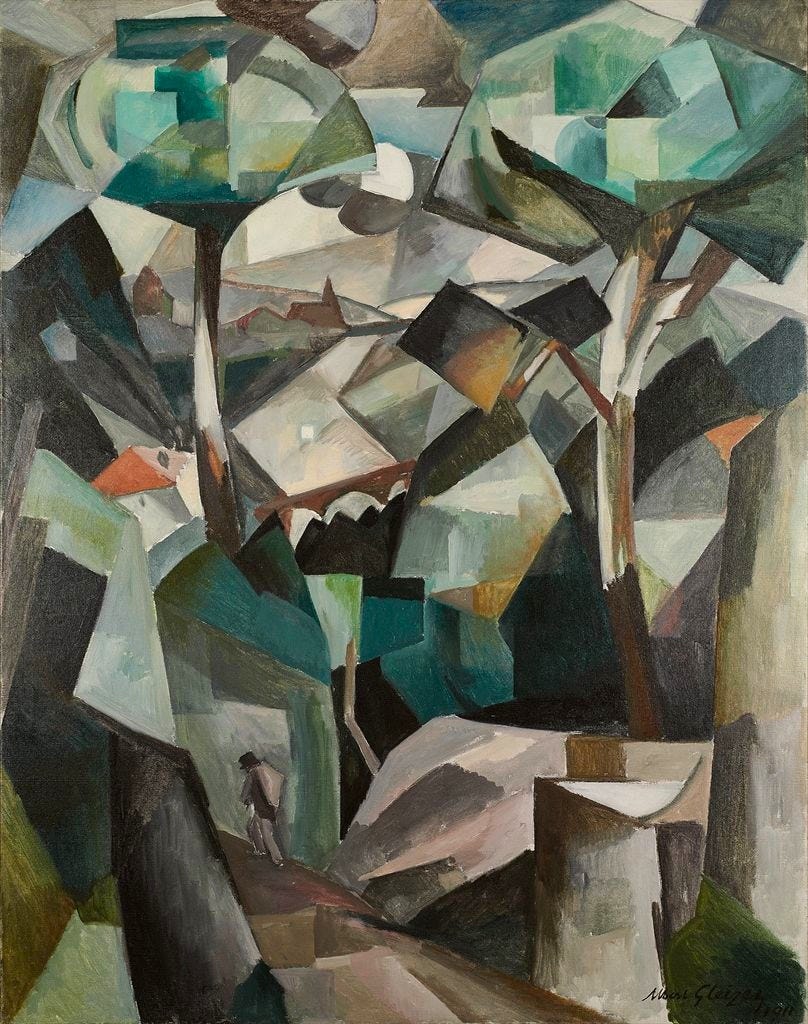
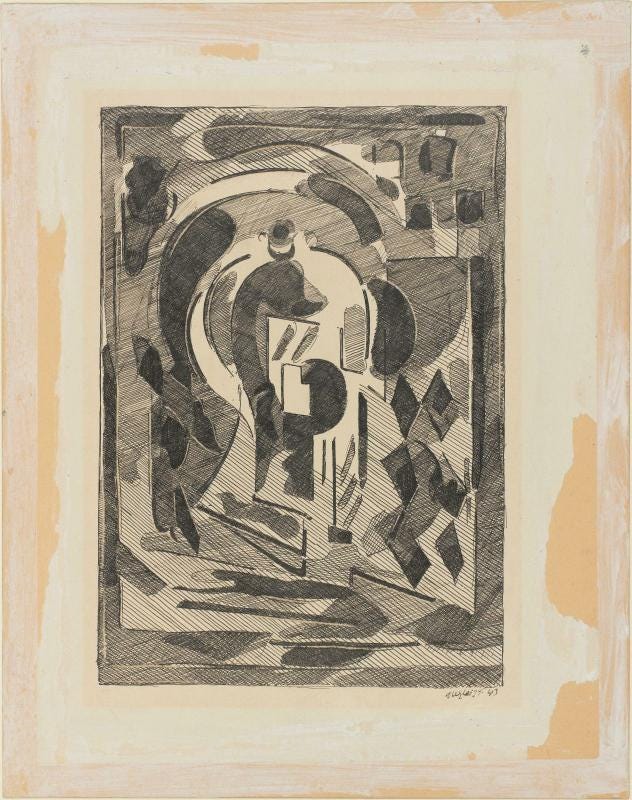
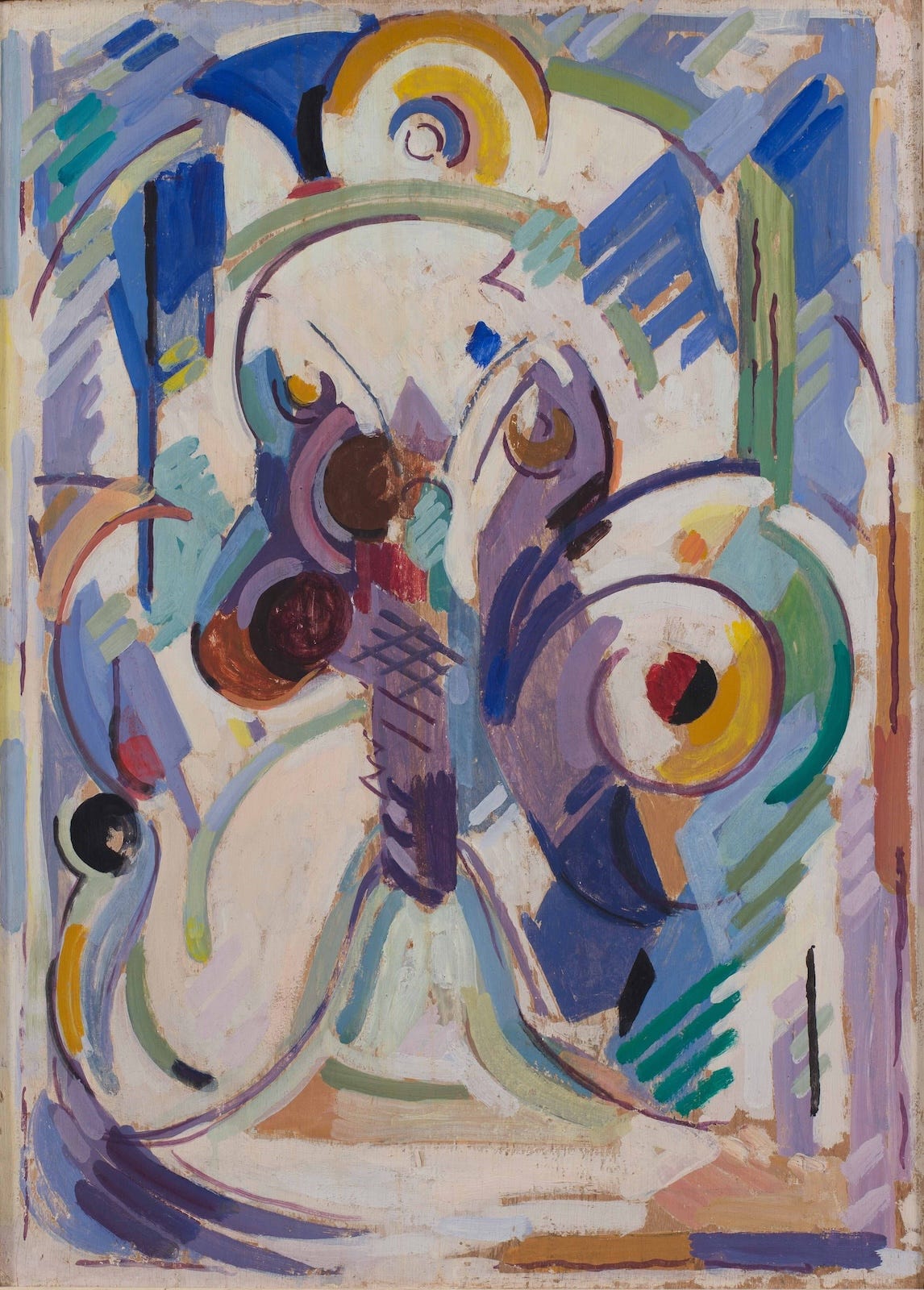
[Albert Gleizes (1881-1953) is a rather unknown name today, yet he was one of the leading figures of cubism, having not only painted in this fashion but also co-authored the first work dedicated to this movement in 1912, with another figure of the movement, Jean Metzinger. His path is interesting in many regards: he was not only a painter but a theoretician and critic, and would later turn to sacred art without abandoning abstraction. He was particularly influenced by René Guénon from the 1930s on, was a correspondent of his and of Ananda Coomaraswamy, and would convert to Catholicism in 1941. The following text examining Dada, from 1920, is reproduced from Motherwell (ed.), The Dada painters and poets : an anthology, 1981 [1st ed. 1951], and will be followed by a translation of three short reviews, two concerning Albert Gleizes, one his followers, by René Guénon, and by a bibliography of his writings available in English.1]
“I know well the author of the article on the interlace, Albert Gleizes; it is a painter, certainly very intelligent and with many interesting ideas, although he may not always be able to express them with all due clarity.” (René Guénon to Tony Grangier, 25 October 1935.)
The Dada Case
As long as those who were subsequently to instigate the Dada movement produced in isolation, taking individual responsibility for their work, they created very little stir in the so-called enlightened world. Public opinion, which is merely a collective neurosis, failed to crystallize around these scattered persons. But, from the day when the Dada label was affixed to their “productions,” everything changed. What had been invisible became visible. What had been known to a few, became manifest to all. The press, which never devoted four lines to a Dada individual, opened its columns to the new association. The socio-diplomatic salons where the stars of our artistic fashion are created, anxiously followed the developments in the affaire Dada. The prophets of our so-called French society—that is to say, the authors of articles monopolizing the “French” spirit—trembled at their own uncertainty as to the destinies of this new aspirant to the avant-garde of modern ideas.
Most of the articles purporting to give information about the Dada case revealed the same blindness to its significance. The Dadaists are called fakers, ignoramuses, idiots; they are accused of producing a kind of a priori advertising. No attempt is made to see them in their proper place, to look behind appearances. Only Lenormand has written an article showing a certain penetration, avoiding the usual scepticism of the man-about-town, and actually seeking a logical key to the mystery. Lenormand’s explanation is in part sound. But since he knew very little about the Dadaists personally, his arguments remained inconclusive. He saw the Dadaists from afar, communicating with them by mail. That is why it seems worthwhile to round out the picture by a special study of the dominant elements in Dada.
Let us proceed methodically, considering the Dada agitation in relation to the epoch. It cannot for one moment be denied that we are now at a great turning-point in the history of mankind. In every country a hierarchy, the hierarchy of bourgeois capitalism, is crumbling, powerless to recapture the reins of power. Events have proved stronger than men, and men are being tossed this way and that, with very little idea of what is happening. The political parties from the extreme right to the extreme left continue to accuse one another of every crime. They cannot get it into their heads that responsibility is an idle word when applied to man, and that superior forces which scientific investigations have not succeeded in fathoming act upon the species far more strongly than any supposed individual will. This bourgeois hierarchy which has organized the economic system on a material plane sees nothing but its threatened class interests. It has reached such a degree of impotence that it can no longer conceive of a system which might provide a safety valve for the ever-mounting pressure in the lower parts of its organism. On the contrary, it constantly increases the pressure, having lost all conception of a possible breaking-point.
On the material plane this bourgeois hierachy is already dead; what we see now is the decomposition of its corpse. The movement with which it still seems to be endowed is merely the wriggling of the worms that are devouring it, and the glow which prevents the night from being complete is the phosphorescence that we know as the will-o’-the-wisp.
Here let it be understood that “bourgeois hierarchy” is not meant in any demagogic sense. The mania for classification has created certain distinctions whose reality is purely an appearance, and our demagogues use them as a basis for telling the lower classes that they have nothing in common with the upper classes. If they do this for reasons of strategy, it is understandable, but if they are simple-minded enough to believe what they say, it’s too bad for them. The bourgeoisie is the expression of a human leaning towards the bestial enjoyment of material realities. And as the division of wealth—an economic conception—is based on money, it is to the power of money that the goods of this world belong. In the human struggle, those who have this power are on top, those who do not possess it but who have the same desire to possess it for the same ends, are on the bottom. Consequently the bourgeois spirit is not peculiar to any special class, but is common to the whole of society. The last scavenger of cigarette butts has the same impulses as the financier who makes peace or war, all that separates them is a simple matter of realization.
The collapse of the money-base and the increasing shortage of goods—these are the factors that are undermining the whole social organism. The cataclysm seems inevitable. There will be nothing ideological about it. From the point of view of the human consciousness, it will be quite simply a rebellion of the stomach and an exasperation of the desire to enjoy life. And indeed, every class of our decomposing society is characterized by an urge toward the satisfaction of every physical desire, and by a total lack of constructiveness or organization.
This engulfing materialism, which is so typical of our bourgeois society, quite naturally prevents us from paying serious attention to the disintegration on the spiritual plane, since spiritual values are what count least in a regime of this sort and the word spiritual has taken on an air of waggish insignificance, living on services rendered and on jokes.
However, it is by juxtaposing the rot on the material plane with the rot on the spiritual plane that we shall gain an accurate understanding of the Dada movement. I am even prepared to say that it is easier to follow the course of this movement than that of the material crisis. Its organism is simpler than the complex of material forces.
The decomposing material body of the bourgeois hierarchy has its counterpart in the decomposition of its spiritual values. The material body returns to dust, the spirit returns to the void. The Dada movement is not the voluntary work of individuals; it is the fatal product of a state of affairs.
Hence it is impossible to accuse the Dadaists of lacking sincerity. If we accept the current conception of what is intelligence, the Dada leaders are intelligent, some of them very much so. Moreover, they are not so very young, and this should be some reassurance as to their honorable intentions.
They are products of the wealthy upper bourgeoisie, and we know that wealth confers possession of the goods of this world, with a view to sensual enjoyment. Even though the environment in which they have developed has stamped them irremediably, we cannot very well hold them responsible for the class into which they were born.
Being intelligent, they have desired to possess not only material goods, but spiritual goods as well. Gifted with a certain dexterity, even a very young man can convey an impression of spirituality. The upper bourgeoisie is quite flattered to discover among its own a man sufficiently intelligent to keep his mind occupied for a while. Between Edmund Rostand and the Dadaists, there is no insurmountable barrier. It is always the word, the spoken word, and the same mental undernourishment. The same devotees who swooned over Rostand already have their big toe on the step of the Dada car.
At the source of the Dada spirit, we find an adroit utilization of spiritual values once combatted, but now grown fashionable. Then various new impulses brought a sudden revelation. The need to be first became a dogmatic tenet, bringing with it further madness. And to these diverse psychological states correspond a series of pathological states. The abuse of pleasures of all sorts brings the search for artificial stimulation of the senses, to the lashing of the nervous system with liquor and drugs. Result: the total loss of control over the physical organism.
Prior to this stage, what does the individual offer? An intellectual suppleness, yes, but no extraordinary sensibility; a certain savoir-faire but nothing to suggest any latent constructive temperament. During this stage and after, he has the illusion of being liberated from the physical laws that govern us. This is a familiar adjunct of the hypnosis induced by drugs, but it is more serious when the illusion is prolonged past the crisis. It is at this moment that the domain of Dada opens. The impossibility of constructing, of organizing anything whatsoever, the absence of even the most confused notion of any such construction, has led Dada to decree that there is no such thing and that the only solution is to do anything, no matter what, under the guise of instinct.
But instinct would seem to be a psychological command which must be translated in order to be properly executed. In the vegetable kingdom or among the lower animals living in the wild state, command, translation, execution are simultaneous, the instinct is manifested free from all constraint. Among the domesticated animals and man, entangled as they are in the mesh of ideas, this simultaneity never occurs in what I would call the waking state. Certain exceptional circumstances are needed before instinct can free itself from its contingencies; these circumstances depend on events and automatically restore the savage state. Consequently disorganization of the practical human conventions is by no means a manifestation of instinct. Such a reversal of values cannot be attributed to instinct, except perhaps to what has improperly been called the instinct of destruction, which in truth is merely the consequence of an atrabilious condition.
The stages of human development cannot be based on instinct. In the course of their searchings, men often have intuitions, no doubt, but these take their significance solely from a constructive arrangement. Any calculated striving to recapture instinct inevitably reminds us of an aged man striving to recapture the first days of his life. When we say that a person has fallen back into infancy, we mean simply that he has lost all his faculties of control, all his powers of organization and construction. To seek an analogy between the wailing of the newborn babe and the mumbling of the dotard, to be deceived by a certain outward similarity, is to have lost all conception of values.
The leaders of Dada, I repeat, are intelligent. They have cultivated men among them, and in general they do not lack a certain cleverness; often, it must be said, they grossly abuse their cleverness, of which they are only too well aware. Similarly, they are gifted with a critical sense. This critical sense and intelligence has always brought them close to worthwhile trends, but their total lack of constructive faculty has kept them in a doubtful relation to these trends. Their works have always been the blurred image of a face whose architectural determinant they did not discern. Falling into the trap of avant-gardism, they inaugurated the era of subconcious manifestations.
In any case, this intelligence, this culture, this wit, this critical sense, cannot be regarded as an adequate basis for full responsibility. A bit of logic in their ideas and the execution of their ideas is not enough. We know of institutionalized madmen who apply equal logic to their madness, and who are not devoid of intelligence, culture, cleverness, and critical sense. On closer investigation, we find in their special heredity certain manias which are hypertrophied in out-and-out madness. From the pathological point of view, the case of the Dadaist leaders is easily understandable. It is their absolute lack of directing will which has doomed them to the spiritual anarchy in which they seek a justification for their individuality.
Their only certainties derive from an exasperation of the bourgeois conception of art, essentially individualistic and hence reserved for a few of the initiate. Carrying this principle to its absurd conclusion, they shut themselves up in themselves. The presentation of the Dada work is always full of taste, the paintings reveal charming colors, all very fashionable, the books and magazines are always delightfully made up and rather recall the catalogues of perfume manufacturers. There is nothing in the outward aspect of these productions to offend anyone at all; all is correctness, good form, delicate shading, etc. . . .
The forms in their art work are likewise inoffensive, the grafitti they draw are quite proper. The texts are so impenetrable that there can be no possible ground for indignation. Sometimes a choice of words creates a lively and felicitous image. What they call instinct is anything that passes through their heads, and from time to time something quite nice passes through their heads. This is no more surprising than to find a certain suggestion of organization in accidental cloud formations.
But very soon we become aware of the dominants, the leit-motivs which recur in their artistic and literary works. And then the pathological case becomes brutally evident. Their minds are forever haunted by a sexual delirium and a scatalogical frenzy. Their morbid fantasy runs riot around the genital apparatus of either sex. There is real joy in their discovery of their own sex and the feminine sex. Though they deny everything a priori, we must, in spite of that denial, which strikes me as somewhat premature, recognize that they are full of conviction when it comes to those ornaments with which babies are made and which they so love to toy with. They are obsessed with the organs of reproduction to such a degree that those of their works which may possibly reveal genius are inevitably of a genital character. Moreover, by lingering in these domains, they have found, perhaps without seeking it, another source of fnstinctive inspiration. They have discovered the anus and the by-products of intestinal activity. And their joy, already great, was further augmented. Progressing from one discovery to another, they announce their triumph to all comers. They make marbles with fecal matter, they gallop over it, they run probing fingers through it. This is a phenomenon well known to psychiatrists. They confuse excrement with the products of the mind. They use the same word to designate two different things.
It is indeed confusion which most characterizes the leveling movement called Dada. With these substantial realities, soul-stirring philosophical aspirations are mingled. The thinkers of the group have acquired solid certainties. Nothing exists. All is appearance and convention. There is no difference between a beautiful work and an ugly work. Nothing is good and nothing is bad. There is no difference between a suit made to order and a ready-made suit from La Belle Jardiniere, between a limousine and a jalopy. Cleverly, they hasten to anticipate the obvious argument that there is no logical relation between such ideas and modern life; and, they add, “we always contradict ourselves anyway.” In their metaphysical system they visibly confuse the absolute with human relativity. But it is needless to dwell too long on discussions of this sort, since the Dadaists affirm that to affirm is a heresy, and that there is nothing, nothing, nothing.
However, it is delightful to follow them in the field of propaganda. Never has a group disposed of such equipment for saying nothing, never has a group gone to such lengths to reach the public and bring it nothing. We are confronted by the manifestation of sheer bourgeois mentality, in which theatrical vanity far outweighs the logic of the idea to be put forward. Here there is no shadow of a contradiction. A perfect logic directs the means of publicity. A smooth-running mechanism automatically enlists the magazines and the scenic sarabandes. Of all human beings it is the Dadaists who have the greatest appreciation for the discovery of printing. They distribute profusely their magazines and books. They do not sell them, they give them away, and this they do in the grand manner. It must be said that they go to all this effort for reasons of hygiene. For these men who say nothing, nothing, nothing, are mortally afraid of silence. They cannot live alone. They seek the crowd, in which they believe. They are flat on their bellies before it, or else they engage in all sorts of clownery in order to coax catcalls or invective from it. They invite it to their demonstrations and stranger still, the crowd comes and does their bidding. As they disperse after their meeting, the Dadaists rub their hands and say, “Big success!” This crowd is composed of curiosity seekers and of highly Parisian boulevardiers, the arbiters of artistic fashion for snobbish circles. These elements are in quest of the “modern direction.” The fear of no longer being modern holds them in its grip, and they keep asking each other what to do. Let them be of good cheer and take up Dada without further hesitation, for Dada is modern if by this we mean that it is the great attraction of the day, the “great event of the season.”
It is only the founders of Dadaism who are consistent with themselves and whose case merits attention; the others who have flocked to their banners are the victims of bourgeois intellectual society. The fever of the epoch has unhinged anxious temperaments, who are often gifted but lack the means of control necessary for constructing what they would have wished to construct. Dada tells them that there s no need to knock themselves out, that they can write whatever they please, and this relieves all anxiety. How comfortable! And a swarm of nonentities who for years and years have been unable to extract anything from themselves, find themselves justified by the new trend. Today the whole world is confronted not only by a social crisis, but by a spiritual crisis as well. And the result is that from all quarters the perplexed and disoriented swarm into the Dada trap.
The Dadaists no longer organize ideas by arranging words according to an ordering syntax. They have not yet destroyed the word itself, but they will do so yet. I know of certain Dadaists in New York, bolder or more naive than the others, who have attained this summit. Our Parisians will taste this dish some day when one of them who has not gone to America serves it up to them, deliciously transposed and adapted to the French spirit. And when Dada will have found its formula, its genetic and scatalogical base will have collapsed and the cataclysm will be upon us.
Dada claims to discredit art by its agitation. But one can no more discredit art, which is the manifestation of an imperious impulsion of the instinct, than one can discredit human society, which also springs from an imperious impulsion of the instinct. One can no more discredit art by systematically destroying its values, than one can discredit society by a fraudulent international bankruptcy. What Dada destroys, without assuming responsibility for its acts, is certain notions of servitude which would vanish very nicely without its help; since what is destroying the bourgeois hierarchy on the material plane is its false conception of the distribution of social wealth. And that is why Dada, in the last analysis, represents merely the ultimate decomposition of the spiritual values of that decomposed bourgeois hierarchy.
Its case deserves careful study as part of a general process whereby, amid the putrefaction of the corpse, something solid is already beginning to take form, something which tomorrow will appear very much alive on a twofold, material and spiritual plane, something which is neither modern nor classical, but quite simply in the human tradition.2
René Guénon on Albert Gleizes
Albert Gleizes. La Signification humaine du Cubisme. [The human Meaning of Cubism] (Moly-Sabata Editions, Sablons, Isère). – This booklet is the reproduction of a lecture in which the author tried to show that cubism, mainly known as an aesthetic manifestation, in fact exercised its influence in a broader and more “human” scope, first due to having been “a real, truthful craft of the painter”, and then because it led painters, so that they solve certain issues, to reflect “not upon the images of the exterior, but on themselves, on their natural tendencies, on what they wanted to do, on their driving abilities”. It was thus, at least for some of them, the departure point of researches that would lead them further, by “reintroducing, through the multiplicity of the points of view (substituted to the perspective unity), time in a human mode of expression, in an art which, as was pretended, did not contain any”, and by making it known that “the geometrical figure was a means and not an ends”. We will neither insist upon the more “technical” considerations, nor on the theory of the “rainbow” that the author already presented elsewhere; but we will bring to the attention, as more particularly interesting, the idea that “cubism forced to modify the unilateral sensitive notion that comes from the Renaissance”, and through that very aspect to come closer to the artistic conceptions of the Middle Age, which could make “a religious expression come back to life” (Reviews, 1939.)
In l’Art et les Artistes (January issue), Mr Albert Gleizes, under the title Tradition and modernism, exposes interesting views upon tradition considered in relation with art, and also with craft, since to him both of them are inseparable. He opposes tradition to “classicism”, which ends up in “aesthetism”; this opposition is also that of “homocentrism” to “humanism”; the man of classical of humanistic background “cannot reach the object, he who is trained but to discourse on the subject… It is the man who does who must teach the man who says, because the man who does is the traditional man, when the man who says, today, is nothing but the individual… The tradition, which is the true knowledge of the universe, translates into and gets transmitted through a series of experimental modalities which go from the inferior reality of man up to his final transcendent reality, passing trough his intermediate reality, which is that of the directed movement where transformation takes place… Hence the importance of crafts at the base of this conquest, by man, of its authentic reality; hence the small mysteries of Compagnonnage [French craftman’s guilds, containing an esoteric aspect], which are like constant preludes to the initiation to greater ones.” Thus “re-engaging with humanism is a backwards process, while coming back from homocentrism is a forward one”; and “the ultimate say will be the invariant tradition’s, centered on man… The artist will sooner or later regenerate by becoming a craftsman [un artisan], a worker fully possessing all the secrets of his craft, while thinking less about Art than about what he accomplishes in his life”. (Reviews, 1939.)
We received the first issue of a magazine called L’Atelier de la Rose [The Rose’s workshop], published in Lyon by a group of “artists-craftsmen”, as they call themselves, and established under the auspices of painter Albert Gleizes. As we can take notice thence, it is an effort towards the restoration of traditional art, and its contributors insist above all, with due reason, upon the “craft”, which must constitute its vital base, which is perfectly conform to what A. K. Coomaraswamy called the “normal view on art”. In the field of painting, which here is the main focus, the greatest importance is given to murals, which needs to be in harmony with the architecture, and in a way be one with it; we advise a particular attention towards Mr R.-M. Burlet’s Notes on the fresco in this regard. Another essential point is the role of rhythm in traditional art: one of the articles referring to it establishes a curious comparison between painting and Gregorian chant. Finally, in the symbolic point of view, we can note a very interesting article by Mr Robert Pouyaud, titled Astrology and colored Harmony; it is about the symbolism of colors, more specifically in terms of their astral and zodiacal correspondences. In another article on The Romanesque Church and the Ogival Cathedral, the same author reflects on ideas he already exposed elsewhere: he sees in the first a type of architecture traditional par excellence, while in the second, he uncovers elements that “announce a rupture of unity”, and which can make us predict already the coming of modern times, “with their cortege of consequences, disastrous for mankind.” (Reviews, 1950.)
English translations of Albert Gleizes.
Works
Cubism, 1912.
Painting and its Laws, 1924 (ed. Francis Boutle, 2001).
Life and death of the Christian West, 1930 (ed. Dennis Dorson, 1947).
Art and Religion, Art and Science, Art and Production, 1970 (ed. Francis Boutle, 1999).
Articles
“French Artists Spur on American Art,” New York Herald, 24 October 1915, pp. 2–3.
“The Abbey of Créteil, A Communistic Experiment,” The Modern School, Stelton, New Jersey, October 1918.
“The Impersonality of American Art,” Playboy, New York, nos. 4 and 5, 1919, pp. 25–26. Reprinted in Middleton (ed.), Modernism: Critical Concepts in Literary and Cultural Studies, 2002, pp. 92-96.
“The Dada Case,” 1920, in English in Motherwell (ed.), Dada Painters and Poets, 1951, pp. 298–302.
“Active Tradition of the East and West,” in Art and Thought - Issued in honour of Dr. Ananda K. Coomaraswamy on the occasion of his 70th birthday, 1947, pp. 244–251.
Introduction to Mainie Jellett, The Artist’s Vision - Lectures and Essays on Art, 1958.
(For a complete bibliography in French and other European languages, see wikipedia.)
For some information on his life and work, see his contemporary Apollinaire’s The cubist painters, 2004 [1913], pp. 48-51, Robins, Albert Gleizes, 1881-1953 : a retrospective exhibition, 1964, and the more recent: Brooke, Albert Gleizes – For and Against the Twentieth Century, 2001.
Your substack is ass bro