


Margaret Atwood had a huge influence on me during my late teens. I read The Handmaid’s Tale first, naturally, and it was a significant milestone in my nascent teen-feminism. I’d come to the basic principles young, but I had little meaningful guidance in developing them. In conservative Gloucestershire, expressions of my politics were met with everything from affectionate, condescending dismissal to open hostility. I struggled with the sense of injustice; the world was wrong, and I had no idea what to do about it, or how to get anyone else to care, or at least to stop treating me like I was insane, naive, misguided. The Handmaid’s Tale was probably the first work of speculative fiction I’d ever read. Today, I have a complex, somewhat-critical view of the novel, understanding the colonial contexts Atwood borrows inspiration from, and uneasy with a vision of patriarchy that treats white supremacy as an unpleasant aside. But the gravity with which the novel treated patriarchal control (especially its potential to tighten in backlash to feminist gains) was a first in my reading life, finally concrete evidence that someone else felt like I did, someone serious and well-respected.
From there, I moved on to Atwood’s poetry, which I particularly treasured. I loved their tenderness and reverence, something present despite Atwood’s wry voice, her cleverness. Clever is the word, I think – something more self-satisfied than intelligence, if also victim to condescension, the sort of ‘clever!’ bestowed frequently on any young woman deemed a clever girl. Perhaps what I mean is the poems have Head Girl energy. ‘Helen of Troy Does Countertop Dancing’ was a favourite of mine then, as was ‘A Sad Child’. My adolescent taste veered towards a sentimental view of suffering, but I liked a little humour in it, something spikier than pure melodrama.
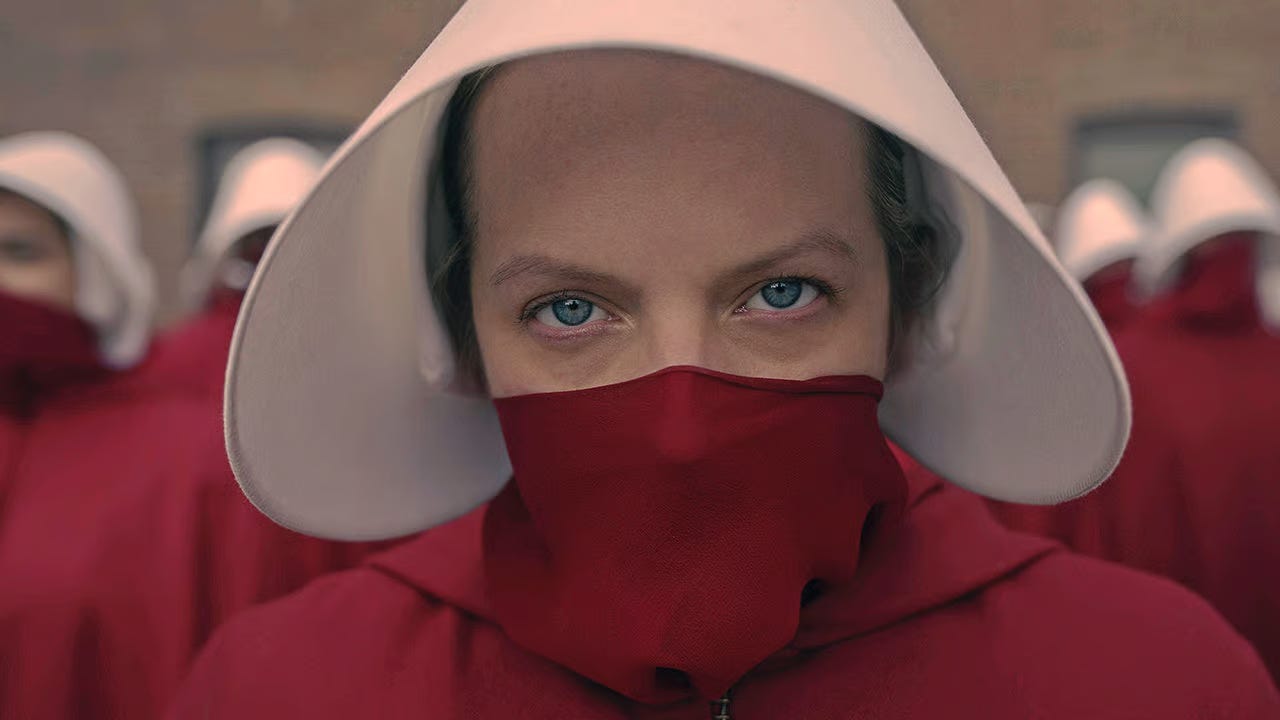
I saw Hamnet in October at LFF. I liked it and hated it; I was moved, I cried, and then I wondered if it was perhaps not very good. The script is weighed down by clunky, obvious dialogue; some lines made me wince. Late sixteenth-century Stratford was a radically different world, one in which church attendance was coerced by law and social pressure.1 But Hamnet takes a mystical, sentimental view of women’s history, and the material reality of women’s lives in this period only serves as a background upon which ‘Agnes’, Shakespeare’s wife, stands out, a remarkable wife worthy of a great man of history.
Reading Maggie O’Farrell’s novel on which the film is based, it became clear to me that Chloe Zhao’s script largely intensified issues that already exist in the source text. O’Farrell’s Agnes is a special woman, a green-fingered healer with a powerful, witchy foresight. It’s very much a novel of the late 2010s, one that cannot find an ordinary woman particularly interesting. Perhaps, like Shakespeare’s practical, conventional mother, Mary, they make good secondary characters, subverting expectations with surprising depth and empathy, but they do not drive or carry a plot; they are not protagonists.
This is a shame – the public conception of Shakespeare’s marriage too frequently veers to extremes, insisting on conventional, heterosexual bliss, or else a shotgun marriage gone cold, insisting his infamous ‘second best bed’ bequeath is evidence of such contempt.2 The truth, I suspect, is something more complicated, a shotgun wedding that probably did not produce the most faithful marriage in the world, but also one with some affection –we know Anne was likely with him in London after their children were grown.
Instead of an ordinary woman in an ordinary marriage with an unexpectedly successful man, O’Farrell gives us a novel for the granddaughters of the witches you cannot burn, and all that nonsense. O’Farrell researched sixteenth-century botany rather extensively when writing, but when it comes to women’s history, the novel makes only vague gestures; she is far more interested in a contemporary idea of the past than the alien reality she might encounter there.
I wondered, reading Hamnet, if O’Farrell had misremembered Virginia Woolf’s ‘A Room of One’s Own’, which imagines a hypothetical sister of Shakespeare, Judith, arguing that comparable genius in a woman would be repressed and overlooked. Perhaps she thought Woolf was imagining a neglected wife. Popular feminist literary history in the last decade or two has been particularly preoccupied by the figure of the wife-as-repressed-writer. I suppose we should credit Kate Zambreno’s Heroines. There are plenty of reasonable, true examples of such a phenomenon: Vivienne Eliot, Zelda Fitzgerald, even Jean Rhys. But as particular tales of cruelty and exploitation have been reduced to a trope, the wives of great men are flattened again, now as victims instead of devoted servants, by the very feminist analysis that seeks to rescue them.
Similar to the “feminish” flavour of some recent cultural criticism,3 worlds of fiction have emerged for the reader seeking work that leans tamely towards vaguely progressive views. Women of all kinds – historical, fictional, and mythological – rescued from the horrors of patriarchal narrative and history, offered sanctuary in prose that is largely mediocre (at best). Think Circe, and all the other retellings of ancient myth, playing a clumsy game of telephone through which they contain fewer and fewer traces of their source texts or contexts. It’s certainly an idea that writers had toyed with plenty in the wake of women’s lib – I could point to Lisa Klein’s YA novels about Shakespearean heroines, Emma Tennant’s feminist riffs on nineteenth century novels, even Angela Carter’s rather psychoanalytic feminist takes on fairytales in The Bloody Chamber. But the cynicism of more recent revisions and retellings is inescapable. Authors, publishers and readers alike seem to approach the trend as a shortcut to feminist insight, but with such a lazy approach to the inspiring sources, the work is hollow.
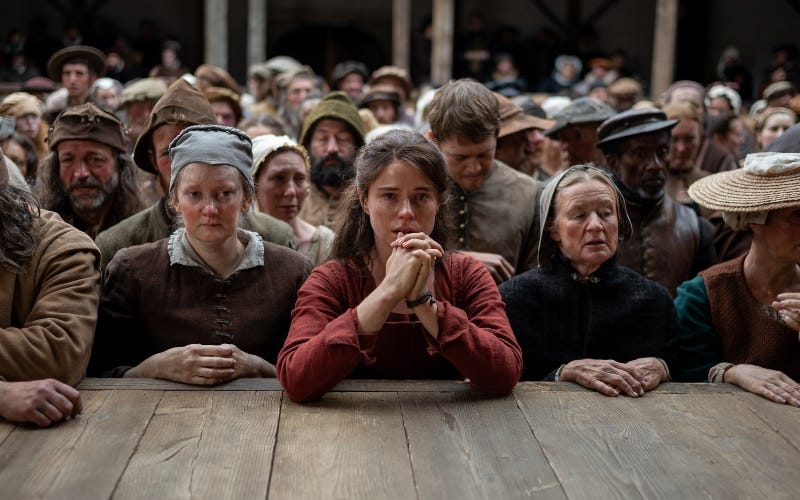
What I hated about Hamnet is what I hate about this wave of recent retellings generally: the pose of concern for the neglected and forgotten women. Such retellings so rarely understand their heroines as historical subjects, existing in a tangle of (often radically different) political and social structures. They don’t imagine women as submissive, weak, cowed, faithful, ambivalent, or compromising. And yet - what would your life be, if you were born in a small town in sixteenth-century England? If you had not ever travelled much further than your own parish, if you had little means of your own to do so anyway, because it is your father and then your husband who have the wealth, debts, and property? If everyone you’ve ever met is Christian? How could it not be a fraught negotiation, navigating patriarchal institutions – church, state, family – every day?
All of which is to say that reading Hamnet was an extremely frustrating experience. And then I encountered this passage, in which Agnes considers the death of her child:
Agnes’s concept of death has, for a long time, taken the form of a single room, lit from within, perhaps in the middle of an expanse of moorland. The living inhabit the room; the dead mill about outside it, pressing their palms and faces and fingertips to the window, desperate to get back, to reach their people. Some inside the room can hear and see those outside; some can speak through the walls; most cannot.
Reading it threw me back to the winter I read The Penelopiad, settling into the poky room of my first home in London.4 In an Atwoodly manner, O’Farrell evokes the numinous in abstract terms. Agnes is, like many Atwood heroines, like Penelope herself, an individual, one whose theology exists not in the social realm, but in the privacy of her own interior world. She is not always so spiky as Atwood’s heroines, but she shares that modern individualism.
It was this commonality that made me think – is it possible that all these bad retellings and revisions are Atwood’s fault? I’m being a little facetious, but the book was a huge success on publication, and, anecdotally, has been recommended to me endlessly in the last decade, as interest in retellings gained momentum.
She is, perhaps, the literary feminist of recent decades. She’s completely inescapable, institutionally beloved – her earlier novels are on academic syllabi (I studied The Robber Bride in undergrad, personally), her new releases make bestseller lists and receive rave reviews, her work has been adapted by Hulu and Netflix and even Wayne MacGregor for the Royal Ballet. Everyone knew that her joint win of the 2019 Booker prize was bullshit,5 but still, the judges couldn’t resist awarding it to her, no matter the obviously bad optics of undermining Bernardine Evaristo’s win.
Yet Atwood has been shy of – and even uncomfortable with – aligning herself with feminism throughout her career. Her work would not exist without the influence of radical and Marxist feminists; these bolder edges of the Overton window of Women’s Lib inevitably had an indirect impact on the tamer flavours of the movement. But where younger liberals are more content to ignore and erase radicals, Atwood comes from the era of a far more confronting left, and better understands the fundamental differences between her politics and those even of radicals, or even of committed liberal feminists.6 Such disagreements bring out a contrariness and contempt within her – consider her insistence that her first novel, The Edible Woman, could only be ‘proto-feminist’ as she wrote it before the explosion of political (including feminist) activity in the late sixties,7 or her obnoxious defence of her support for Steven Galloway, fired from his academic position at UBC after accusations of sexual assault and harassment.
She will not yield to the unruly mob of radicals, who do not, in her eyes, believe in the egalitarianism central to noble, liberal values. She is not interested in feminist critiques of the state, the justice system, marriage, capitalism, etc, which identify such institutions as fundamentally, irreparably built on exploitation, inequality and violence. Of course, at this point in her career, she is an establishment figure – a national treasure, for one thing. She exists in the realm of the power she defends.
I think feminist history is important to ground us, as would-be feminists, in a tradition of collective struggle, a lineage to probe, build upon, and criticise. Rereading Atwood’s atrocious 2018 essay responding to criticism from feminists, I’m struck by her egotism. “It seems that I am a ‘Bad Feminist,’” she begins, but while she attempts to ridicule these accusations, sarcastically listing them alongside the many other things she has been “accused of since 1972”, an earnest sense of persecution bleeds through her words. It is not so playful a flourish as Emma Goldman’s similarly sarcastic opening of her 1908 essay, ‘What I Believe’. The two make for an interesting comparison: Goldman understands persecution has long been part of the “history of progress” and does not take it personally; Atwood is indignant and hostile. She condescends to explain that her support for Galloway reflects her commitment to true civil and human rights for women and for all human beings. Women are “not angels, incapable of wrong-doing,” she insists, deftly deploying a strawman at the feet of her critics.
She indirectly compares these feminist critics – and the MeToo movement at large – to Stalin and Napoleon, before insisting that the “broken legal system” the movement is symptomatic of “can be houseclean”. For all her pose of rationality, it does not seem to occur to her that the university should also consider the duty of care to its students, or that false accusations are very rare and very complicated, or that feminists have little reason to trust that a man found innocent necessarily is, given all the obstacles between a victim and a guilty verdict.
I’m reminded of another essay about sexual violence in Canada, Sarah Polley’s ‘The Woman Who Stayed Silent’, which reflects on the trial of Jian Ghomeshi, revealing Polley’s own experience of violence at the hands of Ghomeshi. Atwood believes in ‘innocent until proven guilty’; Polley knows proving guilt is complex. She is shocked that her lawyer friends, believing Ghomeshi guilty, show such contempt towards the victims who have come forward, knowing Polley to have been hurt by him and having advised her, with compassion, that her own case was not credible, that she’d be torn apart. She picks at a troubling contradiction: that most of the lawyers she speaks to overwhelmingly believe the Canadian legal system to be just and fair, while at the same time expressing that they’d never advise a woman they loved to come forward in a sexual assault case.8
Then again, how feminist is Atwood, really? In her essay, she objects specifically to being labelled a “bad feminist”, but she is not enthusiastic about the movement as a whole; it is equality as an intellectual endeavour that matters. This hostility is interesting in this sense, as the phrase “bad feminist” serves both to claim her as a would-be comrade and criticise her for a failure to live according to those values. As much as politics are assigned to her work by others, she does not align herself with the actions of such a movement. She’s at her strongest as a novelist only ambivalently under the influence of twentieth-century feminism. She describes The Handmaid’s Tale as a novel about authoritarianism, rather than fascism or patriarchy. Would she be content with a sometimes-benevolent liberal patriarchy? I’m not sure, but I’m struck by her desire to wash her hands of politics, to see the power of the authoritarian as a crisis of democracy more than ideology. She is hardly an anti-fascist. Feminism suits her career and sells her books, but it does not particularly drive her into the streets.
Atwood’s essay ends with a call for unity: “A war among women, as opposed to a war on women, is always pleasing to those who do not wish women well.” This is how I know she isn’t about it – is there anything feminists love more than arguing amongst each other?
Perhaps this is unfair, and my frustration is with the kind of critic or reader who reads feminism into her work. For years now, I’ve been haunted by this godforsaken passage from The Robber Bride.
Male fantasies, male fantasies, is everything run by male fantasies? Up on a pedestal or down on your knees, it’s all a male fantasy: that you’re strong enough to take what they dish out, or else too weak to do anything about it. Even pretending you aren’t catering to male fantasies is a male fantasy: pretending you’re unseen, pretending you have a life of your own, that you can wash your feet and comb your hair unconscious of the ever-present watcher peering through the keyhole, peering through the keyhole in your own head, if nowhere else. You are a woman with a man inside watching a woman. You are your own voyeur.
For the better part of a decade, I’ve seen this quote everywhere I turn, recited as accepted feminist wisdom. But it isn’t feminist wisdom, it isn’t even Atwood expressing her own politics, it’s fiction, the perspective of scorned woman Roz as she contemplates Zenia, a “man-eater” and the titular robber bride, who she considers caters to such fantasies. It’s a shame this passage is so frequently quoted out of that context. Like Kristin Scott Thomas’ monologue in Fleabag, it’s excellent character writing that voices absolutely atrocious politics. These are compelling scenes that express a kind of pseudo-feminist nihilism, an insistence that the condition of women is inescapably bad. It’s all a male fantasy; women are born with the pain built in. God help us all.
But fiction, as Angela Carter well knows, is a “different form of human experience than reality”. I always return to Carter, my literary feminist lodestar, and she is particularly on my mind as I have finally finished reading The Sadeian Woman, her study of the pornography of de Sade. It’s an interesting text, approaching his work with a sort of feminist freudo-marxism – psychoanalytic flourishes grounded in a materialist view of history and an unyielding feminist rigour – but also a startlingly mature curiosity, completely devoid of sanctimony. She picks her battles – the point is not how moral or immoral de Sade was two centuries ago, but what his work reveals about the sexual politics of power, domination and patriarchy. Given that our own era has been dominated by the trauma plot, it’s a refreshing read – Carter refuses both prurience and sentimentality, looking at controversial, sometimes difficult material with remarkable directness, completely self-assured in her wit.9
Andrea Dworkin famously dismissed it as a work of pseudofeminism, defending a man who ought to be abandoned to history. I have to wonder if she actually finished the book, given it ultimately concludes with a rather grim view of de Sade’s libertines, for whom “pleasure may never be shared, or it will be diminished.” Carter contends that in de Sade’s work, sexual pleasure is an entirely inward experience. His libertines have victims and accomplices but never true partners; in their solipsistic world, they cannot surrender to reciprocal desire.
The ground Carter treads is a more fertile one for feminists contemplating our relation to art, history and narrative – rigour and wit instead of moralism, a willingness to grapple with the artificiality of our stories and a trust in our readers/audience/comrades and their intelligence. It makes me think of Anne Carson’s experiments, the ancients-meet-modernism of Decreation and Autobiography of Red. Or Toni Morrison making a novel out of a sharp fragment of history in Beloved, or Saidiya Hartman’s ‘critical fabulations’ in Wayward Lives, Beautiful Experiments, or Josephine Decker’s10 Shirley, a strange portrait of Shirley Jackson in her own style, or Hilary Mantel’s thoroughly researched Cromwell trilogy, which offers so much on patriarchy and power from the world of Tudor political intrigue. When such audacious and challenging work exists, why settle for the mediocrity of cliché?
This is perhaps better covered by Kenneth Branagh’s 2018 film All is True, which is probably Branagh at his most Branagh, but does at least understand the strangeness and oppressive conformity of seventeenth century England.
It is interesting to me how rare it is that anyone takes a more neutral position on this line – it’s an awful lot of speculation given how many documents are absent from the archive.
I was reminded of Merve Emre’s use of this phrase by Sanjana’s piece on the gaze.
Compare O’Farrell to the opening of The Penelopiad:
“Now that I’m dead I know everything. This is what I wished would happen, but like so many of my wishes it failed to come true. I know only a few factoids that I didn’t know before. It’s much too high a price to pay for the satisfaction of curiosity, needless to say.
Since being dead—since achieving this state of bonelessness, liplessness, breastlessness—I’ve learned some things I would rather not know, as one does when listening at windows or opening other people’s letters.”
I’ve yet to meet anyone in the industry who thinks otherwise.
By which I mean: despite their shortcomings, I’m frequently surprised by just how left-wing liberal feminists of the second wave often were, compared to mainstream figures of today.
Though, of course, post-’68 movements did not appear out of thin air, and the new left had significant links to the old. I find it particularly interesting, for example, how common it was for Civil Rights organisers to have connections to the Communist Party.
Interestingly, Polley and Atwood worked together on the 2017 television adaptation of Atwood’s novel Alias Grace, which I know I loved but can no longer remember in detail. It is a more challenging kind of work from Atwood, and makes for one of the most interesting period pieces of the last decade, a far richer approach to women’s history than the biopics I have grown so tired of.
What a delight, to read an argument that doesn’t spend the whole time looking over its shoulder, anticipating attack!
I should also credit Sarah Gubbins, who wrote the screenplay and Susan Scarf Merrell, who wrote the novel from which it is adapted!
The problem identified here is fundamentally one of presentism: the projection of contemporary moral frameworks onto historical subjects. Feminist retellings often ignore temporal difference, treating the past as an underdeveloped version of the present rather than a qualitatively different social order. This results in narratives that explain women’s suffering without explaining women’s worlds.
this is really really excellent—so well phrased and deeply researched. i think you've gotten at the heart of what makes these so-called feminist retellings more and more frustrating the more they get absorbed into the mainstream. i think this is also an issue particular to historical fiction as a genre, and what makes some of it so good and what makes some of it so bad.
"What I hated about Hamnet is what I hate about this wave of recent retellings generally: the pose of concern for the neglected and forgotten women. Such retellings so rarely understand their heroines as historical subjects, existing in a tangle of (often radically different) political and social structures. They don’t imagine women as submissive, weak, cowed, faithful, ambivalent, or compromising. And yet - what would your life be, if you were born in a small town in sixteenth-century England?"
i think a lot of (popular?) historical fiction writers think about their historical setting more in terms of how fantasy/sci-fi writers conceive of "world-building"—they're not thinking about how utterly different a person's sense of self would be in a different era based on a million different factors. they're kinda just not that well researched—it's more about the vibes of the historical setting than anything else.
but good, well-researched historical fiction (like wolf hall, or pat barker's regeneration trilogy) 'humanizes' its characters way more effectively than vibes-based historical retelling-as-progressive-mouthpiece novels because the characters are truly fully formed within their specific societies, with all of the complexities and differences that living in a different time and place would naturally have afforded them.
thanks for this, it's given me a lot to think about! and a lot of books to add to my reading list :')