
The Agony of the Silicon Presidency
Obama, Trump, and the Outsourcing of the Future

I’m currently reading Jacob Siegel’s The Information State, about which I’ll have more to say soon. One chapter that stood out so far is “The Silicon President,” about the Obama administration’s close ties to the tech industry, something I’ve also written about. In the late 2000s, Google was the most admired company in America, and it was taken by everyone from progressive Democrats to neoreactionaries to offer lessons for improving governance. Obama, as Siegel recounts, rhapsodized about Google in his campaign book The Audacity of Hope, gave stump speeches accompanied by CEO Eric Schmidt, and appeared at the search giant’s Mountain View HQ to lay out his “innovation agenda.” “Obama and Google,” Siegel writes, “shared an ethos.”
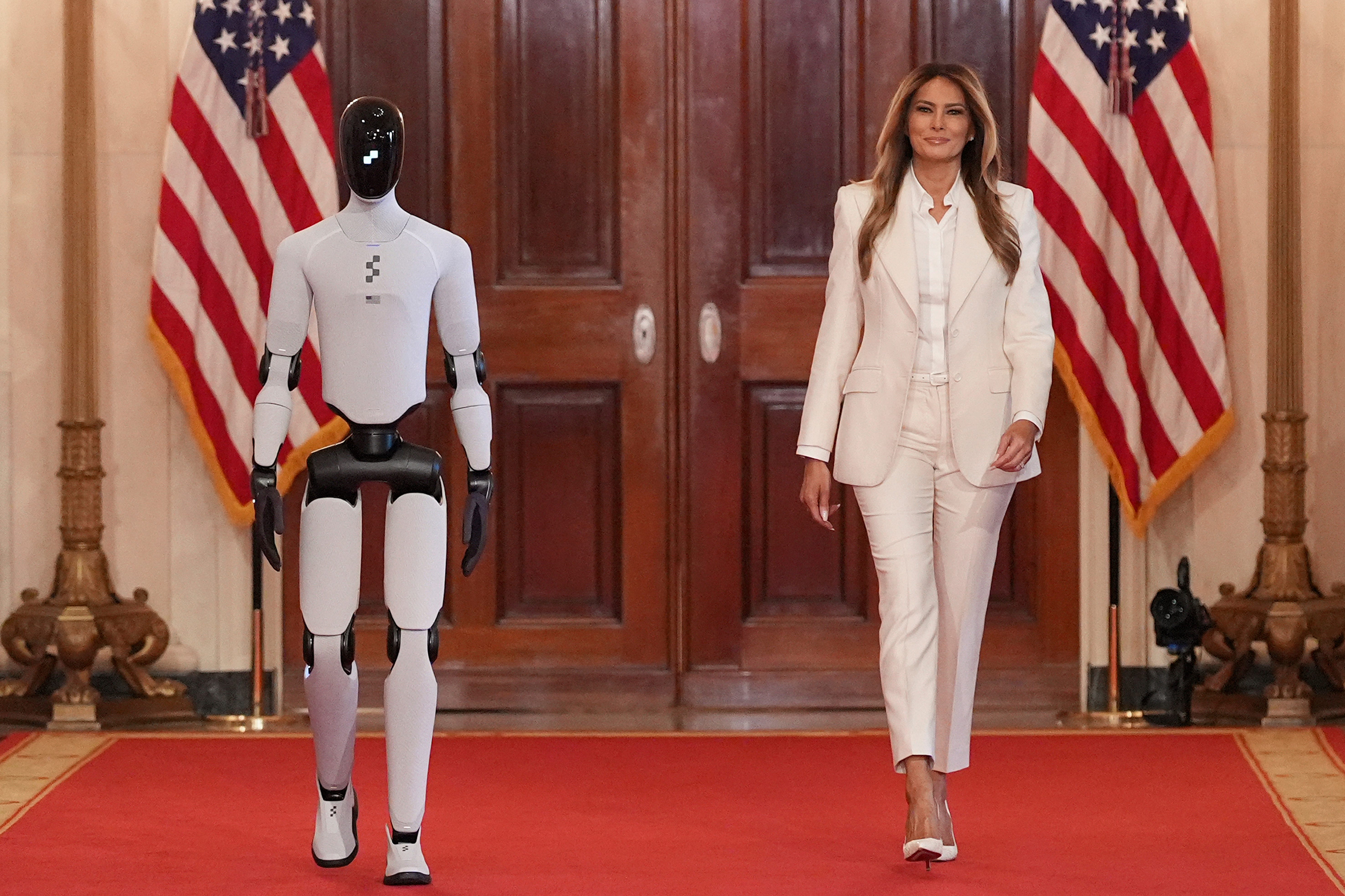
Two news items showed up in my feed while I was reading Siegel’s book this week that gave me a bit of dejà-vu. The first was that President Trump announced the members of his Council of Advisors on Science and Technology.” One is Google co-founder Sergey Brin; another is Mark Zuckerberg, who also cultivated close ties to the Obama administration. (Obama’s tech council included, inevitably, his sidekick Schmidt.) The second was the surreal appearance of Melania Trump in the company of a humanoid robot created by the company Figure AI. Although the robot on display is designed to perform physical tasks, the First Lady emphasized its potential for educating children. “Imagine a humanoid educator named ‘Plato,’” she told her audience. Here, too, anyone who remembers the Obama era will recall its many presidential initiatives around robotics and digitally enhanced education.
Under Obama, Siegel writes, “progressive social goals advanced a technocratic will to power.” His sweeping promises of “hope” and “change” cascaded across new media platforms; his frequent appearances with tech luminaries conveyed the message that technological and political progress were in sync. “Change” was a conveniently vague way to frame these expectations, given that material prospects of the majority of people never really recovered from the 2008 crash. Economic inequality continued to grow, but the digital politics of representation offered hope for symbolic compensation. Meanwhile, Google’s information curation, Siegel says, also promised to “[correct] the misperceptions of an uninformed public and [nudge] it toward the right ideas.”
Obviously, Donald Trump’s 2016 victory—which was widely blamed on the insufficient curation of the digital information landscape—dealt a crippling blow to this political vision. However, as this week’s news reminded us, something like the DC-to-Palo Alto pipeline built up by the Obama administration has reconstituted itself under a regime that was supposed to be its diametric opposite. Once again, Google guys are sitting on presidential councils, and the White House is doing product placement for robotics startups that are somehow going to make education great again. Plus ça change…
While doing my own research on all this, I recently picked up Jeff Jarvis’s 2009 book What Would Google Do?, a strange tome written at the high point of the Obama-Schmidt mind meld, when Google’s “don’t be evil” motto made it an avatar not just of innovation but of moral probity. A self-described “centrist Democrat,” Jarvis concluded his book by imagining a future in which “geeks rule.” “If the geeks take over,” Jarvis predicted, “we could enter an era of scientific rationality in government.”
Jarvis offered a version of the Obama era vision Siegel examines at length: a liberal-technocratic public-private partnership in which Silicon Valley provides the means, the Democratic Party the ends—although often, it was happy to outsource those to Big Tech as well. As he expands on this idea, though, seemingly against his own intentions Jarvis stumbles upon a slightly different scenario. Imagining what might happen if “a Google guy were president,” he remarks that “[o]ther nonpoliticians have improved government. Michael Bloomberg ran New York City as a business. Arnold Schwarzenegger ruled California on the power of personality. A Google guy might just run government as a service to solve problems.” What he has arrived at might, with minor adjustments, be a pitch for Trump 2016.
In their 2021 book Technopopulism: The New Logic of Democratic Politics, political scientists Christopher Bickerton and Carlo Invernizzi Accetti offer a framework for undestanding this convergence. They argue that the usual opposition between technocracy and populism—between Obama and Trump—is a misleading one. This is because both are post- or anti-political styles that thrive amid the demise of traditional mass parties and other mediating institutions. “Both populism and technocracy,” the authors write, “dispense with the dimension of political mediation because they claim to have direct access to the ultimate ground of political legitimacy itself.” That “ground” is a direct relationship between the leader the people in the case of populism, and access to superior expertise in the case of technocracy.
In theory, these might seem like opposite appeals, but in practice, many leaders in recent years have simultaneously made both. JD Vance’s claim that Trump’s war in the Middle East is different from previous ones because previous US presidents were “dumb” and Trump is “smart” could be read as a quintessential expression of technopopulist reason. To quote Bickerton and Accetti: “technocracy is based on an informal relationship of ‘trust’ between the technocrat and those he is supposed to govern, rooted in the assumption that the former possesses a specific ‘competence’ or ‘expertise,’ tied to his or her personal qualities.” Jarvis inadvertently hit upon this insight when he free-associated from promising the inexorable triumph of “scientific rationality” in government to celebrating the way that “Arnold Schwarzenegger ruled California on the power of personality,” without missing a beat.
The Democratic Party’s wholehearted embrace of Silicon Valley in the late 1990s was in part a concession that it had run out of ideas. When Bill Clinton conceded that “the era of big government is over,” acknowledging that the expansive dreams of New Deal liberal governance had come to grief, it was unclear on what basis it could continue to offer Americans hope for a better future. When Ronald Reagan proclaimed “Morning in America,” dispelling the pessimism of the late 1970s, the implication was that it was a time of opportunity for self-reliant individuals, not for the activist state. What would become of the progressive conviction that the citizenry was the protagonist of historical change? Silicon Valley helped liberals arrive at a new answer, to which Obama offered the fullest expression: a better future was a more “connected” one, one in which digital networks empowered individuals, made information accessible, and thereby revived democracy.
Trump’s ever tighter links to Big Tech are, comparably, an acknowledgment of the limits of his political project—an attempt to outsource the “vision thing” to the supposedly forward-looking segment of the private sector. The force of his personality and his unique mastery of the digital media landscape were sufficient to propel him back into the presidency against the odds. But in his second term, especially when he isn’t pursuing vendettas around the 2020 election and related grievances, there is an unmistakable sense of drift. It is in this context that the American version of the technopopulist synthesis—the DC-Silicon Valley mind meld—has come back to the fore. The problem, however, is that, contrary to the peak Web 2.0 moment when Obama moved into the White House, today’s tech elite seems uniquely incapable of articulating an internally coherent program for the future. Say what you will about Obama and Google’s “shared ethos,” at least it was, well, an ethos.
This week in Compact:
Emma Ashford on the looming quagmire in Iran
Robert Lynch on the conformist nightmare of the “global village”
Juan Rojas on the Mexican left vs NGOs
A.A. Kostas on the return of serial fiction on Substack
Alicia Nieves on the Democrats’ middle-class tax cut proposals
The 2000s' "Talks at Google" included Zizek and Chomsky iirc
In other words, Big Tech is a serpent. It has a place but perhaps maintain a certain awareness of its doings and an appropriate distance from its pit.