
Artemis Shows Another Tech Is Possible
How the tech right gets space wrong

In his 1971 presidential memoir The Vantage Point, Lyndon Johnson concluded his chapter on the space program as follows:
On the morning of July 16, 1969, at President Nixon’s request, I stood under the Florida sun at Cape Kennedy and witnessed the launching of Apollo 11, carrying the voyagers who would first set foot on the moon. As I watched that vehicle rise on its pillar of flame, seeing sky and earth and rocket all tied together in one majestic and unforgettable panorama, I could not help remembering that earlier vigil, twelve years before, when we strained to see the Soviet Sputnik orbiting overhead. In the short span of time between those two events, we wrote a story that will be told for centuries to come. We developed the ability to operate in space with both men and machines. From outside the earth’s environment we studied the sun and the planets. We used space machines to forecast weather and to improve communications a hundredfold. But there is even more to the story than that, I believe.
Space was the platform from which the social revolution of the 1960s was launched. We broke out of far more than the atmosphere with our space program. We escaped from the bonds of inattention and inaction that had gripped the 1950s. New ideas took shape. If we could send a man to the moon, we knew we should be able to send a poor boy to school and to provide decent medical care for the aged. In hundreds of other forms, the Space program had an impact on our lives. Across the entire range of our technology we are beginning to reap benefits from the investment we have made in space—from the Pacemaker, which can add years to the life of a heart patient, to intercontinental television; from new lightweight electronics equipment to improved navigation techniques for ships and planes.
Within another decade the spinoffs from space will be improving life in ever-increasing ways, from medicine to urban planning. We will use the vantage point of space to locate new supplies of food and new resources on earth. Weather control will save lives and crops and cattle. New concepts of communication will help to banish ignorance. Cameras in space will warn us of crop plagues before they have time to spread across half a nation. We can build laboratories in space that will enable us to learn more about our own earth as well as the planets. We can build natural resources satellites at relatively little cost that can tell us about mineral and oil deposits, water and fish supplies, and dangers from flood and fire. We can build an Antarctica-type station on the moon. We can marry aeronautics and astronautics to develop a spacecraft that can be reused, and thus lower the cost of space travel.
And we can go on from there. I hope we will move out to other planets. I hope we will pursue new dreams. We must not be content to relegate this great adventure to a business-as-usual status. We should never permit the plaudits that President Nixon and our other leaders have given our spacemen in this noble effort to be silenced by the pleaders for economy. I am concerned and disappointed that as I write this some of our previous plans are being abandoned and our vision appears to be in the process of being replaced by that of thinkers of another day who compared this magnificent thrust to an “outer space basketball game.”
The new adventures in space that lie ahead will bring with them excitement and accomplishment as great as anything we have witnessed in the epic period just past, when we proved ourselves once more to be the sons of pioneers who tamed a broad continent and built the mightiest nation in the history of the world.
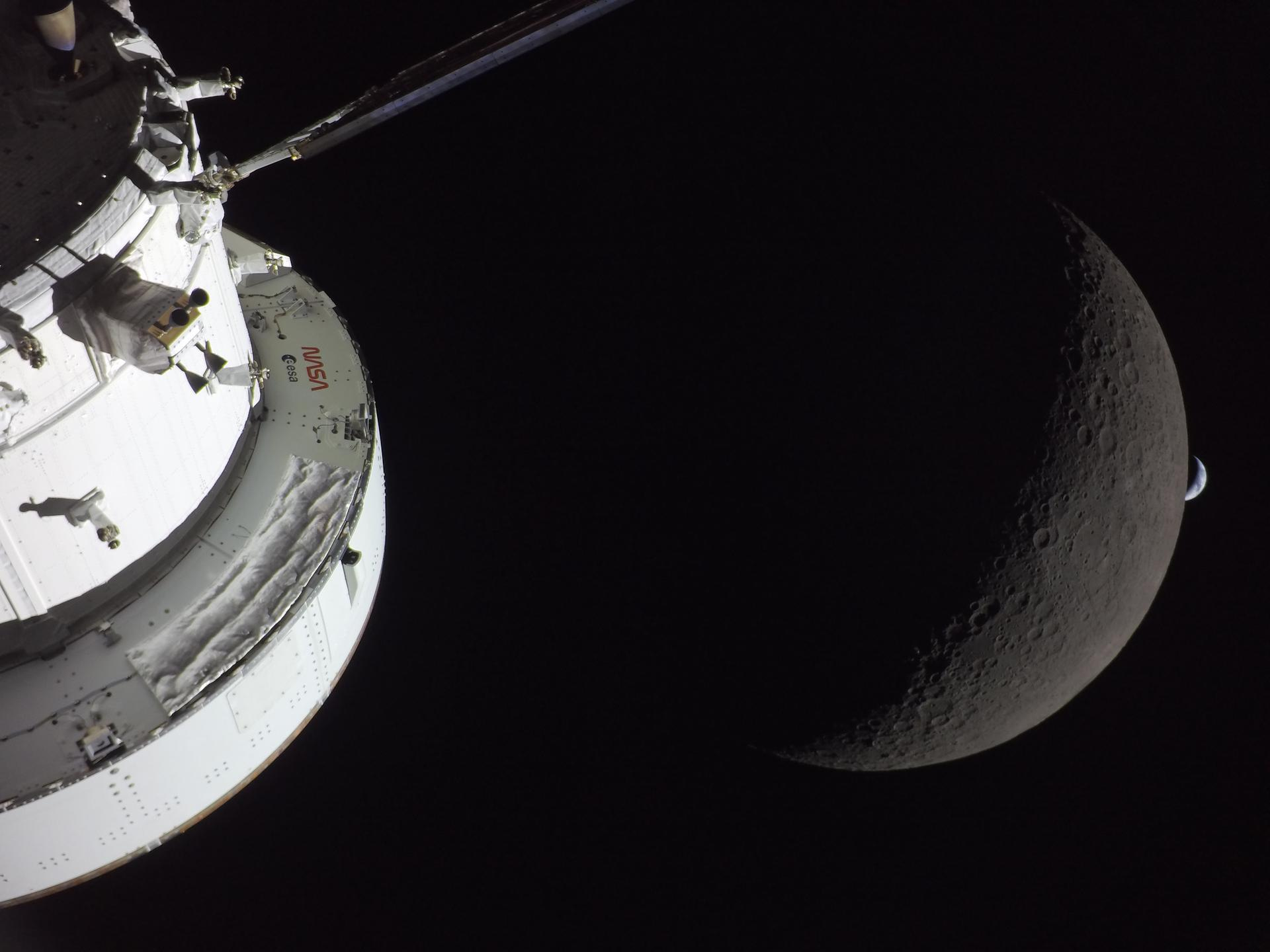
There are a few things that stand out when we read this passage today, as the Artemis II astronauts return to earth. The first is that it offers one of the era’s most explicit articulations of the presumed complementarity of technological, material, social, and moral progress—an assumption that fell apart in the subsequent years. The second is that, like so many others at the time, LBJ seemed confident that the progress he had overseen in all these areas would continue steadily, even if he did express concern about the influence of the “pleaders for economy” who viewed space exploration as a mere extravagance. In fact, the Apollo program would be terminated the year after he published Vantage Point, one of many casualties of the fiscal strain that was beginning to erode the foundations of American power in the early ’70s.
Fifty-four years on, the Artemis astronauts have picked up where Apollo left off, going further from the earth than any humans before them. Unlike in the Apollo era, our public sphere and media landscape are highly fragmented, so it is difficult to determine what the broad perception of the mission has been. However, I think its successful completion at least has the potential to offer a far more compelling vision of our collective relationship with technology at a time when many people seem increasingly disillusioned with the prevailing one, especially when it comes to AI. (And for good reason, as I have argued.)
Current AI discourse, especially coming from the industry itself, is largely about the replacement or, at best, obsolescence of humanity—and not about expanding or augmenting the capacities of human beings. In this sense, it should be noted, it contrasts with the rhetoric of early Silicon Valley, which was all about personal computers as a means of human augmentation; read John Markoff’s What the Dormouse Said for a full account of this rhetoric. But it also contrasts with the vision that prevailed America’s more optimistic era, which LBJ—writing at the close of that era—so powerfully encapsulated.
The Artemis mission offers a reminder of this older—and in my view far better—way of conceiving the relation between man and machine. What we see in manned space missions is a marshaling of sophisticated technological apparatuses to enable human beings to do things they would otherwise be incapable of doing. Here, the technological achievement doesn’t detract from the human one. To become an astronaut is to become a new kind of person, expanding one’s capacities and achieving a productive symbiosis with the machine that is not a complete merger with it. Human experience remains fundamental to the whole project; what is thrilling about it is precisely human beings achieving something previously unimaginable—and still remaining human beings throughout.
The people who have talked most about space in recent decades belong to the so-called tech right—most prominently, Elon Musk, whose associate Jared Isaacman now leads NASA. Musk’s fellow PayPal mafioso Peter Thiel has returned often to the falling off of progress after the moon landing as a wrong turn made by America. “We landed on the moon in July of 1969,” he has remarked, “and Woodstock began three weeks later. With the benefit of hindsight, that’s when the cultural war around progress was lost and the hippies sort of took over the country.” A third tech right luminary, Marc Andreessen, picked up some similar Thiel comments recently—to the effect that in 1969 we abandoned outer space and so we could start exploring inner space—as part of his war on the supposed excesses of “introspection.”
In recent years, the tech right has argued roughly the opposite of what Johnson claimed in his narrative of the 1960s. By tech rightists’ account, it is precisely what LBJ presented as social progress—the expansion of rights, the buildup of the welfare state—that has hampered technological and material progress. They present space above all as a destination for individual “exit”; a realm for bold entrepreneurs to, as Thiel put it in 2009, “find an escape from politics in all its forms—from the totalitarian and fundamentalist catastrophes to the unthinking demos that guides so-called ‘social democracy.’” “Because the vast reaches of outer space represent a limitless frontier,” he went on, “they also represent a limitless possibility for escape from world politics.”
The history of space exploration is at odds with this vision. Thiel is historically knowledgeable enough to be aware of this, and alludes to the central role of state planning for Apollo in his book Zero to One. Musk, too, at least in practice, has accepted the continued role of the state in space exploration. In their forthcoming book Muskism, Quinn Slobodian and Ben Tarnoff identify “state symbiosis” as one of the key planks of Musk’s business model, but whereas during the Cold War, private aerospace companies had a subordinate role, Musk imagines a future where “entrepreneurs would be the ones in charge.” The state’s function, in other words, is to de-risk private entrepreneurial initiative—to bail out the failed Mars colonies of the future.
Tech right skepticism of democracy comes into the picture here, because one imagines the public might have problems with this arrangement. But is the revival of the sort of ambition conveyed in LBJ’s remarks compatible with privatized government functions and the weakening of democratic input? I would say not. Although space missions are of course not democratically organized operations, they have historically been an expression of a democratic national spirit, as LBJ’s remarks convey. Because the investments necessary to make them happen require the involvement of the state, the faith underlying the project must transcend the self-interest of the entrepreneur—even if that will likely be one element of the system enabling it. What is required is a vision of secular transcendence rooted in the nation—in the 1960s and now, the only entity capable of mobilizing and coordinating sufficient resources and will to undertake such a task.
For the tech right, space is above all an exit route for the “sovereign individual” to liberate himself from the encumbrances and impositions of complex modern societies. But what missions like Artemis show us is not untrammeled individuality, but complex interdependence: that of the astronauts on the machine and vice versa; of the mission on a vast support apparatus back on earth; of the entire coordinated system on a nexus of state and private initiatives; and so on. The dependence of the astronauts on this constellation of other entities is not at odds with their remarkable individual talents; on the contrary, their ability to exercise these special capacities is contingent on their participation in a complex system of coordinated activity. This is simply the nature of modern society in microcosm, at least when it is functioning well. It is also what Silicon Valley seems to want to escape, in part by automating it all out of existence—a prospect most of us find repellent.
If projects like Artemis are not possible without the impetus provided by what Mariana Mazzucato calls the entrepreneurial state, that means that what the public thinks about them matters and will continue to matter. Perhaps ironically, Donald Trump’s own rise to power made clear that even in a highly decayed democratic system, the citizenry exercises a veto on an unaccountable technocratic elite when that elite deploys technologies that neither improve our lives nor stimulate our imaginations. The tech right owes its ascendance to the self-discrediting of the previous Silicon Valley elite, but it is setting itself up for a similar fate. Artemis is a reminder that a very different sort of symbiosis between politics and technology is possible.
This week in Compact:
My review of Jacob Siegel’s The Information State
Ryan Zickgraf on how the lift ditched class for race
Leighton Woodhouse on political violence in the 1990s
Tyler Antonio Lynch on green finance scams in Brazil
Paul O’Connor on the persistence of technocracy
Kennedy-Johnson official Walt Rostow ghost-wrote much of LBJ's memoir you quote from (mostly the foreign policy sections). The "modernization theory" approach taken by Rostow as a government official and also in his academic economic histories was similar to the cod e/acc tech bro view insofar as it posited an techno-economic determinism but with capitalism vs communism as the victorious ideology (a sort of American Whiggery similar to the Andreessen manifesto) However, in other respects, wild differences can be observed. Rostow was more or less the inspiration for USAID, which was inaugurated under Kennedy, his book proposing foreign aid as a major foreign policy goal was a finalist for a National Book Award. Less "developed" parts of America (the Southern states under Jim Crow law) were considered comparable by Rostow to the "developing world," (@NilsGilman writes about this) and hence to be similarly transformed by what market liberals might call a "big government" approach to resolving social issues (Civil Rights, Great Society), in the Vietnam context and globally this became characterised by Third Worldish academics as neocolonial. If anything the Rostovian foreign policy was arguably more of an EA worldview; indeed, the DOGE assault on foreign aid itself seemed like in part weird intramural revenge against the mosquito-net types like Gates etc (mixed with traditional Republican know-nothing-ism and parochialism that sees overseas activities as "globalist" "charity"). Nonetheless, the "military industrial complex" as represented by the "Rocket State" of the New Frontier era is not entirely dissimilar from Karp's Palantir Technological Republic analytically, although surely mirroring of the extent of "barbarisation" of US society since then among other distinctions.
All that being said, space and NASA are objectively cool.