

Is America Moving Left Economically?
A latent approach


In a short post analyzing political sentiment shifts over time, Crémieux writes the following with respect to economic items:
Movement on economically left-wing views has been generally pretty flat, which is roughly what we also see for economically right-wing views.
Indeed, this is what the graph shows:
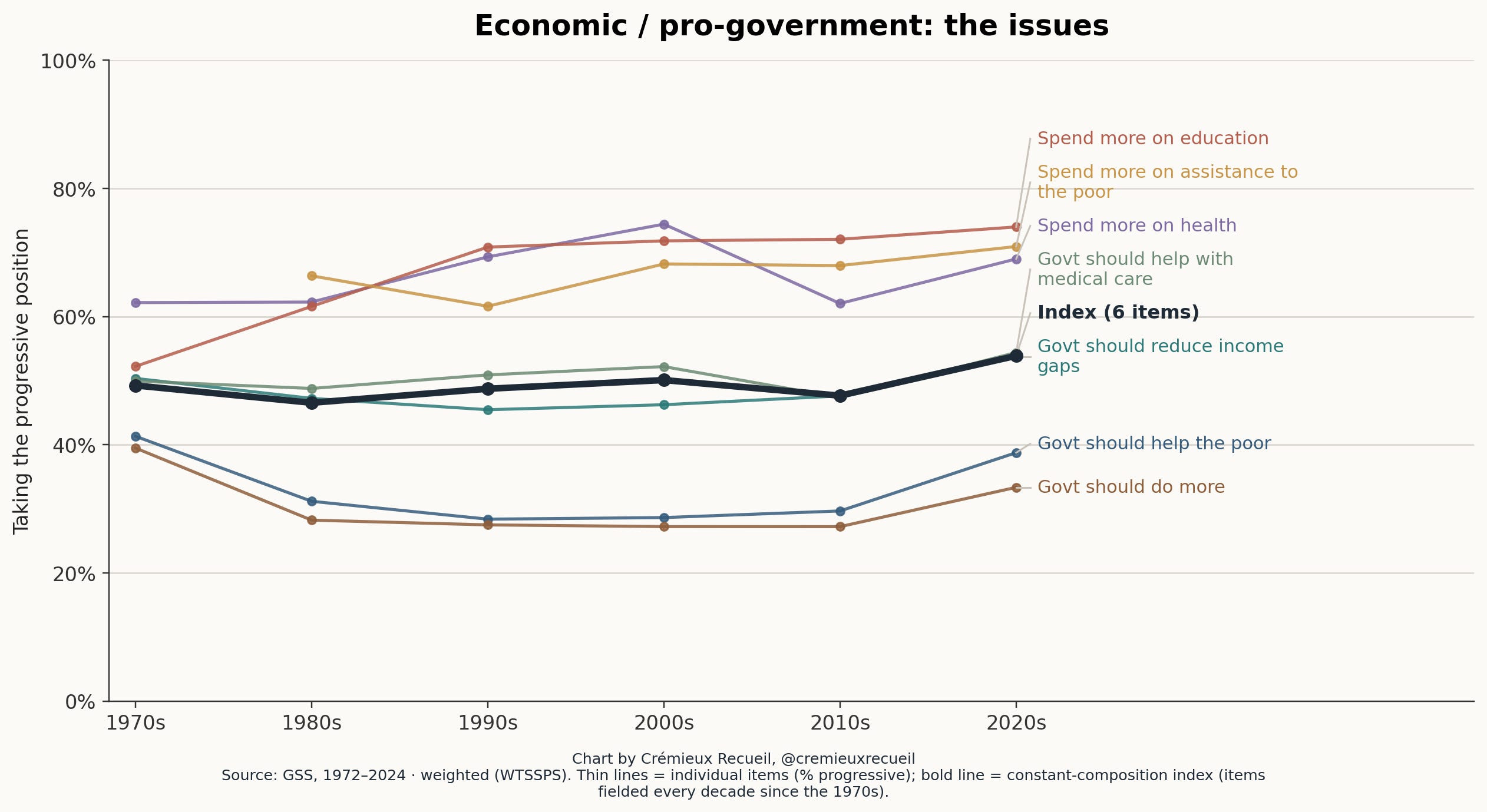
But these are decade averages; economic opinion trends tend to be more volatile and less interpretable than those surveying visceral responses to, for instance, interracial marriage or homosexuality:
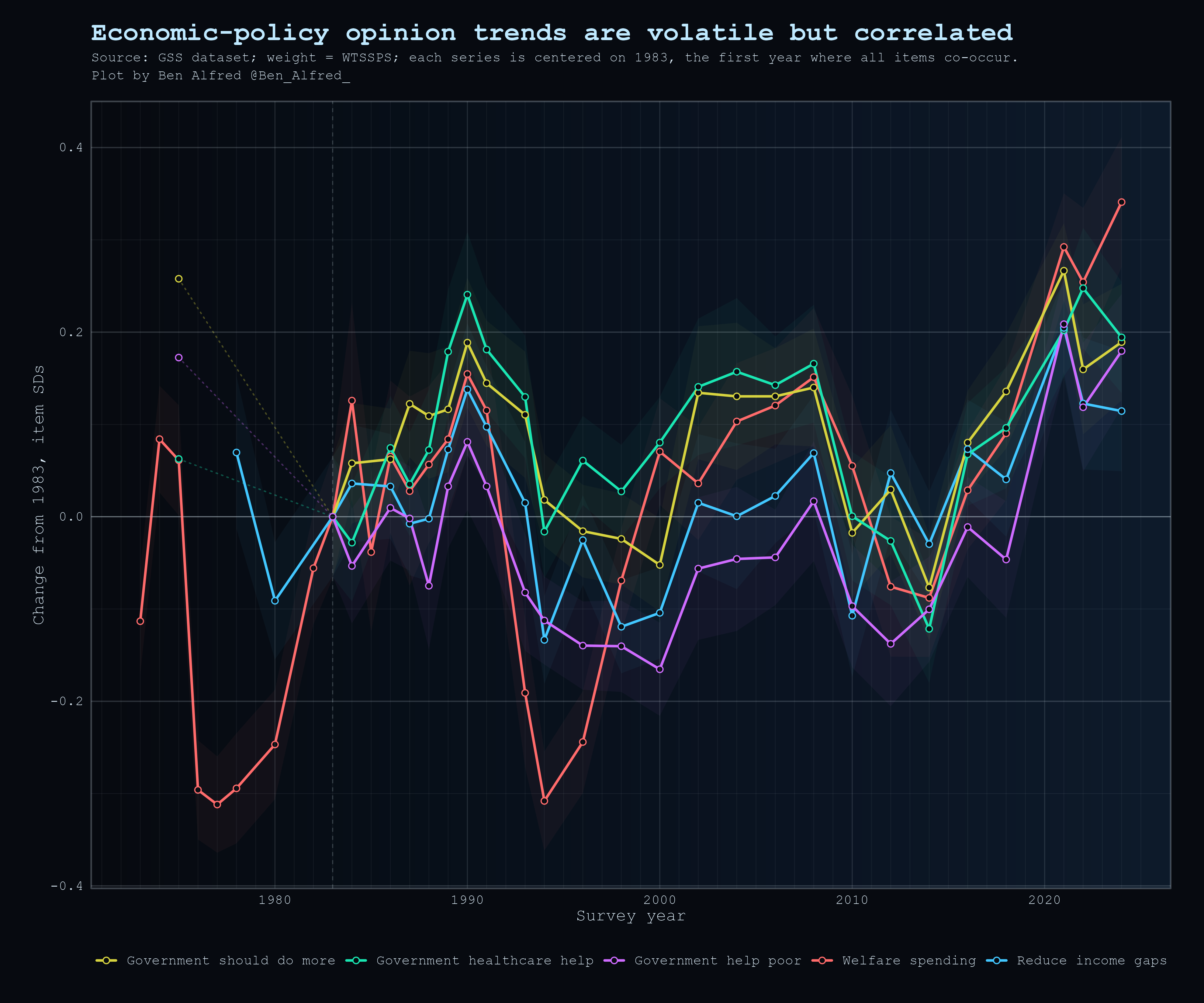
This amount of fluctuation cannot be attributed to sampling error, evidenced by the confidence intervals, and the jumps are not trivial in absolute terms; they imply the average man’s expressed economic politics can shift by half a standard deviation in response to subtle alterations to his environment. Contrast this with movement on items that assess more instinctual responses, as with questions whose answers depend on the presence of a disgust response:
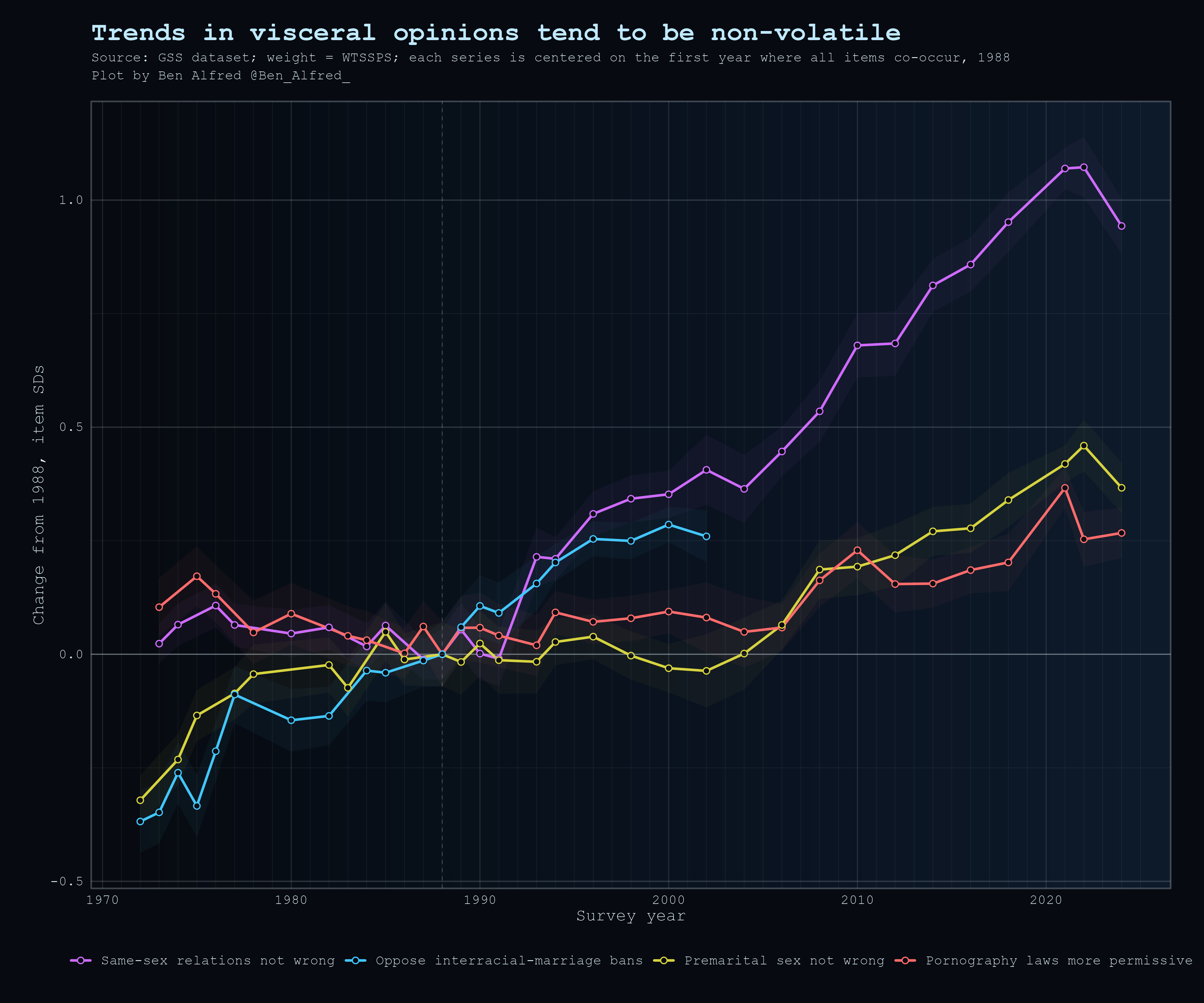
It would thus appear that the reflective beliefs of the population are able to be moved by environmental factors more so than intuitive beliefs, likely due to the former being more or less inconsequential in terms of influencing behavior.1
Nonetheless, environmental influences are nonrandom and in a given year if a question associated with a economic-leftism g (EL-g) rises, it is often the latent trait reacting to the environment as opposed to an opinion on a specific issue.
Indeed, this is what the data indicates: referring to the first chart, when one question capturing this general factor moves, the others tend to follow; they move together. To visualize this, we can plot between-wave opinion changes of each item against those of every other item:
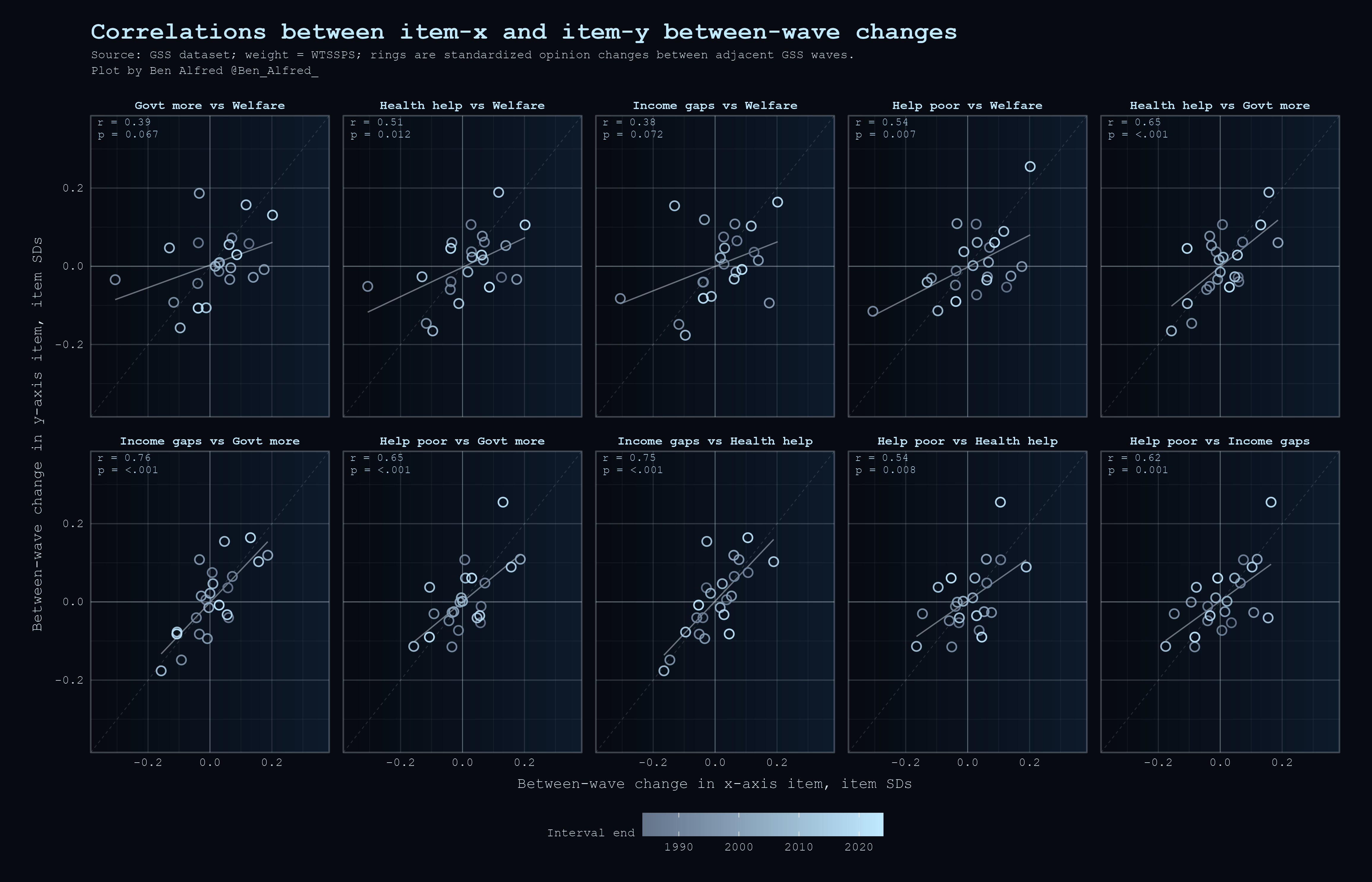
Thus, it is the aim of this article to examine changes in the latent trait, derived from five questions within an item response theory (IRT) framework, and answer the following: How has the latent trait changed over time, and how much of this movement can be attributed to environmental context, and how much to population change?
The Model
Of the seven questions included in Crémieux’s index, those on education spending, health spending, and poverty spending were dropped to improve model integrity.2 Welfare spending was then added due to its high coverage and responses on it being associated with the four-item model; we end up with a single-factor model that explains almost half the standardized item variance, with a reliability of 0.8 and, excepting M2, excellent fit metrics.3
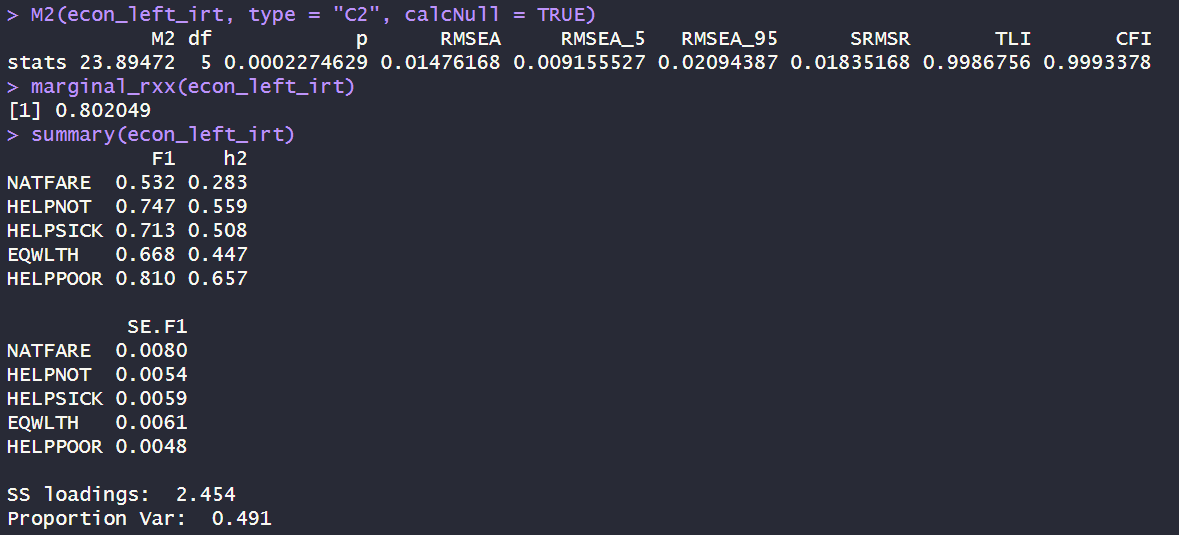
The items most related to EL-g pertain to general government involvement and whether it should do more for the poor.
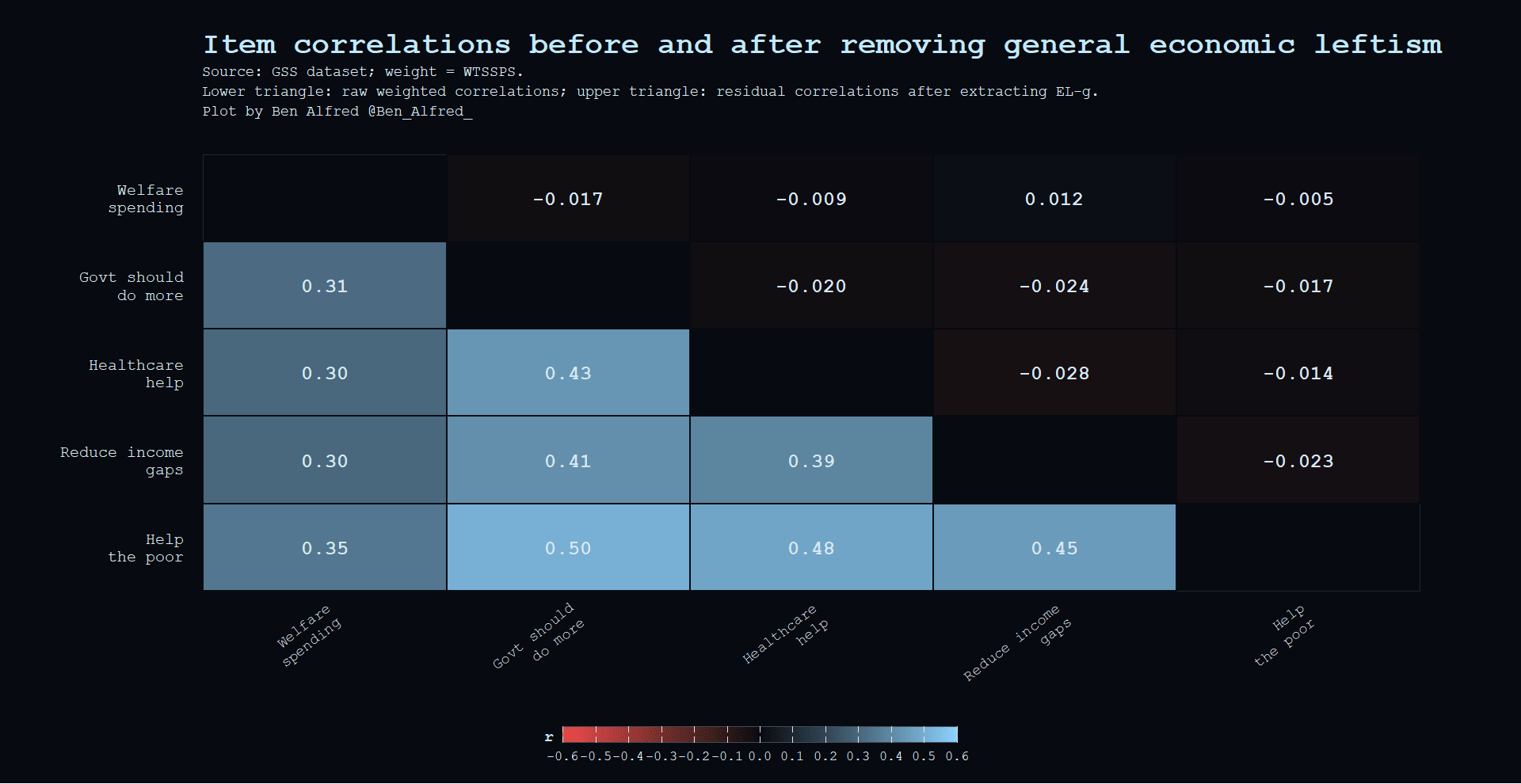
This correlation matrix shows the raw item correlations (lower triangle) and the residual correlations after the shared latent component is removed (upper triangle); the residuals all being approximately null indicates a single-factor model is appropriate:
The model was approximately measurement-invariant across both cohorts and periods.4
EL-g Over Time
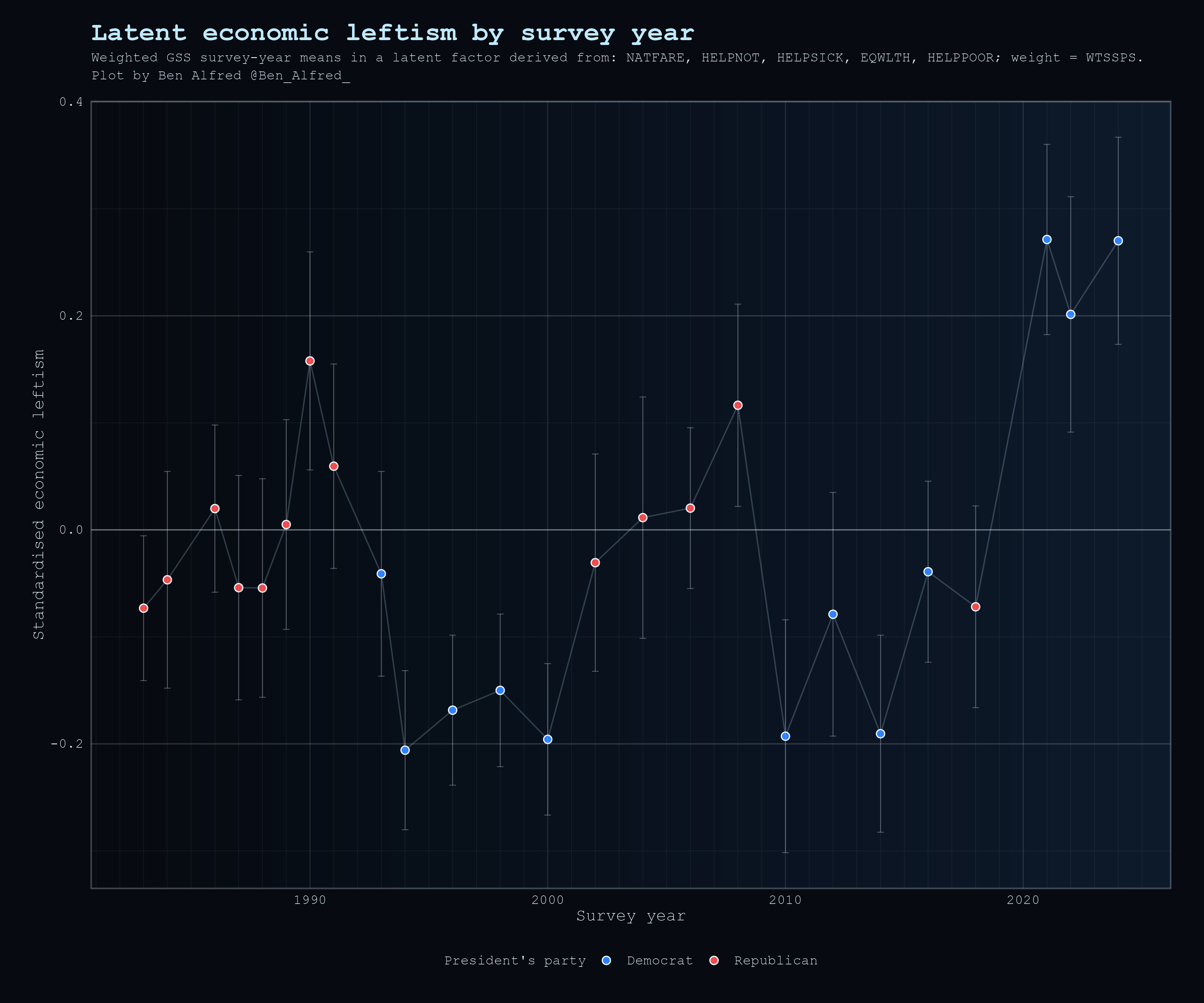
As implied, the trend in EL-g is not much of a trend; visually, the undulations seem like they could be related to which party is in power, so points are colored accordingly; importantly, verifying a causal effect of party-rule is not necessary for our purposes.
To separate what can be considered environmental noise for this analysis (period effects) from the more fundamental population trend, the simple decomposition model is
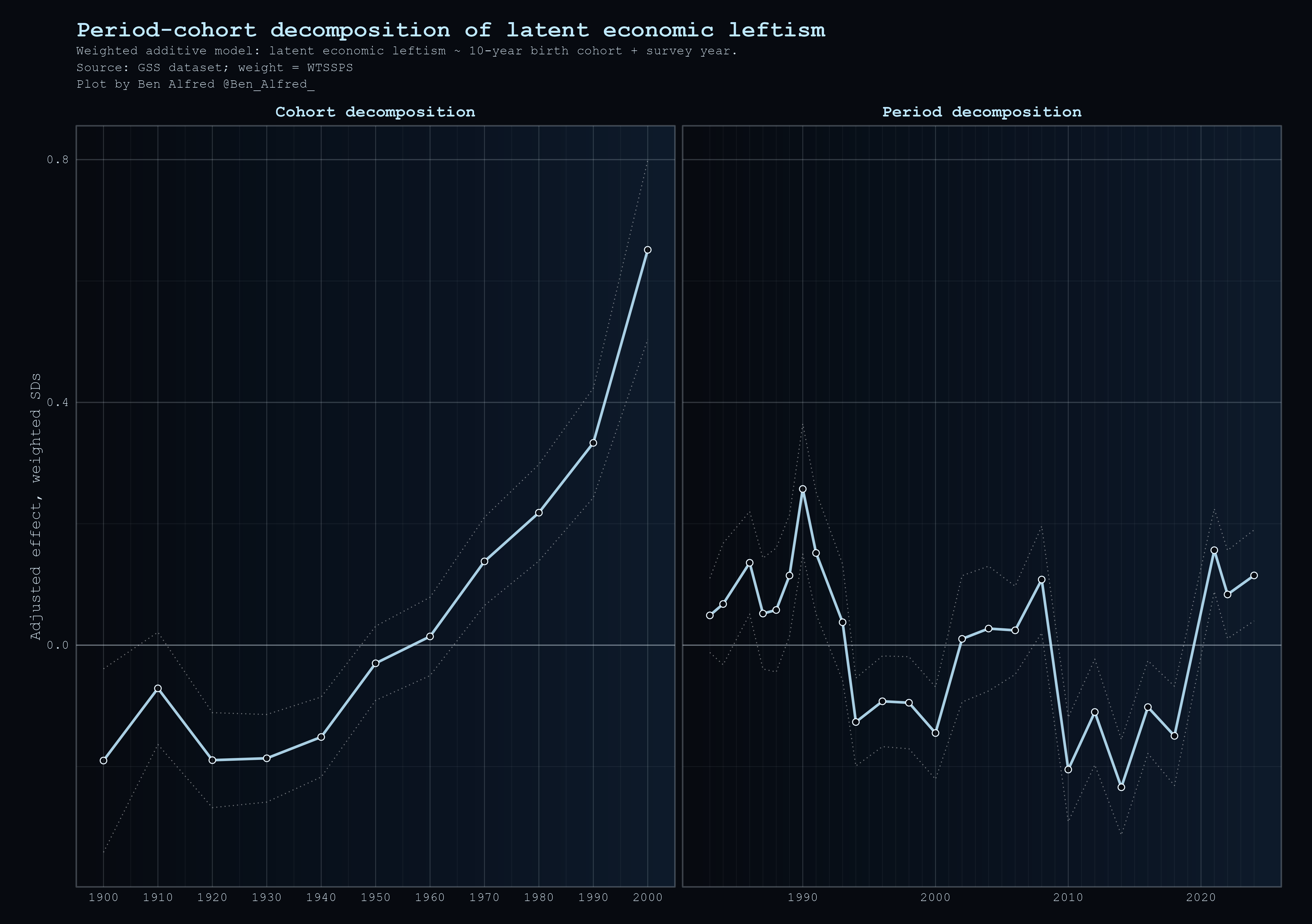
where ELg_i is respondent i’s estimated EL-g, α is the intercept, C and P are the fixed effects for his 10yr cohort and the survey year in which he was interviewed respectively, and ε is residual individual variation.
The left panel shows how economically leftist each cohort is after adjusting for survey year, and the right shows how economically left each survey year is after adjusting for cohort composition. As you can see, the population trend is far more interesting and stable, and shows an almost linear increase in EL-g over the last 100 years.
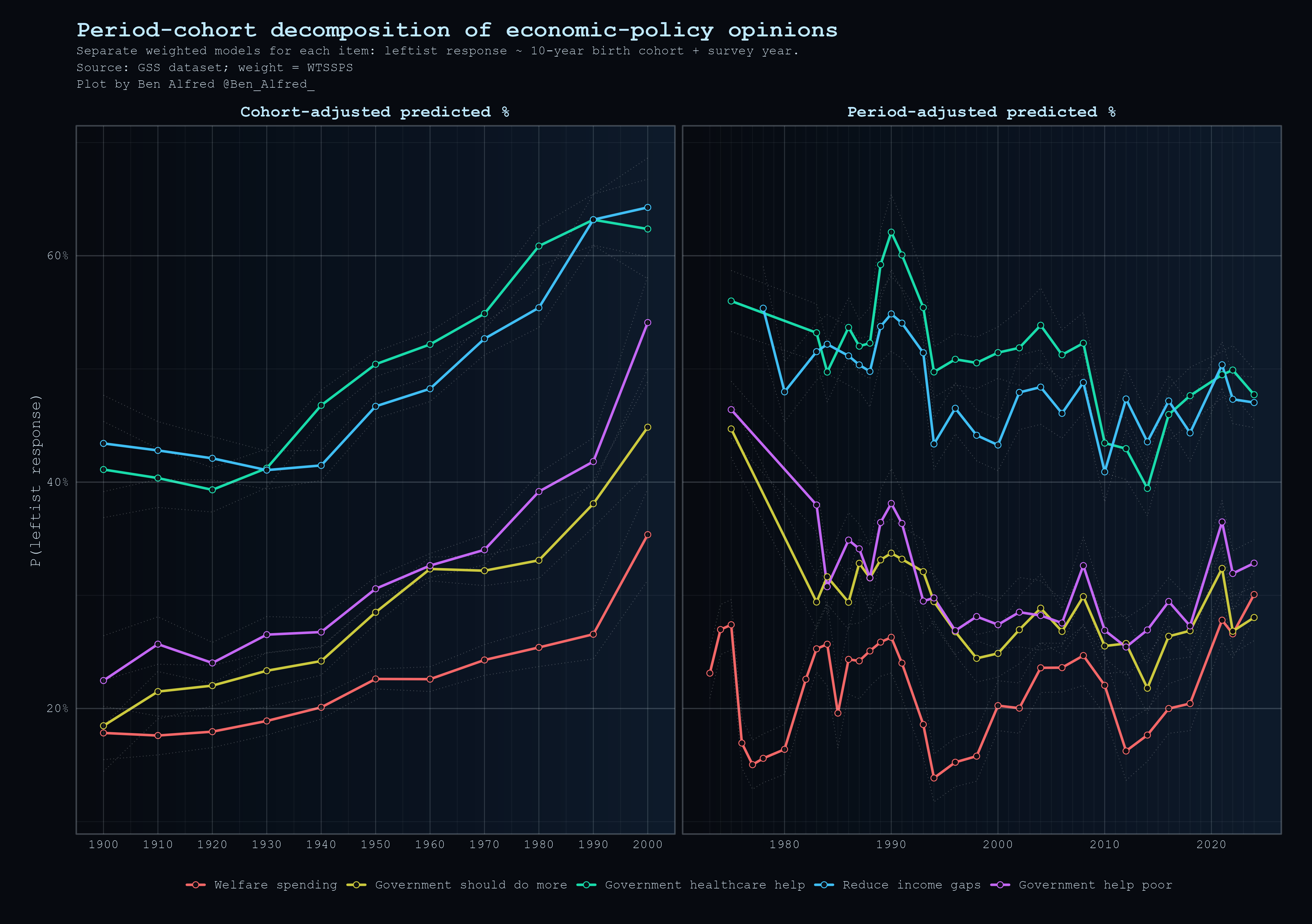
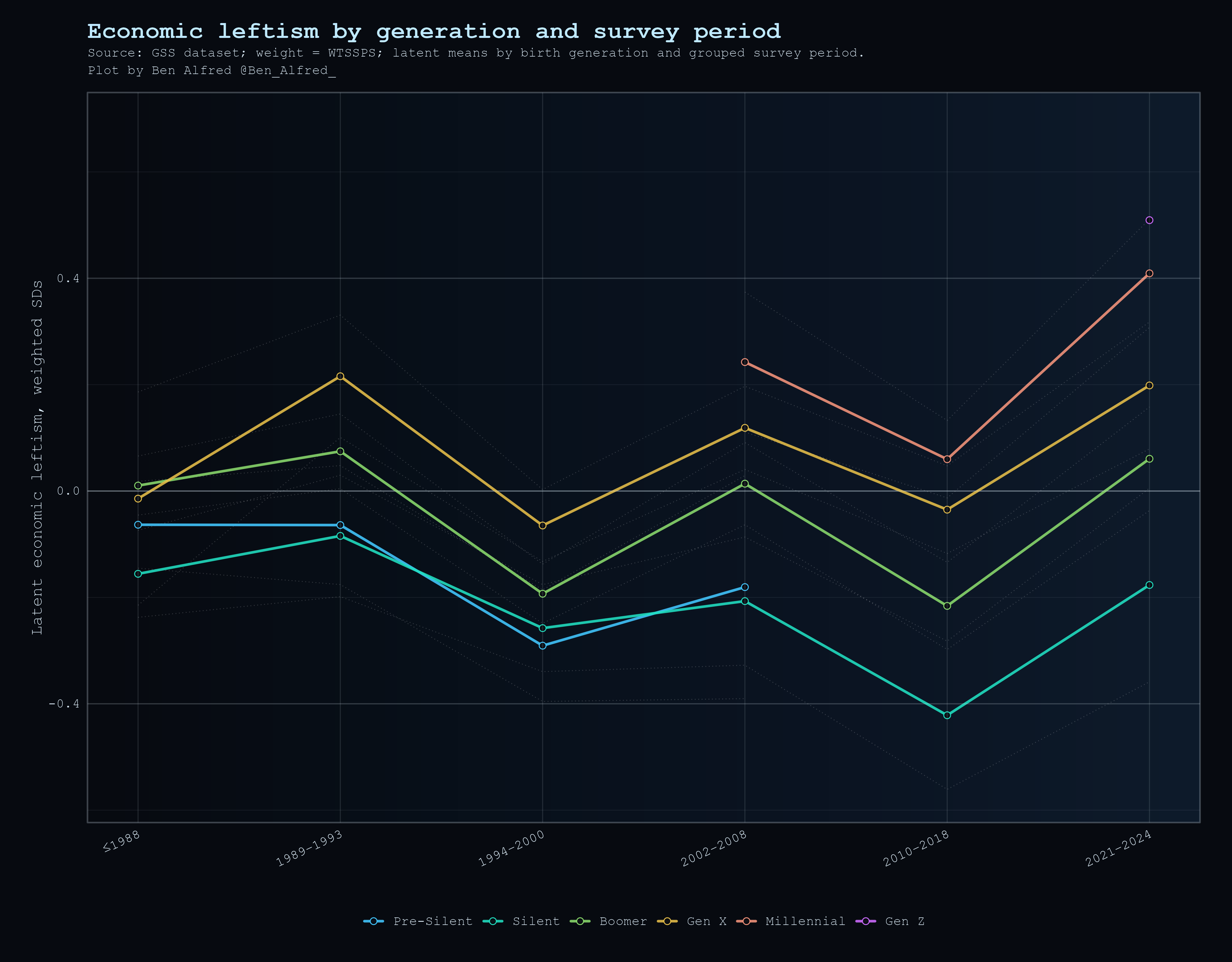
Period effects appear to influence all cohort groups to a similar degree, which is good and means we need not clutter the analysis by adding interaction effects:
What About Aging?
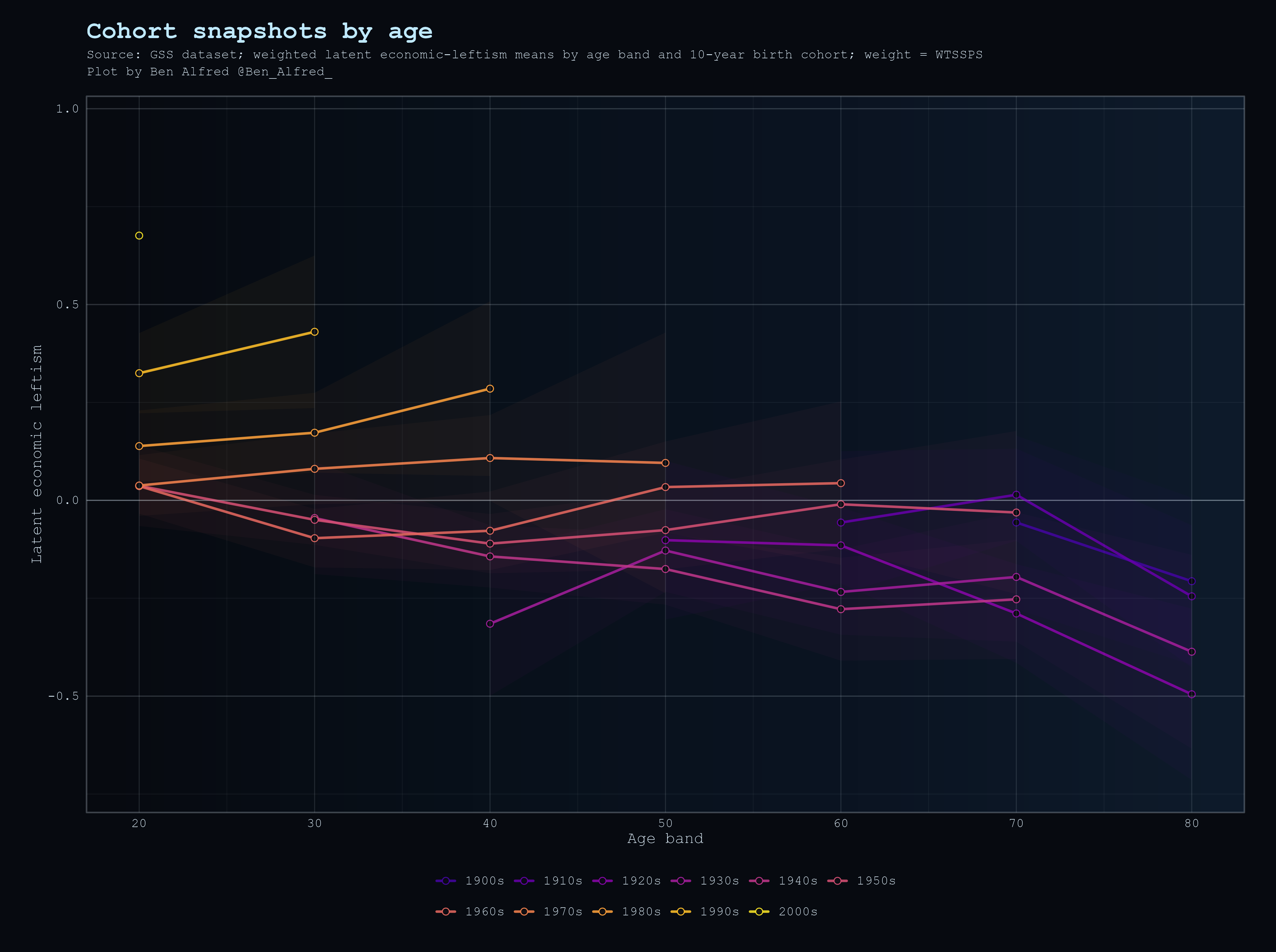
Whilst promising work is underway to solve this problem, we cannot easily partial out any potential age effects because
and there is no way to entirely disentangle the influences of the three. What we can say is that more recent cohorts are more leftist in each decade of life than were preceding ones, and there is no obvious aging → more conservative relationship. Indeed, averaged across decades the mean EL-g of each generation seems flat across a lifetime.
Conclusion
Demography is destiny. When evaluating the trajectory of a country, cohort trends are more important than period ones since a nation is its people and older cohorts ultimately die or lose power. Whilst the likelihood that an American answers ‘yes’ to more welfare may not be steadily increasing, some latent trait—whether it be inherent bitterness, ressentiment, self-righteousness, or something more benign—is and has been for a while.
People have evolved epistemic vigilance and the ability to hold reflective beliefs without them influencing behavior: https://hal.science/hal-03895019/document
When included their discrimination values were < 1.
The RMSEA is small but the M2 p-value is still significant due to the sample size. If we exclude either EQWLTH or NATFARE, M2 no longer rejects the model; this comes at the cost of some reliability and narrows the model conceptually, and so is ultimately not worth it.
The chief exception to this is the 2010s–2020s period comparison. Freeing the worst-drifting thresholds (the loadings were invariant) reduced the latent gap by 0.044 SD, or by about 13%. The recent rise is still real and substantial.
"Whilst the likelihood that an American answers ‘yes’ to more welfare may not be steadily increasing, some latent trait—whether it be inherent bitterness, ressentiment, self-righteousness, or something more benign—is and has been for a while."
Dysgenics is knocking on the door. And of course, the watchword is "resentment"