



Recently, an article in The Argument titled “Elon Musk’s zero accountability life” by Kobe Yank-Jacobs accused Musk and DOGE of helping dismantle USAID and thereby sentencing millions of people to death. Just to be clear, this is not a loose paraphrase of the argument. It is, more or less, the actual claim. He even defends Ro Khanna’s statement that Musk “possibly sentenced” 4.5 million children to death by dismantling USAID. Oh, and just in case the reader somehow missed the point, he adds that at best the toll is around the number killed in the Civil War every year, and at worst Musk is responsible for 14 million deaths.
Now, there are a few different ways one could respond to this.1 The easiest would be to say that foreign aid is often wasteful, corrupt, self-serving, ideologically motivated, and ineffective, which is true enough—but not sufficient. After all, just because USAID funded a great deal of nonsense does not mean it had absolutely zero valuable contributions, and the fact that the people defending USAID are often hysterical does not mean every concern over its dismantlement is fake. However, that is also precisely why the death-toll argument deserves more scrutiny and not less. One would think that the question of what happens when a major global-health donor suddenly changes course is important enough to warrant careful and rigorous analysis. Well, this article was anything but that. For one, repeating “hundreds of thousands” or “millions” of deaths is not a minor exaggeration but an extraordinary accusation that requires extraordinary evidence. If someone wants to accuse a man he dislikes for political reasons of killing on a scale comparable to history’s great catastrophes, then the evidence presented here is not even remotely going to cut it.
Don’t get me wrong, there is a place to be had for a serious conversation about foreign aid and what obligations America does or does not have to the rest of the world in terms of contributing to global health.2 Unfortunately, before we can have that conversation, we first have to clear away the most theatrical claim in the room, that being that Musk and DOGE killed, or will kill, millions of people, because the people reciting it like a religious chant can’t be bothered to actually check the quality of the evidence behind it.
Before getting into whether the death toll claim is true, it is worth being clear about what kind of evidence is even being offered. The article’s argument essentially rests on three sources: a study published in The Lancet by Cavalcanti et al., henceforth referred to as the Lancet study, estimates from the Center for Global Development, and Impact Counter. These are treated as if they are three independent academic pillars all pointing toward the same obvious and settled conclusion, even if different in precise magnitude. In reality though, they are just three different ways of doing the same basic thing: researchers made some bad assumptions, put those assumptions into a model, and the model produced some wildly incorrect numbers.
Let’s begin with the Lancet study, which is the high-end one of the three, and the one which estimates that USAID cuts could cause 14 million deaths by 2030, including 4.5 million children under five. Yank-Jacobs leans on this because the number is shocking and because “published in The Lancet” sounds serious to people who do not remember that respectable journals are perfectly capable of publishing bad work when the political mood is right.
To get to the numbers that they did, the Lancet study estimates past associations between USAID spending and mortality, then projects those estimated effects forward under a defunding scenario, which itself is already a difficult task. This is because in order to get the right projected toll, the model has to isolate the causal effect of USAID from everything else affecting mortality in poor countries over the same period, such as economic growth, sanitation, local health spending, war and violent conflict, disease-specific innovations, institutional quality, and the fact that USAID typically spends money in places already experiencing health crises. If any correlations are misattributed as being causal to USAID spending, then the projected death toll will be grossly overstated.
And that brings us to the first reason to be suspicious of the results, which is that they are unusually clean, given the aforementioned challenges. Across nearly every targeted cause of death, higher USAID spending predicted lower mortality in the expected order, while the placebo outcome—injuries—did not show the same effect. Considering the poor quality of data from these countries, it’s almost miraculous. It’s also exactly the kind of result where robustness matters, and this one does not survive the test.
A replication attempt by an independent researcher who goes by “Ralph Balric’s Attorney” (RBA) found that the results are highly sensitive to modeling choices. One major issue is how USAID spending is grouped. In the Lancet study, the authors grouped countries into spending bins. However, they appeared to bin spending across the entire dataset rather than within each year. But because spending and mortality both change over time, if high-aid observations are disproportionately drawn from later periods, or if mortality was already trending downward, then the spending bins can partly capture time trends rather than the causal effect of aid itself. As RBA demonstrates, when the spending is grouped by year instead, the all-cause mortality results weakens substantially. In the cause-specific models, some effects remained, but they were smaller and messier. Worse yet, in at least one case, the sign flipped, raising the possibility of reverse causation (i.e., USAID may increase spending in response to a crisis, rather than the spending itself explaining the mortality pattern).
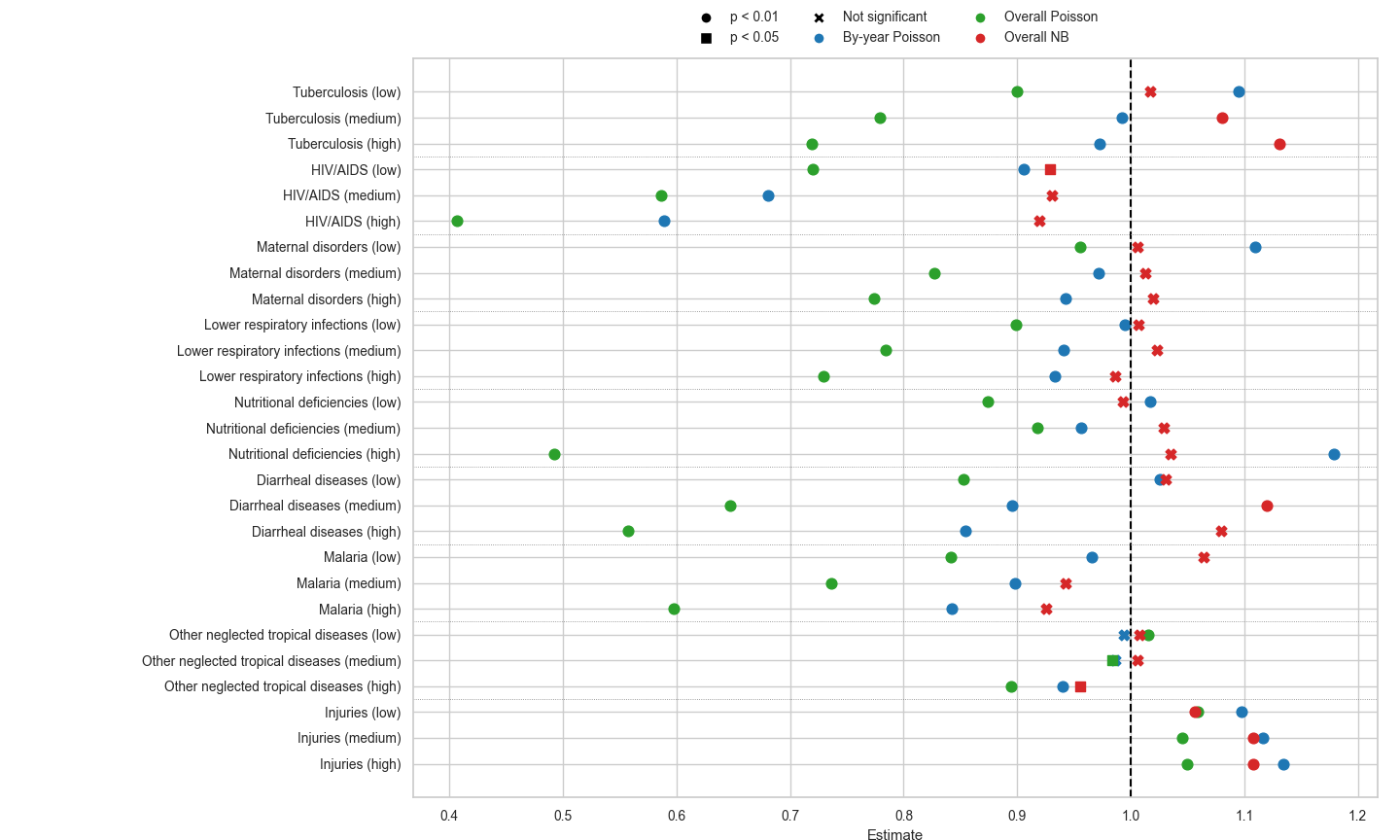
An even more serious problem with the Lancet study is its use of Poisson regression. To employ a Poisson model, a crucial assumption is that the variation in the number of deaths is relatively well-behaved. One does not need to be a health expert or a statistician to be able to tell that this is not the case when it comes to mortality in poor countries. Deaths in these places will cluster around all sorts of causes, from epidemics to famines to wars, and don’t forget to sprinkle in reporting changes and local crises as well for extra variation. When the data varies much more than the model expects, the model can become too confident and make effects look more precise than they really are. A standard alternative to Poison regression is negative binomial regression, which allows for this extra variation. When negative binomial models are used instead, the results became much weaker. Consider the example of the HIV/AIDS models from the visual above. The Poisson specification produced much larger and more statistically impressive effects than the negative binomial specification, and while the latter still found some relationship, it was nothing like the dramatic effect size needed to justify the article’s rhetoric.
The Lancet study’s authors knew this was a problem, as evidenced by the fact that they themselves attempted a negative binomial version. However, they wound up rejecting it under the justification that their Poisson model had better AIC/BIC scores. In theory, those scores tell you which model fits better after penalizing unnecessary complexity. The problem though is that this comparison only works when the scores are actually comparable. In this case, they are very much not. This is because the Poisson and negative binomial models were not being evaluated with the same underlying likelihood setup, so the AIC/BIC numbers were not even measuring the same thing.
It’s evident then that the initial dismissal of the negative binomial model by the Lancet study’s authors was shortsighted, because the difference was not trivial. Consider that, in the Lancet study’s supplement, the Poisson and negative binomial information criteria differed by orders of magnitude—roughly tens of thousands versus millions. Rather than treating this as the Poisson model fitting better, it should have been treated as a sign that the comparison itself was broken. The clearest sign of this was the over-dispersion in the mortality data. On the HIV/AIDS, for instance, RBA reported a massive over-dispersion test result, which is exactly the condition under which Poisson models become inappropriate and negative binomial models become the more natural choice. Once that model is used, the effects become much smaller, and given that the projected death toll depends on the estimated effect sizes, the 14 million figure is not a reliable “high-end estimate” in the slightest bit.
A nice lesson that Yanks-Jacobs and his fellow USAID supporters should be taking away from this is that “peer-reviewed” is not a magical answer to research quality. Peer review does not turn fragile models into facts, and journals publish bad studies all the time, especially when a paper flatters the political priors of the class of people likely to review, promote, and write about it afterward3.
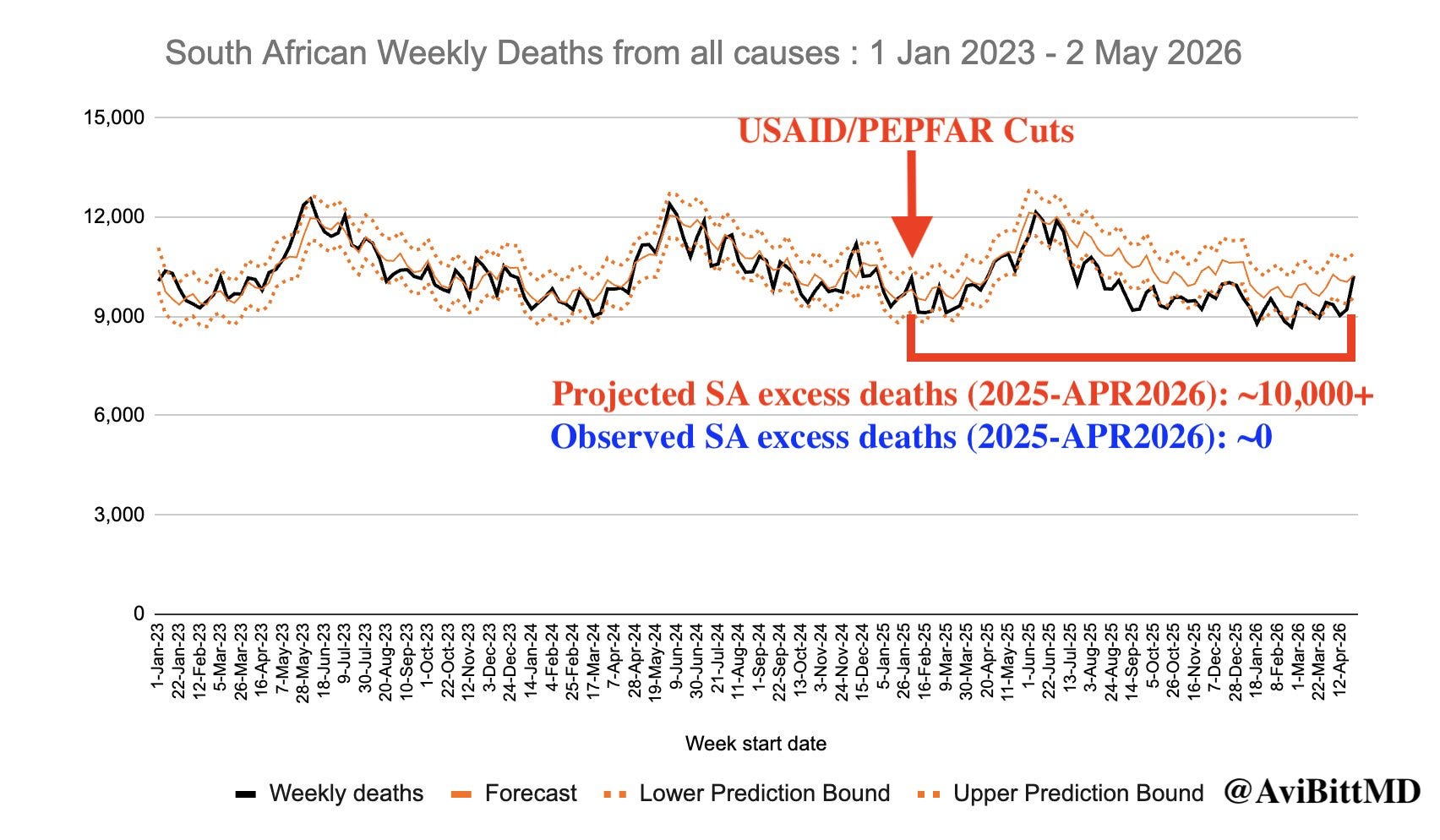
Moreover, now that some time has passed since the termination of USAID, one can assess the actual impact gutting it has had by looking at the actual data published by affected countries. To that end, provisional mortality data from Egypt outright failed to show the predicted spike. The first available post-cut mortality datum showed fewer deaths in May 2025 than in May 2024, with levels broadly comparable to 2022 and 2023. While Egypt is not the perfect test case, it did have substantial USAID exposure under the Lancet study’s spending categories. Even though Egypt’s results on its own does not settle the global question, if the claim is that hundreds of thousands have already died, the first available mortality datapoint from a USAID-exposed lower-middle-income country showing no excess mortality should at least make people pause. The same is true with South Africa, which is among the largest recipients of USAID programs:4
The article tries to dispose of one sanity-check critique of the Lancet study from Aaron Brown in Reason Magazine. Brown noted that, if you held the world’s 2001 death rate constant and compared it with actual deaths from 2001 to 2021, you’d get about 79 million fewer deaths. The Lancet study claims USAID saved 91.8 million lives over that same period. On its face, then, the study seems to credit USAID with more than the entire global mortality improvement, plus another 11 million “phantom lives”. Yank-Jacobs responds that this is too simple because the global population grew and aged after 2001. In his telling, merely holding the 2001 death rate constant would itself have been a kind of achievement, so the Lancet study’s estimate is not disproven just because it exceeds that naïve 79 million figure.
But this does not rescue the Lancet study’s estimate. While Yank-Jacobs is correct that using a flat 2001 death-rate baseline as a no-USAID counterfactual is not sensible, the actual reason why is because that’s already giving USAID too much credit. Death rates had been falling, and life expectancy had been rising, long before 2001. In Africa, the improvement in life expectancy and age-specific mortality was part of a broad post-1950 trend (astute readers may have noticed that this trend predates the creation of USAID). In fact, it’s hard to see from the broader picture over a longer time period if USAID was responsible for really anything. Here’s some visuals from Our World in Data:


Meanwhile, here is what total foreign aid spending by the U.S. in 2016 dollars looks like:
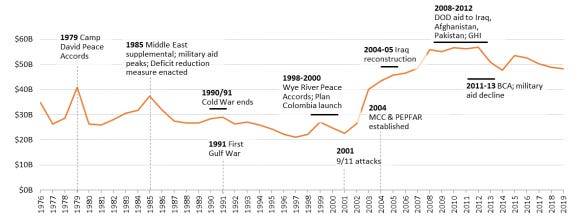
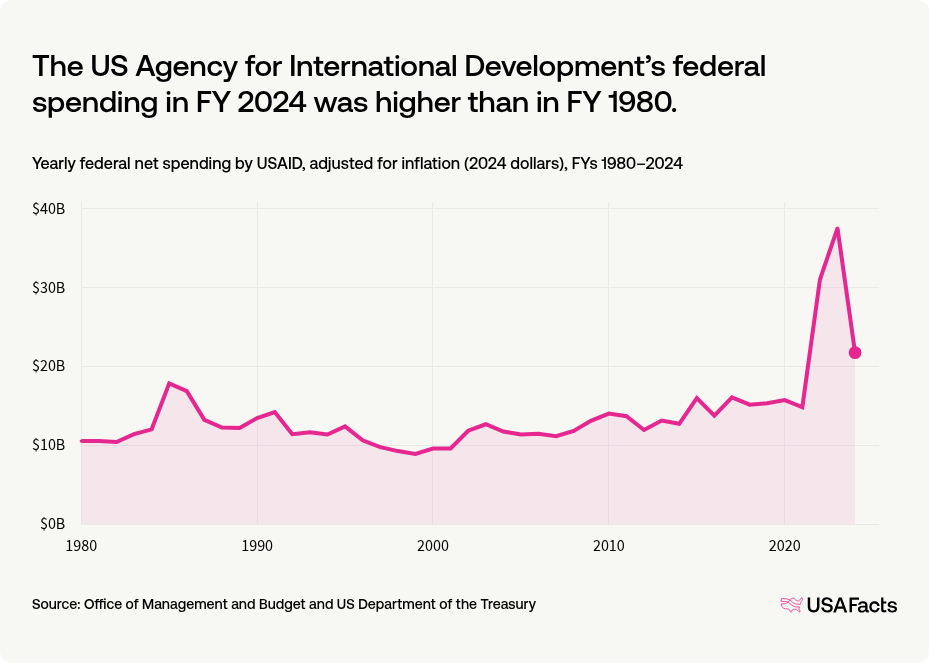
Even if one restricts the spending to just USAID—which doesn’t make sense to me because it’s a common argument from foreign aid supporters that even aid for other purposes will have indirect positive effects in other areas, presumably including health (e.g., maybe economic aid could improve health outcomes indirectly by raising national prosperity which allows for more healthcare treatment)—it’s clear that the increases in USAID spending do not correspond to accelerated improvements in mortality or life expectancy among the largest recipients (check the graphs above from Our World in Data again for comparison).5
If the total improvement relative to a flat 2001 baseline is 79 million, and USAID alone supposedly saved 91.8 million, then the model is already asking us to believe something incredibly implausible, especially considering that 79 million is already too many. Moreover, as Brown pointed out, if much of the observed mortality decline happened in countries with little USAID exposure, while the largest recipients of USAID did not show comparable aggregate improvement, the burden becomes even heavier. The Lancet study’s model appears to be claiming ownership over a mortality decline that was already underway, had many causes, and was often largest in places where USAID could not plausibly have been the main driver. This latter point made by Brown in the Reason Magazine article is not addressed by Yank-Jacobs at all.
After the article treats the Lancet study as the high-end estimate, it then turns to the Center for Global Development and Impact Counter as more conservative confirmations of the same basic story. This appears to be a tactic employed by Yank-Jacobs so that the article’s fallback position is that even if the Lancet study’s estimates are too high, the lower estimates are still large enough to imply a catastrophe.
CGD estimates that the USAID cuts could produce between 670,000 and 1.6 million additional deaths annually. Its method is simple: estimate how many lives are supposedly saved per dollar of U.S. foreign aid, estimate how many dollars were cut, and multiply the two. The formula is literally:
Lives lost = (lives saved per dollar by US foreign aid) × (dollars cut in 2025)
But this model is clearly way too simplistic. CGD is fairly open about this, describing its lives-saved-per-dollar estimates as “ballpark estimates”. While a model can be used to estimate the amount of aid used to save X many lives on average, it cannot automatically tell you how many people actually died. Why not? Because it ignores the basic fact that people and governments respond to change.
The biggest and most flawed assumption that models like CGD’s implicitly make is that of a static world. In it, if USAID funding disappears, then programs disappear, patients lose treatment, and deaths follow suit. Such models are practically guaranteed to get large numbers quickly, but they also have no bearing on actual reality. Here’s a useful comparison: abortion. If there are 1 million abortions in a year, one cannot simply say that banning abortion would produce 1 million additional births. Sure, a small share of those pregnancies would be carried to term, but people also change their behavior. Whether it’s through increased usage of contraception, reducing sex, changing the timing of marriage and birth planning, increased illegal abortions, traveling further to access abortion clinics, the result is that studies on the effects of abortion restrictions find far more modest boosts to fertility than what would simply be predicted by the existing number of cases each year. As it turns out, in the real world, humans react to change.
Let’s apply this thought process to the issue of foreign aid cuts then. Foreign aid is essentially a subsidy, and subsidies lower the cost of staying alive. Removing it can, in theory, be harmful. Perhaps it make medicine harder to obtain and increase the chance of missed treatment, which forces people into worse tradeoffs and thereby raising the probability of death. At the same time, however, “higher risk” is not the same thing as “automatic death”. Rather than waiting to die when the probability of survival is nonzero, people may find workarounds, like cheaper suppliers, switching clinics, relying on family networks, receiving help from local charities, or making sacrifices elsewhere in order to preserve the treatment that matters most to them. Governments also learn to adjust spending accordingly when aid is cut. Once incentives change, institutions and individuals respond. What matters ultimately is how much harm remains after those responses, not how many deaths a static model which is completely unrealistic about human behavior produces before anyone is allowed to adapt.
So, how have recipient countries responded to USAID’s termination? ODI reported that African governments responded “proactively” to disruptions in U.S. aid, especially in health. Many governments increased domestic health allocations or created new institutional arrangements aimed at self-reliance. Nigeria approved an additional $200 million for its health sector to offset the U.S. aid shortfall, with much of the money intended for vaccines and epidemic disease treatment. Ghana and Ethiopia also shifted domestic resources in response to the shock. Examples like these are exactly what a static death counter cannot see.
Impact Counter has a similar problem. Its presentation makes it look like a death counter, but its own site describes the dashboard as a projection of the one-year human impact of funding changes, frozen at the one-year horizon from when the cuts began. Yank-Jacobs cites Brooke Nichols’ modeling tracker for roughly 260,000 adult deaths and over 500,000 child deaths at the one-year mark, then says that simply extending the trend would produce at least 2.5 million deaths by 2030. Once again, it does not account for changes in behavior of the governments or people of the recipient countries.
Before fully addressing Impact Counter’s estimates, it’s useful first to to understand how its methodology works. Let’s start with adult HIV deaths, which Impact Counter projected using PEPFAR expenditures. PEPFAR is the President’s Emergency Plan for AIDS Relief, America’s main global HIV/AIDS program. Impact Counter assumes a complete disruption over a three-month period, averages the results across existing mathematical models of HIV service interruption, and then attributes 47% of the resulting deaths to PEPFAR because PEPFAR funds roughly 47% of HIV programs in those Sub-Saharan African countries. This produces an estimate of about 159,000 adult deaths over one year from the PEPFAR disruption alone.
Another example is their estimate of child HIV deaths. For this, Impact Counter starts with UNAIDS estimates of women using services that prevent mothers from transmitting HIV to their children during pregnancy, birth, or breastfeeding. It then assumes transmission rises from about 1% with treatment to around 40% without it, applies PEPFAR’s funding share, and finally estimates deaths among infected children.
Their tuberculosis tracker works similarly. Tuberculosis is a bacterial disease which usually affects the lungs. It is treatable but can be deadly when diagnosis and treatment break down. Impact Counter models funding discontinuation across 26 high-burden countries and presents different scenarios depending on whether funding resumes within three months, within a year, or never resumes. Under the one-year scenario where funding resumes within a year, it estimates about 55,000 additional tuberculosis deaths over one year. Under the “never resumed” scenario, the projected 2025–2030 death toll becomes much larger.
The good thing about these numbers is that these are scenarios, not observations, meaning that they can be falsified by looking at the actual outcomes. If the funding disruption had produced anything like the mass treatment collapse implied by the worst rhetoric, we would see it in the 2025 numbers. Instead, UNAIDS—the United Nations program on HIV/AIDS—reported continued improvement on the most important top-line measures.6 Their numbers show that new infections declined slightly from 2024 to 2025, while AIDS-related deaths fell from 600,000 to 570,000 during this time, and the number of people on antiretroviral treatment rose to 32.1 million by the end of 2025. It is clear then that Impact Counter’s estimates were driven by faulty assumptions about treatment interruption. The actual data shows treatment coverage rising, not collapsing.
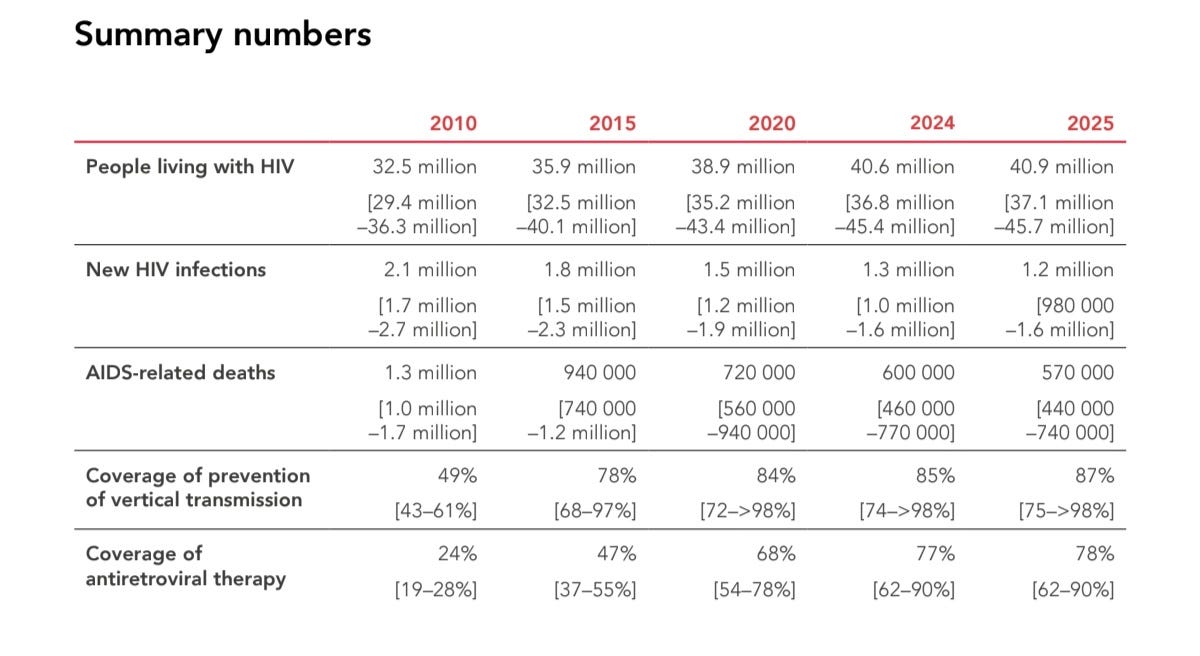
There was one key weakness, however, and that was prevention. UNAIDS reported a 38% decline in PrEP access across 62 countries. PrEP, or pre-exposure prophylaxis, is preventive medication taken by people who do not have HIV but are at risk of infection. Additionally, HIV testing fell by 22% in some high-burden countries. At first glance, this seems like it could be a potential issue, but even here the story is not simply catastrophe. Prevention declines do not instantly translate into observed deaths, and the treatment side—the part most directly tied to near-term mortality—continued improving. On top of that, HIV prevention is entering a different technological environment. The U.S. and the Global Fund expanded access to lenacapavir, a twice-yearly injectable HIV-prevention drug, aiming to reach an additional 1 million people over three years and 3 million people through 2028. Lenacapavir has shown near-100% effectiveness in clinical trials, and rollout has already begun in several African countries. Again, the real world did what static death counters do not model. The most valuable services were prioritized, local systems adapted, and treatment continued expanding. Prevention took a hit, but new tools and replacement efforts are already changing the trajectory.
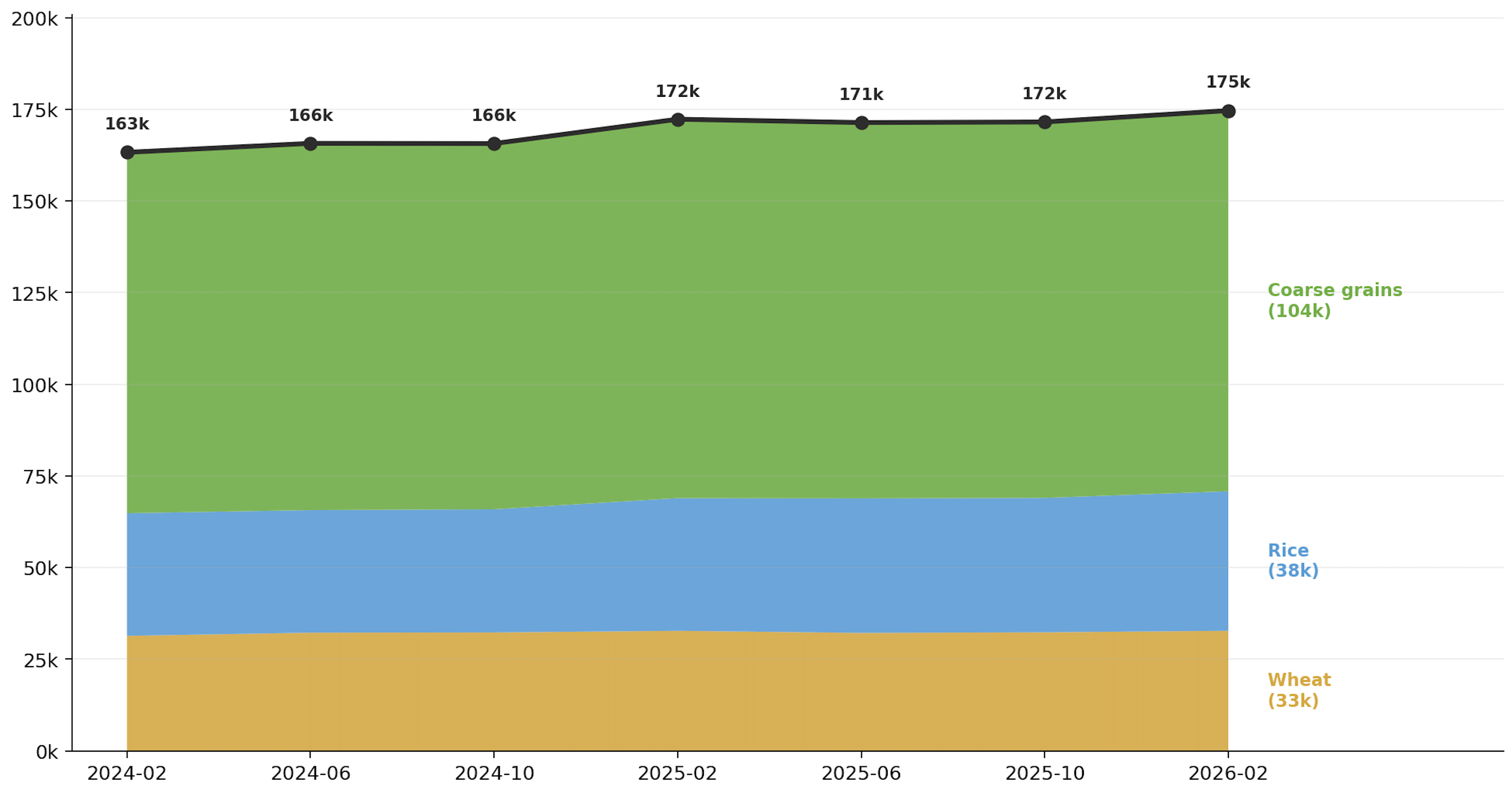
Other sanity checks point in the same direction. If hundreds of thousands of people had already died from a generalized aid withdrawal catastrophe, one would expect some broad evidence of crisis. Well, contrary to such expectation then, food use data from the Food and Agriculture Organization does not show a collapse in Sub-Saharan Africa after USAID was rolled up. Rather, the trend remains broadly stable and rising slightly, which make the sensational claims of mass deaths much harder to take seriously.
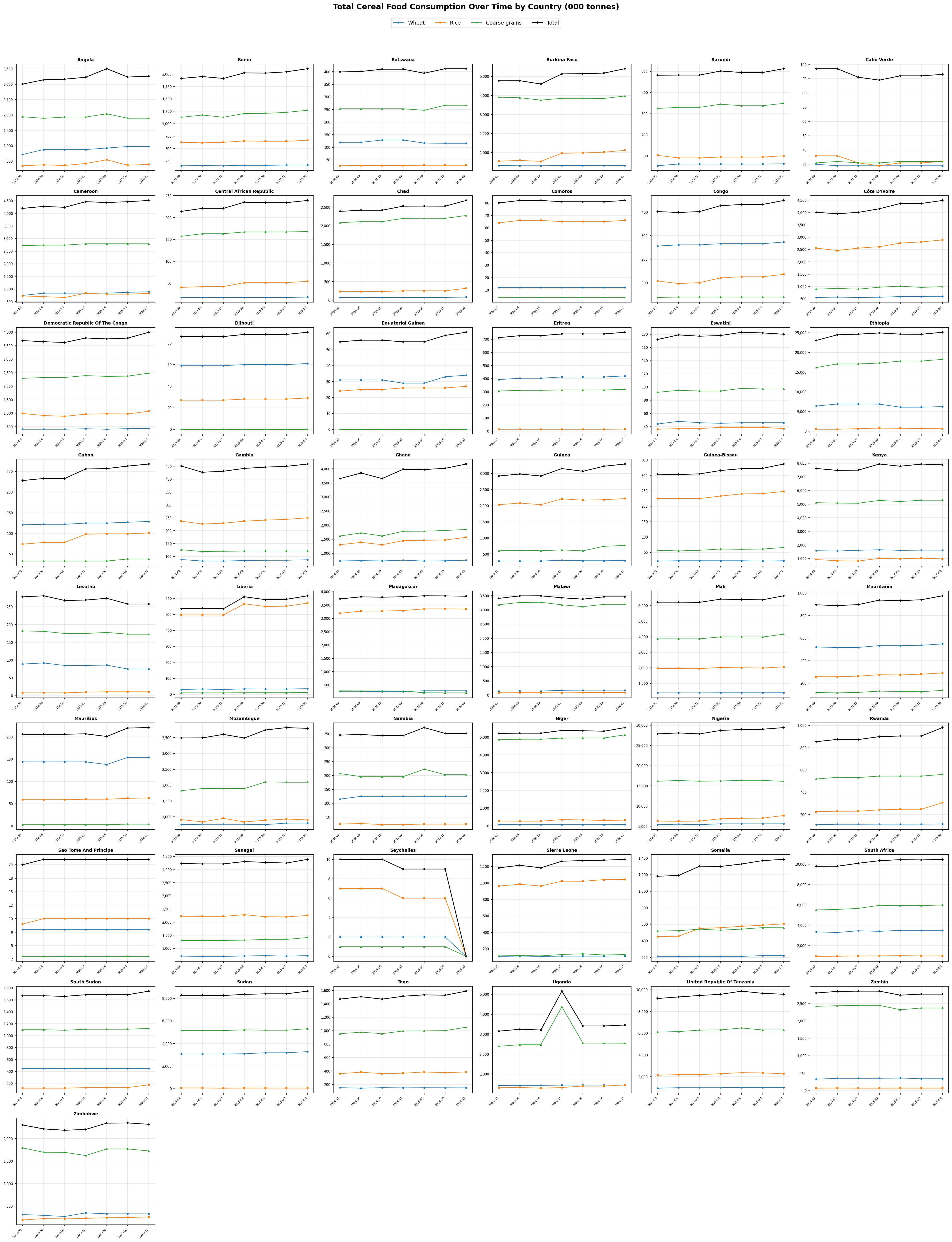
What about local hardships? Disaggregating the data, it would appear that, with a few exceptions, the USAID cuts do not seem to have impacted food consumption in most Sub-Saharan African countries:
Another issue when it comes to the foreign aid debate is a conceptual one: what we do actually mean when we say “lives saved”? As it turns out, that’s one of the dirty little tricks in these death projection models, because a “life saved” here really just means a death averted within a particular time window, rather than saving an entire lifetime. Preventing the death of a child who then lives another seventy years and delaying the death of a very sick adult by one year will both enter the tally as one “life saved”. For technical public health purposes, this could plausibly be justified as legitimate. In political rhetoric though, it makes the effect sound much larger and more permanent than the underlying measure may justify. This becomes even more important for programs that must be repeated every year. If an intervention prevents the same person from dying this year, and then must do the same thing again next year, each annual counterfactual can be counted as another death averted. As a result, headline numbers can easily give less attentive readers the impression of unique, full lives permanently rescued when the underlying metric may be closer to temporary mortality deferral under continuing support.
There’s a broader question behind all of this: does foreign aid, in practice, even produce the kind of huge population-health effects these models assume? The evidence is not very flattering. Toseef et al. (2019) looked at 90 developing countries from 2001 to 2015 and tested whether total foreign aid and health-sector aid improved infant mortality, life expectancy, death rates, measles immunization, and DPT immunization. This is important because they did not only look at health aid. They also used total aid, which gives indirect pathways—education, infrastructure, water, sanitation, and so on—a chance to show up.
The result was mostly null. Aid showed a statistically significant relationship with life expectancy, but the effect was tiny. In their main models, a 1% increase in total aid was associated with only a 0.004% increase in life expectancy. Health aid performed similarly. Their Generalized Method of Moments (GMM) robustness checks found no impact of aid on any health outcome. It seems that once you look across countries and over time, the simple story that foreign aid reliably converts into large health gains becomes much harder to defend.
So, let’s take a step back and remind ourselves what this post is responding to. The claim is that Musk and DOGE killed, or will kill, millions of people; that the rollback of USAID can be translated into one of the great death tolls of the modern era; that projected deaths from unreliable models should be treated as essentially confirmed casualties. Nope. Sorry, but that’s not how this works. If you want to say certain programs should have been preserved, make that argument. If you want to say the cuts were too abrupt, make that argument. But if you want to accuse someone you dislike politically of killing on the scale of the Civil War every single year, then you do not get to wave around fragile models, online counters, and gross estimates that explicitly do not account for adaptation, and then act as if the matter is settled—especially not when the actual evidence that arrived afterward failed to bear out the catastrophe they predicted.
As the article is paywalled, I can only respond to the free and public portion, though I doubt there’s much more additional substance beyond the paywall.
And, as I don’t believe the United States has any moral obligation to help prop up dysfunctional societies that practice things like dry sex, “virgin cleansing”, and mass rape—especially not when the same people who insist we have to bear this responsibility to begin with are also usually of the belief that America is a morally decrepit empire that intentionally sabotaged the development of the Third World—I am the most objective and fair writer on this topic, since I have no motivations to care about whether or not the numbers are true.
One possible reply is that the mortality data are simply lagging behind the policy shock. This would be more persuasive if the models had mostly projected deaths far into the distant future. But in fact, the more detailed HIV projections did not do that. To the contrary, even when the studies covered five- or ten-year windows, the deaths were not expected to arrive only years later. In models that break the estimates down by year, a large share of the projected deaths was expected early, with peak death rates generally appearing in 2025 or 2026. If those projections were roughly right, the early mortality signal should already be visible.
South Africa reflects part of a broader problems with the post-hoc excuses. Before the data came out, South Africa was treated as part of the catastrophe, with many models projecting large numbers of excess HIV deaths because USAID had been cut, making implication clear: South Africa was dependent on that funding, and cutting it would be deadly. But once the provisional mortality data failed to show the predicted spike, then the explanation suddenly changed. Now South Africa is too wealthy, too institutionally capable, too responsive, or too resilient to be a fair test case. Besides the fact that no one would characterize South Africa this way in literally any other context, even if we granted that the characterizations was true, it would still be a concession that the model missed many things that mattered.
If South Africa adapted because its government, clinics, and health system were able to preserve the core services, then it’s obviously the case that the assumptions baked into the models were wrong. If local actors redirected resources and prioritized treatment, thus preventing the collapse, then these models way overstated the harm by failing to account for said adaptation. Moreover, if South Africa was always capable of doing that, then one has to ask an even more awkward question: how much of this foreign aid was actually indispensable in the first place? The defenders of USAID do not get to predict catastrophe, fail to find said catastrophe, and then declare the absence of catastrophe irrelevant because the country turned out to be more competent than their models allowed.
If I were as bad faith and dishonest as USAID supporters, I might just as well claim that increased USAID spending from 2021 to 2023 was killing people because mortality and life expectancy slightly worsened and pretend COVID-19 wasn’t a thing. Who cares if the time trend changes reflects an actual causal effect, right? As long as the two happen to line up, you can make up whatever narrative you like.
When I did the replication work cited here almost a year ago, I was completely stunned The Lancet paper got literally no critical attention. Lone voice in the wilderness.
Thanks for the work, but I think surrendering the frame is the fundamental problem.
1) "Killing" means you harmed people. At best Musk refused to harm people (US taxpayers) to try and save third worlders from their own dysfunction.
That certainly isn't "killing". And if it is, basically every first worlder that isn't going full EA donating 90% of your income is a killer.
2) Let's say all these third worlders did die. Is that a bad thing?
These African hellholes are all above their malthusian carrying capacity.
Without foreign aid, they will die. With foreign aid they will multiply and require exponentially more foreign aid, until eventually we can't provide it.
Worst of all, all these excess people might move to the west, where they will gain access to the welfare state (100x burden) and influence our politics and society (perhaps turning us into third world hell holes and destroying global society).
Meanwhile, all human advancement comes from smart people reinvesting into economic growth. It's obvious that using USAID funds to fund growth will do more for future people than USAID to Africans today by a factor of like 1000000000x. So any EA case that cares about the future still says cutting aid is good.