
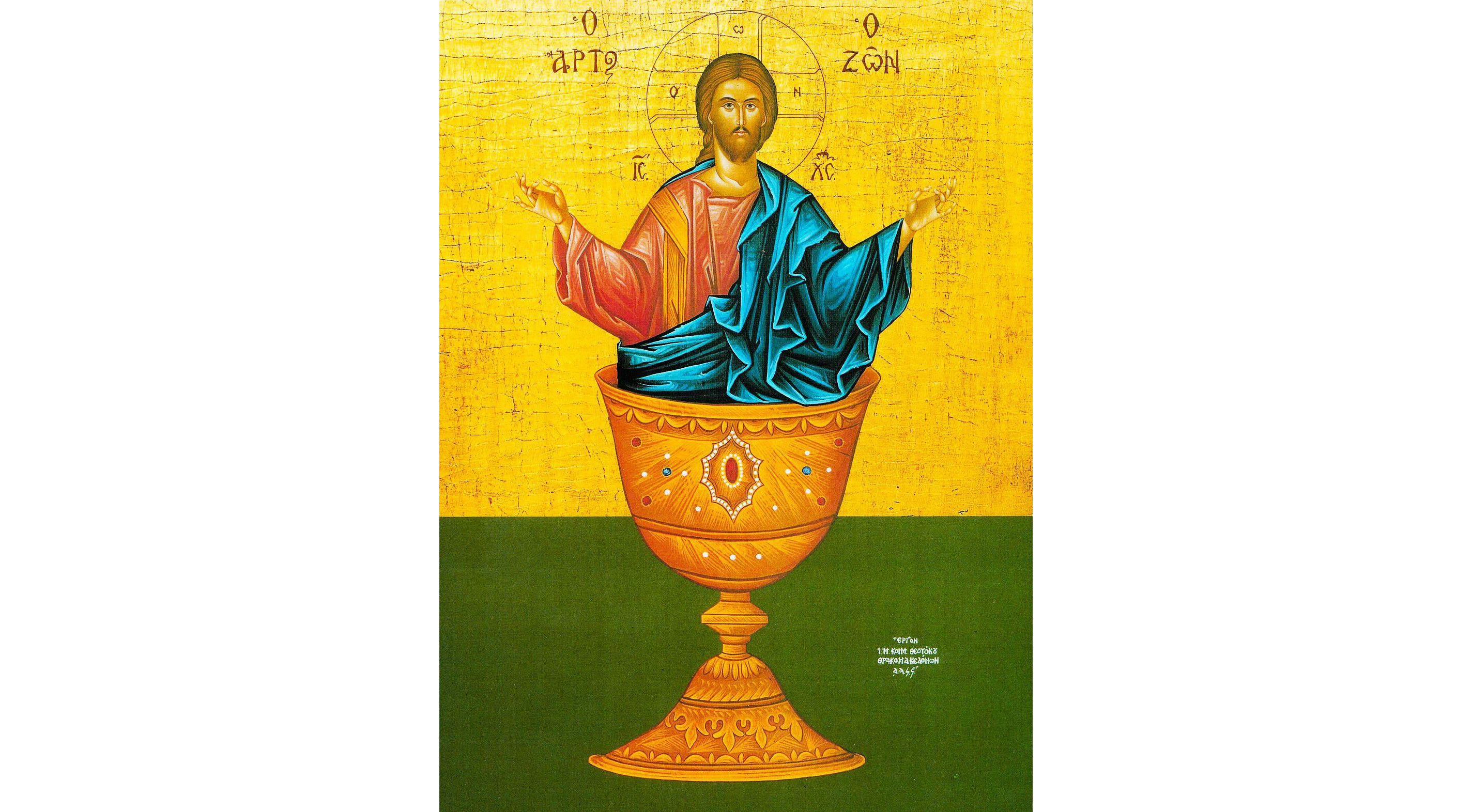
On these Sundays after Trinity, I will be reflecting on the Eucharist. We are eucharistic people, we are part of the One, Holy, Catholic and Apostolic Church because the Eucharist is necessary to our life in Christ; because the Eucharist is never considered optional, but required of all Christians to receive who are able to do so. Over the Sundays after Trinity I will be looking at the Eucharist from different angles, always looking for perspectives on the Eucharist that edify us, that is, build up our house, our heavenly house—for we, as Saint Paul teaches, are living Temples of the Holy Ghost our Comforter.
I concluded my preaching last Sunday with these words: The Eucharist must always remind us of Christ’s love; and in receiving the Eucharist, we are fed so as to be able to continue to live in His love made available to us—in our heart and soul—which is fully realized and received when we imitate Christ and love others. The Eucharist is a heavenly banquet. In receiving the Eucharist we are participating in heaven, because we are receiving the Body and Blood of Christ, Who has ascended to heaven; Who shares Himself with us from His ascended and heavenly existence.
What we are to imitate of Christ is His love, His Divine love. And it is divine love that is shown on the Cross of His Crucifixion. As Saint John writes in our Epistle: “By this we know love, that He laid down His life for us, and we ought to lay down our lives for the brothers.” Christian life, which is life in liturgical community that worships Christ at its center, which is fed by Him Who is our daily Bread, being rooted in Christ known through the power of the Holy Spirit, is rooted in Christ’s revealing of love through the Cross. This is why Saint Paul teaches that “For as often as ye eat this bread, and drink this cup, ye do shew the Lord’s death till he come.” Because the Cross of Christ is love in perfect form, our receiving of the Eucharist truly happens when Christ’s love shows forth from us towards others.
Notice the how Saint Paul regards the Eucharist. “For as often as ye eat this bread, and drink this cup,” he says, “ye do shew the Lord’s death till he come.” In speaking about the Lord’s death, Paul is describing the essential and highest truth of Christianity: that the Cross of Christ is glory, is salvific, and transcends the conditions of time and space. And with this transcendent truth, Paul associates the Eucharist. The glory of the Cross is associated with the truth of the Eucharist, the fact of the Eucharist, the meaning of the Eucharist. Certainly the Eucharist is a Sacrament of Christ’s Love, but we can also speak of the Eucharist as the Sacrament of Christ’s Death, which reveals His love.
Notice what Paul does not say. He does not say “For as often as you hear a sermon, you do show the Lord’s death.” Some people might think preaching is more important that the Eucharist; Paul would disagree. Nor does Paul say, “For as often as you simply attend Mass, you do show the Lord’s death.” Some people might think the most important thing is simply being present at a church service; Paul would disagree. Nor does Paul say, “Whenever you decide to receive the Eucharist on your own personal schedule, you do show the Lord’s death.” Some might think that receiving the Eucharist is something they do every once in a while, whenever they feel like it, whenever they do not have a better offer; Paul would disagree.
And so does Christ. We heard His parable today about the great banquet. We heard the excuses people made in the parable: “I must go out and see my new field”; “I am going to look at my oxen”; “I just got married”–what great reasons, obviously, to not receive the gift of the great banquet that was prepared for them. The clear inference of Christ’s parable is that the heavenly banquet should be the highest priority of the people invited to attend. Should celebrating the perfect expression of love which is the Eucharist ever be less than the highest priority for us? This is why Paul teaches what he does. The Eucharist can become our highest priority when we see it intimately tied into Christ’s sacrificial and voluntary offering of Himself for us our of His love. We show the Lord’s death–which is His perfect love–when receiving the Eucharist through the channel of the Church becomes the source and summit of grace in our lives; through Jesus Christ our Lord, Who lives and reigns with the Father in the unity of the Holy Ghost, ever one God, world without end. Amen.


